
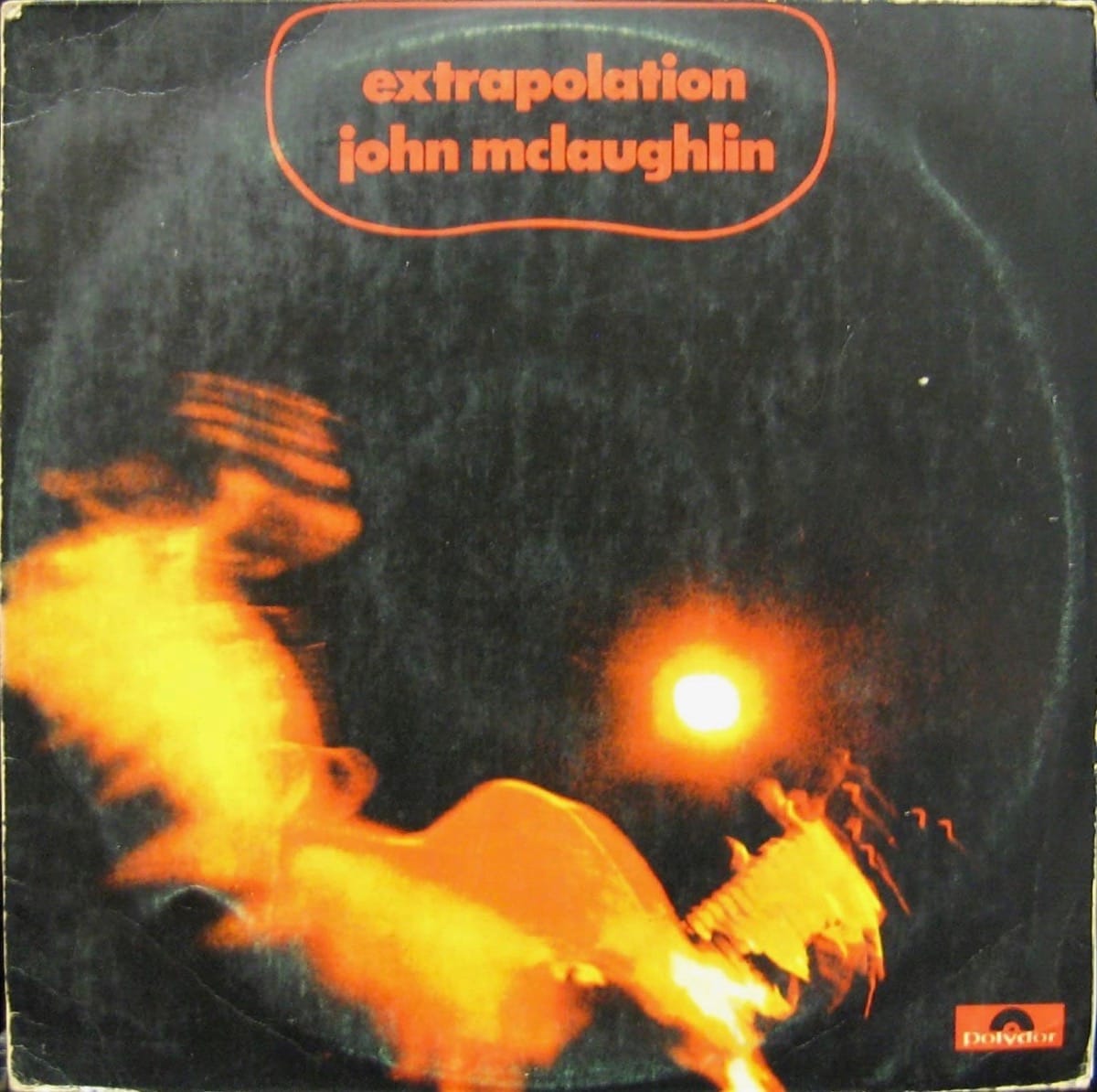
JJ 08/70: John McLaughlin – Extrapolation

Fifty years ago Ron Brown counted Extrapolation as one of the best British jazz records he'd heard. First published in Jazz Journal August 1970

It’s significant that John McLaughlin has spent so much time with Miles Davis since this album was recorded, since it reflects the trumpeter’s influence in many ways, not only because its emotional climate is similar to Miles’ pre-rock LPs (Dave lllingworth com­pared it to ‘E.S.P.’ in his review of this al­bum’s first issue exactly a year ago, but I would have thought ‘Miles Smiles’ was nearer the mark) but also because it displays a textural unity and group cohesion such as Miles always imposes on his sessions.

It would be difficult to imagine this record with­out any one of its participants, and the group feel is most important, but the solo work is consistently excellent too; the mighty Surman plays some rumblingly powerful baritone and contributes some wistful, Trane-ish soprano on It’s Funny, while McLaughlin (who is I suppose, an ‘avant garde’ guitarist – I certain­ly can’t think of any other guitarist I could compare him to) really makes his instrument sing.

Advertisement

There are I know a lot of people who wouldn’t regard this LP as jazz at all, but bearing in mind the diversity of personal tastes, I’d un­hesitatingly recommend ‘Extrapolation’ as one of the best British jazz records I’ve heard.

Discography
Extrapolation; It’s Funny; Argen’s Bag; Pete The Poet; This Is For Us To Share (20 min) – Spectrum; Binky’s Beam; Really You Know; Two For Two; Peace Piece (20 min)
John McLaughlin (acoustic & electric guitar); John Surman (bari/sop); Brian Odges (bs): Tony Oxley (dm). 1969.
(Polydor 2343012 Standard 29s 10d)

Latest audio reviews

Advertisement

More from this author

Advertisement

Jazz Journal articles by month

Advertisement

Cannonball Adderley & Miles Davis: Somethin’ Else

Widely regarded as a seminal recording of the 1950s, Somethin’ Else featured Cannonball (as leader) renewing a partnership with Miles that had earlier produced...
Advertisement

Count me in… 01/22

Transfer today's appetite for cultural, but especially racial, inclusivity to the early days of jazz and one wonders if the all-white bands at that...
Advertisement

Robert Mitchell: ‘Even with the freest of free jazz, the stuff that is good is never completely free’

Former Tomorrow’s Warriors, J-Life and Panacea pianist Robert Mitchell is a highly cerebral and learned fellow. When we spoke for this interview, for example,...
Advertisement

Uncharted Creativity and the Expert Drummer

Tirelessly researched and seemingly aimed at scholarly types and the academic end of the drumming community (though musos in general will find much of...
Advertisement

Green Book

Fifty-six years after LBJ officially ended racial discrimination in the USA with the pen-stroke that signed the Civil Rights Act, the years immediately preceding...
Advertisement

JJ 10/83: Annette Peacock – Been On The Streets Too Long

Forty years ago Matthew Bateson admired Peacock's writing and performing in general but wasn't convinced by all her solo albums