
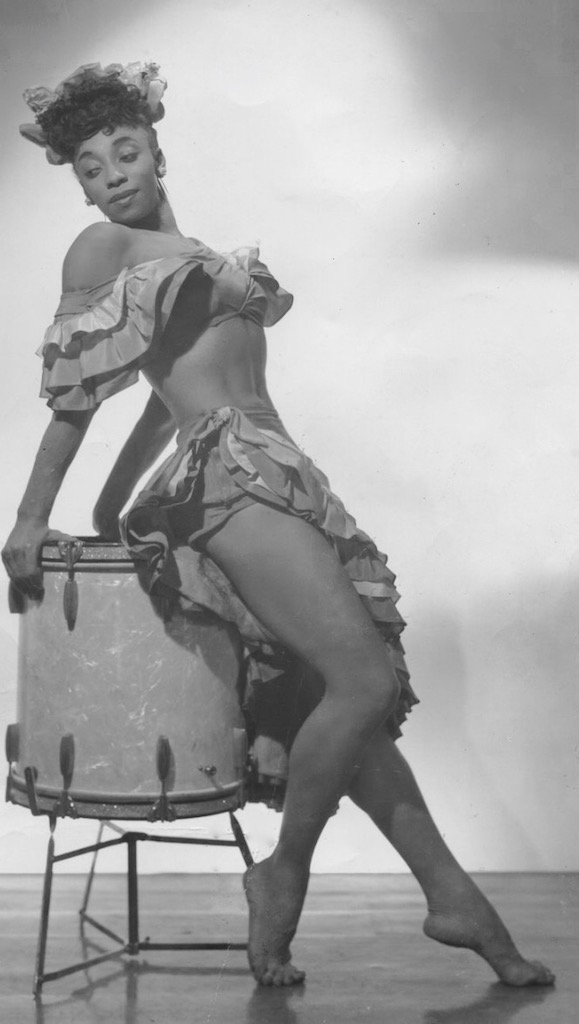
Norma
Norma Miller died on 5th May. If you don’t know the name, Norma was a star of Whitey’s Lindy Hoppers. the astonishing dance group which graces the Marx Brothers film, A Day At The Races (1936) and also that fabulously bonkers comedy-musical, Hellzapoppin (1941). If you’ve seen neither of them, then your education is sadly incomplete and I advise you to rectify it immediately, if not sooner. You can see the dance routines by googling the titles of both films, but Hellzapoppin, in particular, has to be seen in full to be believed.
Norma died at age 99, so she was almost certainly the last survivor of the full-on, crazy, athletic, showbiz Lindy Hop. One had to be phenomenally fit and dedicated even to think about attempting the kind of feats she and her fellow artists brought off with such style and grace. But they were the peak, the crème de la crème. Beneath them came squads of other professionals, and below them millions of social dancers in ballrooms, nightclubs, dives and joints – the swing era on its feet, in fact. Because we can still listen to the music, we forget that it was usually one half of a complex mutual creation – a night at the Savoy, or the Paramount, or Joe’s Place. or wherever. When the band and the dancers click, there’s nothing like it. I remember experiencing it sometimes, playing with rhythm and blues bands in the 60s – a kind of mass happiness. They say the Savoy Sultans could turn it on like a tap.
Chuck Green: ‘He began by shuffling his feet on the sand. It sounded like Jo Jones on brushes. Then came the bags, one containing something hard and the other something metallic and rattling, which he bumped rhythmically on the ground’
In 1981, I had the pleasure of meeting Frankie Manning, one of Norma Miller’s most distinguished dancing partners, who summed it up simply: “We had the best dancers because we had the best musicians, and the best musicians because we had the best dancers”.
At around that same time, several other veteran dancers came to Britain and gave a show in London. For me, the most remarkable among them was Chuck Green, late of the duo Chuck and Chuckles. He was at the time in his early 70s and his career had been interrupted by illness several times. He came on wearing an old mackintosh, carrying two droopy shopping bags that almost touched the ground, and stood on one of those sand trays that Wilson, Keppel and Betty used to use for their sand-dance routine, back in the old days. He began by shuffling his feet on the sand. It sounded like Jo Jones on brushes. Then came the bags, one containing something hard and the other something metallic and rattling, which he bumped rhythmically on the ground. Now there were two Jo Joneses, swinging like the proverbial bitch. I shall never forget those five minutes.
Jazz 625 revisited
Did you catch the revival of Jazz 625 (for one night only) on 3rd May? They certainly crammed a lot in, and the whole thing was stylishly done. Shooting it all in black and white was a nice touch. So was having a “house band”, under the leadership of that super pianist, Robert Mitchell. The star guests (Jean Toussaint, Joshua Redman, Gregory Porter) did their stuff faultlessly, as expected, but most of the clips from the original programmes were too short to make much impression.
‘There was one tiny incursion of academic dry-rot into this agreeable entertainment’
The talky bits were fascinating, though: Jacqui Dankworth and her mum, Dame Cleo Laine; Dave Green and Charlie Watts (not to mention the surprise appearance of Scott Hamilton), and the authoritative but cosy presence of Andi Oliver as Mistress of Ceremonies. Quite a cheering hour and a half altogether, and especially good to hear two fine newcomers – altoist Camilla George and guitarist Shirley Tetteh. Better still, it wasn’t a competition, unlike the po-faced Young Jazz Musician Of The Year.
There was, though, one tiny incursion of academic dry-rot into this agreeable entertainment. It was on the subject of jazz in general and here it is, word for word: “It’s not just something you’d listen to on a night out, something you’d have a few drinks to. It’s something that should be thought about, studied, enjoyed in a quite intellectual way”. The speaker was one Nicolas Pallai, author of Jazz As Visual Language. His words reminded me of Ronnie Scott’s occasional greeting to the audience at his club: “Quiet please! Settle down! You’re not here to enjoy yourselves”. The difference is that Ronnie was joking, and I fear Mr Pallai wasn’t.