
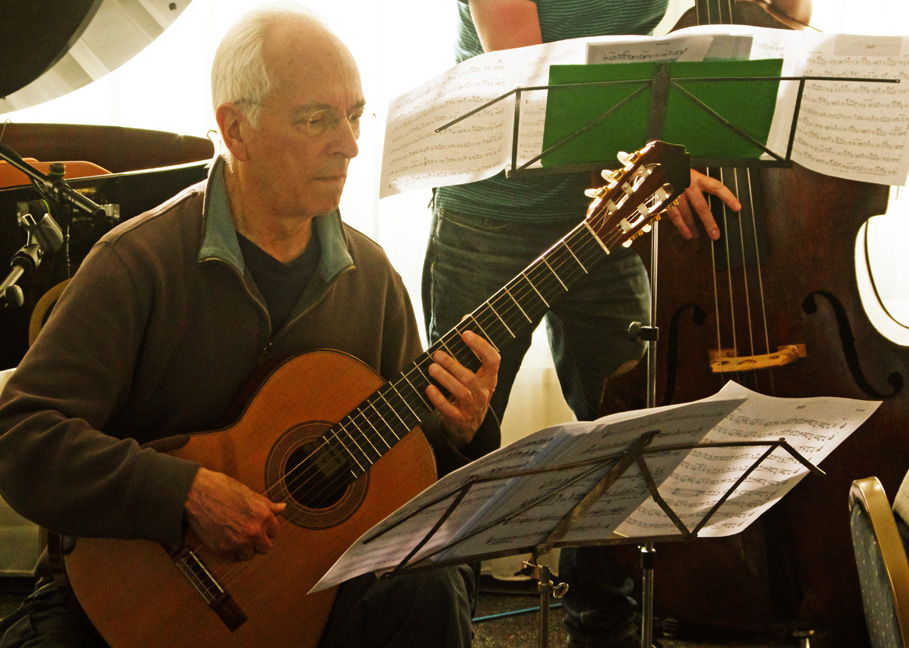
At a time when fusions between jazz and other kinds of music are often attempted, it seems strange that we’ve not heard much about Ronnie Scott’s devastatingly simple idea of placing classical music and jazz side by side, as he’s done on guitarist John Williams’ frequent visits to the club. The most recent session paired Williams with the Keith Tippett Group, consisting of Marc Charig (cnt), Nick Evans (tbn), Elton Dean (alt/saxello), Tippett (pno), Neville Whitehead (bs) and Brian Spring (dm).
I like this group a lot, mainly because of their enormous drive. Tippett is a derivative pianist who still hasn’t purged his solos of the mixed influence of Bill Evans and Cecil Taylor pointed out by Barry McRae in our November 1969 issue, but he’s part of a rhythm section that pushes the front line like hell, and their music is extremely exciting. I have a special preference for Charig’s work because I like his tone so much, but all of them have something to say, and they’re not too shy to say it.
It’s a pity that Julian Bream, a classical guitarist who always plays with great feeling (and also happens to play a little jazz on the side), hasn’t done a Scott season, but in any case the club atmosphere does wonders for John Williams’ normally rather icy style. As a curtain raiser he did several Villa-Lobos preludes joined together, and unfortunately managed to ignore nearly all their qualities as mood pieces, but from then on went from strength to strength, particularly in his second set, when he left behind the lighter pieces of the guitar repertoire by Albéniz and others, and gave us some moving music.
The highlights of the evening were the Variations On A Theme From ‘The Magic Flute’ by Fernando Sor, the greatest of the composers who wrote specifically for the guitar, and Granados’ touching Memories Of The Alhambra. [Actually by Tarrega – Ed, 2020] John was joined for his last four numbers by Ron Matthewson on bass; had a drummer been present on the final selection, (another Villa-Lobos piece) it would have sounded like one of the Charlie Byrd Trio’s bossa-nova efforts!
It’s very good to see programmes like this; it’s nice also to witness the proprietor’s magnificent irreverence: ‘John Williams would like to come back and play again’, said Mr. Scott in response to the loud applause that greeted the guitarist’s final exit, ‘but that’s all he knows’.
Ron Brown