Thanks perhaps to its star-studded cast, Time On My Hands has excited considerable critical acclaim, but it’s actually hard to discern here any material advance on Scofield’s late seventies and eighties work.
The primitive New Orleans-inspired Wabash III and Farmacology and the Ornette-flavoured So Sue Me, Stranger and Be Hear all suggest resurrection rather than discovery. Even the changes in Scofield’s guitar technique in recent times have been borrowings rather than inventions. Volume-swelling and heavy chorussing (on the son-of-Protocol cut Stranger) and open and fretted harmonics (Fat Lip) have been popular devices in rock music for years.
However, as a balladeer Scofield remains ahead of the pack. Easily the highest point of Time On My Hands is Let’s Say, where, shadowed sensitively by Joe Lovano, Scofield squeezes out a poignantly beautiful melody over Haden’s enormous bass figure. The bare major 7ths which dominate his brief solo show that he still retains the ability to raise eyebrows.
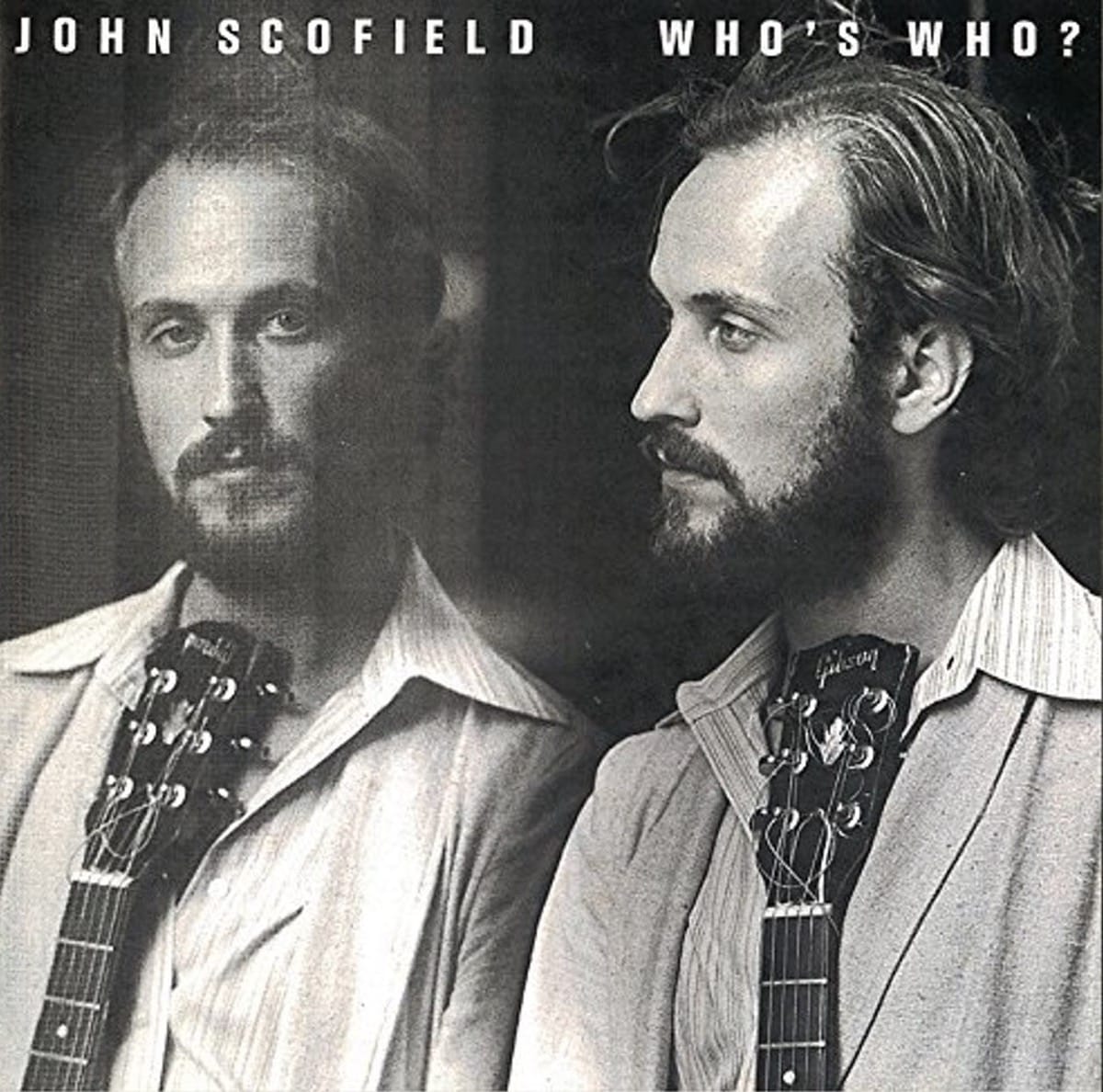
Apart from reminding us of Scofield’s original sound of surprise, the welcome reissue of Who’s Who perhaps indicates a new trend. With the hard bop vaults surely now near exhausted, the reissue bandwagon seems to be rolling forward into the heyday of fusion. BMG’s Novus ’70 series promises to reintroduce much that might have been feared lost forever, including two volumes of Brecker Brothers material.
Who’s Who is in fact an amalgam of two Arista Novus issues — the complete 1979 Who’s Who and four tracks from the 1980 Bar Talk. Both albums demonstrate a level of creative inspiration which Scofield has never surpassed. After this, through Miles and his own electric quartet, Scofield’s main task was one of consolidation.
Who’s Who is the more decisively fusion-oriented of the pair, the funk, samba and rock grooves of Steve Jordan and the great Anthony Jackson given breadth and colour through Scofield’s distinctive harmonic resources. Other, lesser, tracks (How The West and The Beatles) feature the Coltranisms Scofield adopted on two straightahead dates for Enja in the late seventies. Perhaps the most memorable episode here is Scofield’s solo on Who’s Who, where he takes extraordinary risks with upper neighbour sideslips. Unfortunately for Scofield disciples though, the entire CD runs about half a semitone sharp. Mixing Jim Hall lyricism and BB King raunch in equal measure, the Bar Talk tracks long prefigure the late eighties work that has brought Scofield to popular notice, and for sheer beauty and compelling melodic power, his Fat Dancer solo matches anything he has produced since.
Discography
WHO’S WHO
(a) Looks Like Meringue; Cassidae; (b) The Beatles; (a) Spoons; Who’s Who?; (b) How The West Was Won; (c) Beckon Call; New Strings Attached; How To Marry A Millionaire; Fat Dancer (63.22)
(a) Scofield (g); Kenny Kirkland (kyb); Anthony Jackson (elb); Steve Jordan (d); Sammy Figueroa (pc). Brooklyn, 1979. (b) Scofield (g); Dave Liebman (ss/ts); Eddie Gomez (b); Billy Hart (d). Brooklyn, 1979. (c) Scofield (g); Steve Swallow (elb); Adam Nussbaum (d). New York, August 1980.
(BMG Novus Series ’70 PD83071)
TIME ON MY HANDS
Wabash III; Since You Asked; So Sue Me; Let’s Say We Did; Flower Power; Stranger To The Light; Nocturnal Mission; Farmacology; Time And Tide; Be Hear Now; Fat Lip (62.30)
Scofield (g); Joe Lovano (s); Charlie Haden (b); Jack DeJohnette (d). NYC, November 19-21,1989.
(Blue Note COP 7 92894 2)