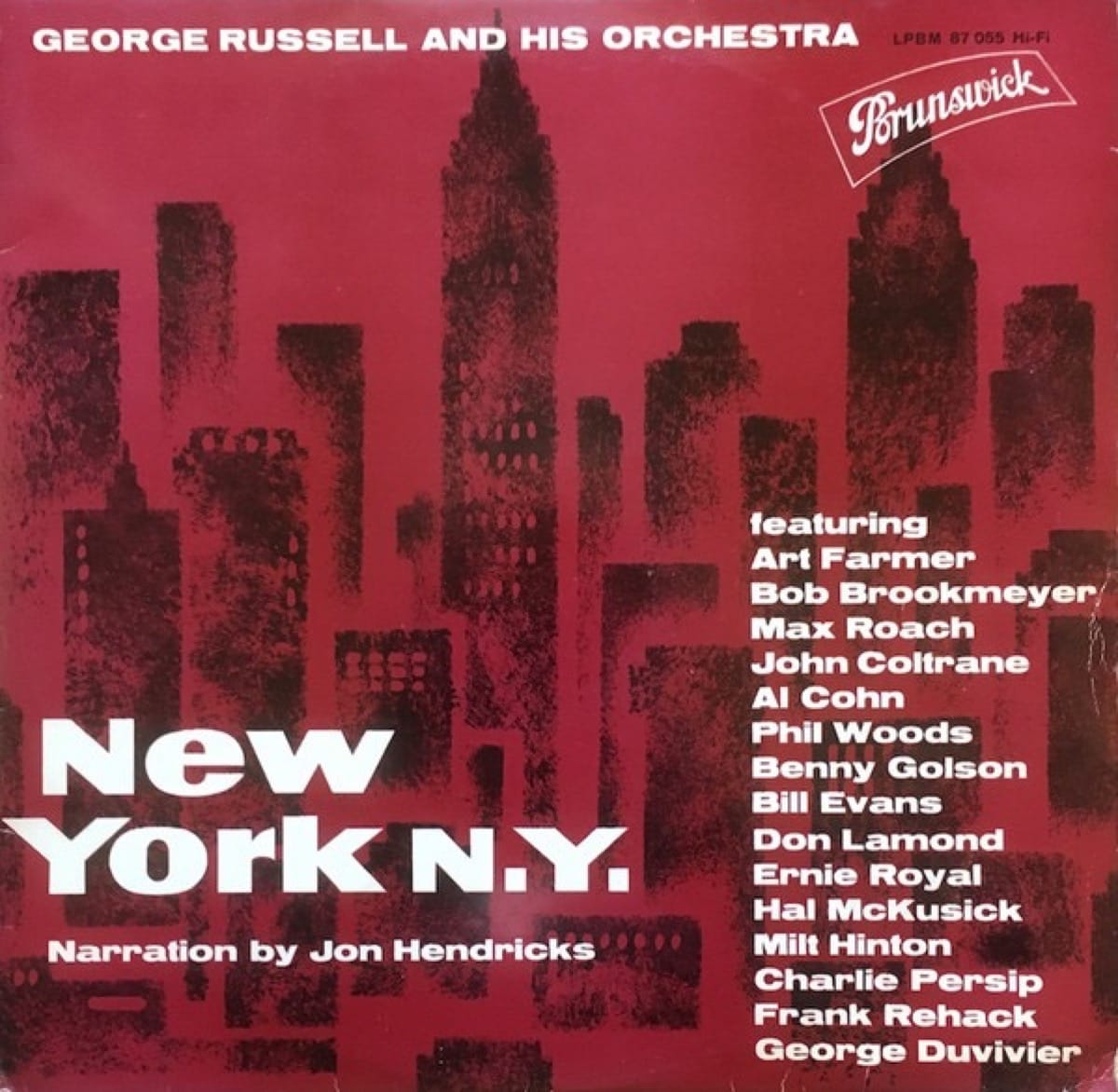
This album has been hailed, in some quarters, as a milestone in jazz, a new conception of jazz presentation, and so on. It turns out to be a moderately interesting but thought-provoking exercise in modern jazz writing and playing, to which has been attached an affected narration spoken by Jon Hendricks.
This sort of thing is tolerable for the first couple of playings, but after that you want to skip the dialogue and get on with the music, which isn’t in the least pretentious.
Russell himself is probably one of the most interesting and versatile of today’s more cultured jazz writers. He is best known for his thesis on the “Lydian Concept of Tonal Organisation” which roughly means the adoption of flatted fourths in the otherwise normal major scale.
The orchestra plays extremely well and is very simpatico to Russell’s music, particularly in “Manhattan” and “Big City Blues”. The latter is, of course, an original and not the old pop song of the same title. It is also interesting to find Russell writing an acknowledgement of the recent Puerto-Rican invasion of New York, which combines modern jazz tones with native Puerto-Rican rhythms.
The medley is well arranged, with good Bill Evans piano,’ but “Helluva Town” is spoilt by too much drumming. Where does Russell think New York is – in the middle of the jungle? Well, maybe he is right at that! Recommended for the writing and arranging.
Discography
(a) Manhattan; (b) Big City Blues (22 min.) – (c) Manhattan-Rico; (d) East Side Medley (Autumn In New York; How About You); (e) A Helluva Town (20 min.)
(a) Art Farmer, Doc Severinsen, Ernie Royal (tpts); Bob Brookmeyer, Frank Rehak, Tom Mitchell (tbns); Hal McKusick, John Coltrane, Sol Schlinger (reeds); Charlie Persip (d); Barry Galbraith (g); Bill Evans (p); Milt Hinton (bs).
(b) Farmer, Joe Wilder, Joe Ferrante (tpt); Tbns same as (a); Phil Woods, McKusick, Benny Golson, Stinger (reeds); Rhythm section same as (a).
(d) Same as (b).
(e) Farmer, Wilder, Royal (tpts); Brookmeyer. Jim Cleveland, Mitchell (tbns); Woods, McKusick, Al Cohn, Gene Allen (reeds); Max Roach (d); George Duvivier (bs); Evans (p); Galbraith (g).
(c) Brass and reeds as for (e). Don Lamond (d); Duvivier (bs); Evans (p); Galbraith (g); Al Epstein (bongoes); George Russell (chromatic drums). Sleeve lists order of soloists on all tracks.
(Brunswick LAT 8333. 12in LP. 35s. 9½d.)