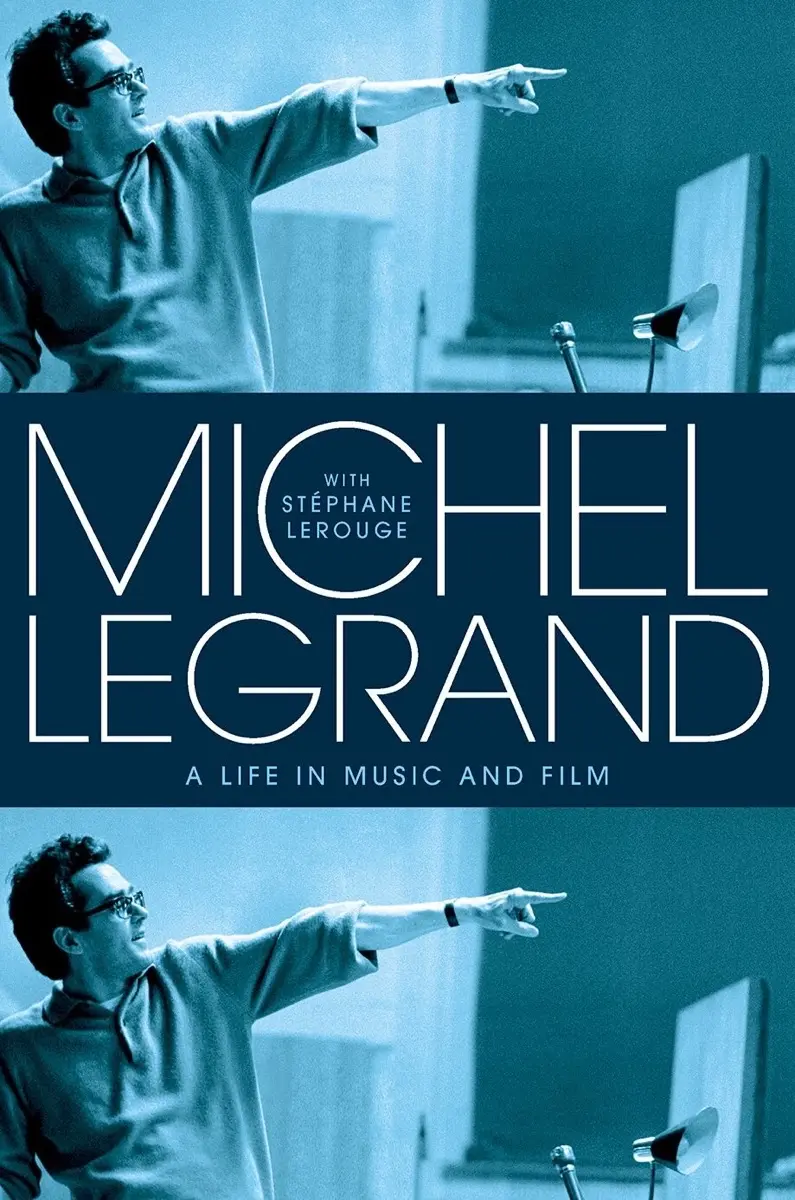
Although essentially an autobiography, this is a series of interviews with French writer and longtime collaborator of Legrand, Stéphane Lerouge. It doesn’t follow a chronology, but each event triggers memories, anecdotes and recollections of episodes in the life of the famous musician, arranger and composer.
Legrand was best known for film scores (he composed over 160), so it’s hardly surprising that most of the book concerns this aspect of his career, his dealings with directors, actors and producers, from his emergence in the early 50s, through his work with the French Nouvelle Vague (Godard, Truffaut and others), Hollywood and up to his death in 2019. As a result there are name-checks with a multitude of people involved in this area and his most successful film scores crop up regularly – The Umbrellas Of Cherbourg, The Thomas Crown Affair, Summer Of ’42, and Yentl – as do his hugely popular hit songs The Windmills Of Your Mind and I Will Wait For You.
His early life growing up in France during World War II, his relationship with his parents and his development as a musical child prodigy are all covered, as are his relationships and later family life. But the emphasis is on how successful and ground-breaking Legrand was in his work, and how he was admired by those in the film and entertainment worlds, from Maurice Chevalier to Barbra Streisand, Michael Jackson and even Orson Welles.
At times the stories reminded me of another musician and arranger, Vic Lewis, whose propensity for name-dropping was legendary and who left you in no doubt about the extent of his talent and success.
However, there are a few instances of self-effacement and not all the collaborations were successful. In the chapter The Ones That Got Away, Legrand speaks of the times when his film scores were rejected or when he turned down commissions. His differences of opinion with directors Richard Lester, Alain Resnais and Joseph Losey are all entertaining, as is his view of Pierre Boulez’s modernism (“mechanical coldness”) and the mood changes of the volatile Streisand, although Legrand often comes out of the encounters with a sense of achievement.
By now you may wonder where the jazz element is, especially as he admits to being “deeply steeped in jazz”. Despite numerous references to individuals he’s worked with, these aren’t featured to any great extent. Sarah Vaughan gets a short section, as does his Communications ’72 with Stan Getz, and he mentions playing with Shelly Manne, Ray Brown and Bud Shank. Coverage of the famous 1958 Legrand Jazz recording for Columbia, highly regarded at the time (“excellent, often startling results” – Dom Cerulli, Downbeat) and with an all-star line up (Miles, Coltrane, Webster, Bill Evans etc), is disappointingly brief. Incorporated into a 12-page chapter, it also includes Frankie Laine and, inevitably, Chevalier. Legrand claims he and Miles played together often, but they only recorded twice – for Legrand Jazz then much later, in 1990, on a soundtrack for the Australian film Dingo. His 1954 I Love Paris album is referred to several times throughout the book, but other sessions from the 50s don’t get a look in – oddly, as they evoke the spirit of Parisian jazz of that era, especially his trio on the 1959 Paris Jazz Piano he recorded for Philips.
A book primarily for film buffs who want to know more about one of the most prolific soundtrack composers of the 20th century.
Michel Legrand – A Life In Music And Film, by Michel Legrand with Stéphane Lerouge. OUP (2025) hb, 288 pages with index and 32 pages of photographs. ISBN 9780197782187