Despite this being my first visit to the Ystad Sweden Jazz Festival, it felt as though I was coming home. Located in the Skåne province on the southern tip of Sweden, it’s a beautiful part of the world I know well from many childhood holidays spent touring Scandinavia with my parents. When the editor asked if I’d like to cover the event I didn’t need long to reach a decision, scarcely taking time to check the calendar.
Previous correspondents including Michael Tucker, Pascal Dorban and our esteemed editor have all extolled the virtues of the great sense of warmth and community which lies at the heart of the annual event, and there is very little I could usefully add to their wise words. Born from a chance conversation between jazz pianist Jan Lundgren and former Ystad garrison commander turned politician Thomas Lantz, the festival this year reached its 17th edition. The event has steadily grown in size and stature since its inception in 2010, Lundgren acting as the festival’s artistic director and Lantz as the organisation’s president. This year’s festival, 29 July to 2 August, marked Lantz’s final year in the role, and he can be immensely proud of what he has achieved.
Yet as instrumental as Lantz and Lundgren have undoubtedly been in establishing and growing the festival, they’re always the first to acknowledge the importance of the festival’s committee and loyal team of over 70 volunteers. The event is about as far from the faceless, sponsor-driven world of the larger festivals as you could imagine, Ystad’s gift to the international jazz community and an enterprise built on a wealth of social capital. The organisers say this year’s festival featured over 200 performers in 45 concerts across 13 stages and attracted an audience of around 11000, including visitors from Argentina, England, France, the Netherlands, Germany and Denmark. Sweden P2/Jazzradion recorded six concerts to be transmitted in the autumn.
Day 1: Yttling Jazz, Jan Lundgren, Kurt Rosenwinkel, Nils Petter Molvær
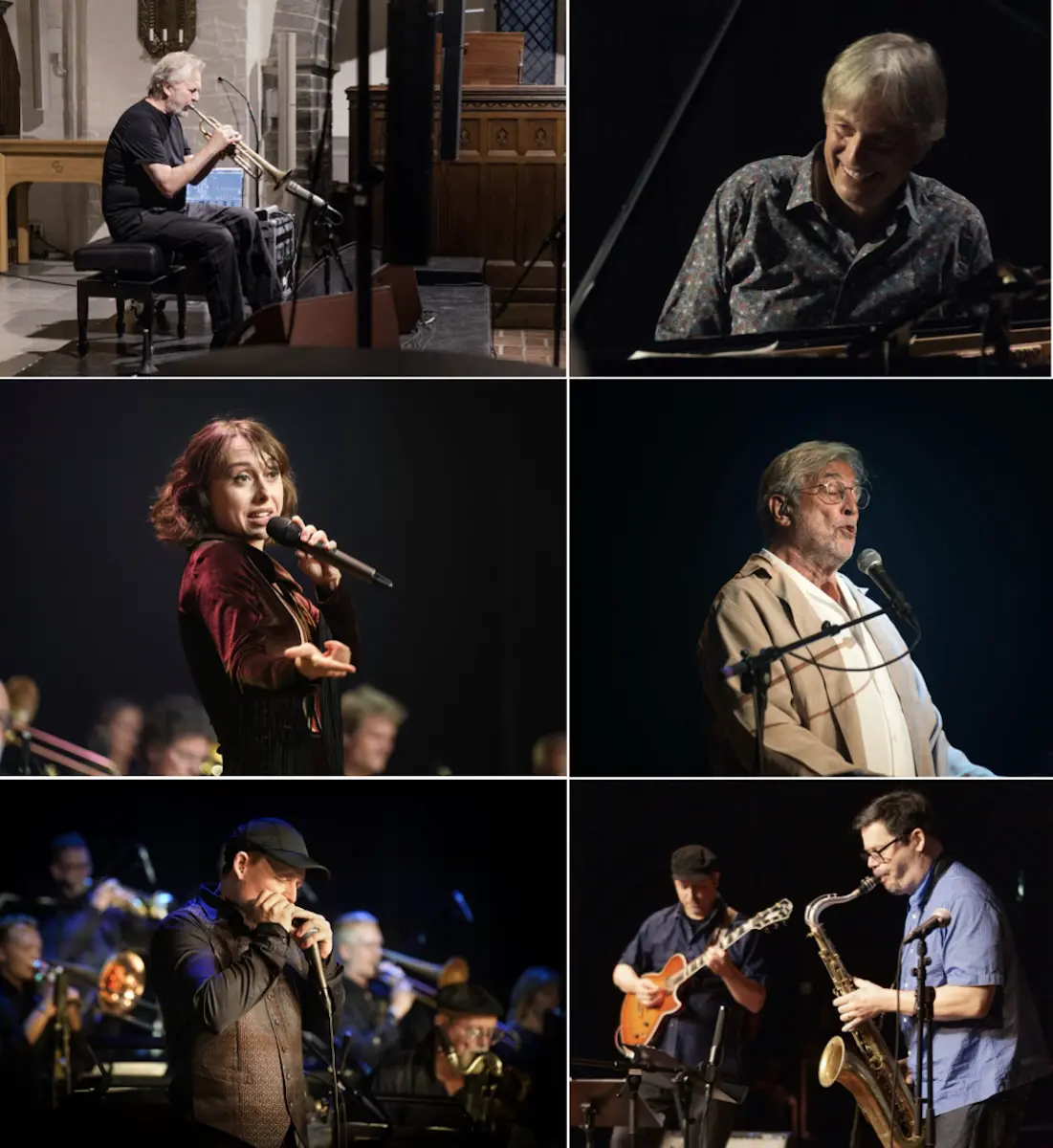
Arriving just before lunchtime on the opening day, there was barely time to check-in before heading out to the coast for this year’s curtain raiser at the Saltsjöbad Spa Hotel by stellar Swedish six-piece Yttling Jazz. Fronted by the charismatic Björn Yttling of indie-pop giants Peter Björn and John, the project takes him back to his roots as a jazz pianist. After a 20-year gap between albums, the band recently returned with Illegal Hit (Out Of Bounds) and the concert featured music from the album, played by a slimmed-down group of Yttling (piano and tambourine), Jonas Kullhammar and Fredrik Nordström (saxophones), Mattias Ståhl (vibraphone, harmonica), Dan Berglund (bass) and Fredrik Rundqvist (drums).
The charismatic Yttling held centre-stage like a lounge lizard turned impresario, sometimes sitting down to belt out a left-hand vamp, sometimes standing up as he surveyed the scene, and sometimes strolling around the stage, tambourine in hand. Leading the frontline for much of the show were two duelling tenors, the Coltrane-ish Kullhammar an effective contrast to the more Rollins-like Nordström. The bulk of the original pieces were groove-based, rooted in hip 60s soul-jazz and funk, though there were also a couple of folk-inflected pieces that recalled the pastoralism of Jan Johansson. Yttling’s experience across a wide spectrum of genres brought a sense of surprise to what might otherwise have been a set of pretty generic riff-based compositions, colouring the pieces with unexpected harmonic twists. It had been a superb opener to the festival, and a show that I won’t forget in a hurry.
Next it was back to town for the first event of the festival at the charming Ystads Teater, one of two special events arranged by pianist Jan Lundgren. With a capacity of around 500, the space is preserved in its original 1894 condition, and as well as being central basecamp for the festival committee and volunteers the theatre was also the intimate setting for most of the festival’s headline events. The concert was an engrossing encounter between Lundgren, Mattias Hjorth (bass) and the Malmö Academy of Music Chamber Choir, directed by Mats Paulson. Both Lundgren and Hjorth teach at the academy, and the programme of folk, classical and jazz pieces tore down the barriers between departments. The choir performed several pieces alone before Lundgren and Hjorth made their entry, and once together they struck the perfect balance, each part enhancing the other. Amongst the many highlights was a moving rendition of Ellington’s Come Sunday and a playful Martin Berggren arrangement of Bartók‘s Six Romanian Folk Dances. As the performance ended, a volunteer came onto the stage to hand each performer a single pink rose, an act which was repeated at every concert in the festival. It was a simple gesture of appreciation, and one that reveals so much about the festival’s ethos.
After some wonderful home-cooking prepared by the volunteers l was ready for the first big-name visiting US artist, Kurt Rosenwinkel. The guitarist brought his quartet with Seamus Blake (tenor saxophone), Alex Claffy (bass) and Joe Perry (drums). It was state-of-the-art post-bop, a mixture of originals and some covers from Mingus and Joe Henderson. Playing a solid body Les Paul-style guitar, Rosenwinkel stuck to the same Metheny-esque tone throughout, soloing with the fluidity of a saxophonist and occasionally breaking up his lines with dark blocky chords. It’s hard to think of a more consistently exciting saxophonist in this style than Seamus Blake, and his impassioned blowing counterbalanced Rosenwinkel’s cooler tones. To experience the quartet close-up in a small intimate venue was something quite special, and the audience’s demands for an encore conferred rock-star status on Rosenwinkel for a moment.
Drawing the opening day to a close was a very special event at the Sankta Maria Kyrka, situated in the heart of Ystad’s medieval centre. In a daily tradition stretching back to 1748, Ystad’s tower watchman ascends the 107 narrow steps to blow a traditional copper horn from each of the four sides of the tower, signalling that the town is free from fire. The festival organisers choose a musician each year to perform the duty, and this year the honour was bestowed upon the great Norwegian artist Nils Petter Molvær. It was a magical moment as the sunny evening turned to dusk, a moment only surpassed by the concert that was to follow in the church below.
Playing trumpet and electronics, Molvær created an ever changing, ever regenerating soundscape. For once it was an advantage to be in a seat with a restricted view, and with no distractions I was able to close my eyes and allow the waves of sound to wash over me. Starting the set with clean, unprocessed trumpet, he phrased in way that nodded to Miles in his centenary year, with strong flavours of Sketches Of Spain. A series of low electronic rumbles then signalled a shift, shamanistic rhythms providing a trance-like backdrop to Molvær’s liquid melodies. The 60-minute set cycled through a range of moods, and a wonderfully introspective sequence about 30 minutes into the performance seemed to bring the church’s organ into life, Molvær’s sound design harnessing some long organ-like tones. Samples of half familiar sounds – a voice, a drum, an aeolian wind-harp, perhaps – were woven into his rich electronic tapestry, his layering of sounds every bit as impressive as his renowned command of the trumpet. It was the perfect end to what had been a deeply satisfying opening day, and one of many truly unforgettable experiences.
Day 2: Fredrik Kronkvist, Kindly, Bobo Stenson, Mathias Heise
The festival’s second day started early with a performance by Swedish alto saxophonist Fredrik Kronkvist, scheduled at 9.30 am. Hosted in the secluded garden of festival supporter Lilla Östergatan’s home, it carried on the festival’s tradition of presenting concerts “in the yard”. The space accommodated an audience of about 100, a shady patio acting as a temporary stage. Playing music from the new album Worlds Unseen, Kronqvist struck me as a player who should be far better known outside of his homeland. His energetic attack, fluid legato lines and constant flow of ideas tap into the spirit of Blue Note-era Jackie McLean and Wayne Shorter. At one point, in a nod to the surroundings, he deftly inserted a quote from Percy Grainger’s Country Gardens into his solo, and in pianist Thiery Marazanye he has a perfect foil, a laconic player who always takes the less obvious path. There was a strong accent on Latin and Afro-Cuban rhythms, highlights including fresh arrangements of Summertime and A Night In Tunisia. The concert, recorded for broadcast by Swedish national radio, helped to blow away any overnight cobwebs.
As with all good festivals there will occasionally be some tough choices over what to see. The first came early in the afternoon when Randy Brecker’s set with vocalists Anna Pauline Andersson and Janis Siegel clashed with an event that I wanted to see at the Next Jazz Generation stage. (However, Pauline is reviewed on the related Storyville recording with Brecker and Siegel.) Each year the festival spotlights emerging artists, a reflection of Lundgren’s desire to offer a ladder up to the next generation, and given my love of contemporary Scandinavian jazz it wasn’t, in the end, such a difficult decision to skip Brecker.
Located in Bäckahästan, a welcoming café in an outdoor square just over the garden wall from Lilla Östergatan, the stage hosted about half a dozen events for up to 250 people at a time. The band that caught my eye was a young Swedish-Danish quartet Kindly, fronted by Emil Boesen (alto and soprano saxophone) and August Kjær Agergaard (bass). Performing original compositions in the endlessly appealing style of the Garbarek-Stenson quartet of the 70s, their playing was at once passionate and tightly focused, the quartet adding a few contemporary rhythmic twists along the way. Whether collectively or individually, I’m sure we’ll be hearing more from these musicians in the years ahead.
The late afternoon show at Ystads Teater was for me perhaps the most eagerly anticipated event of the entire festival – pianist Bobo Stenson and his trio with bassist Anders Jormin and percussionist Jon Fält. Recently awarded a Svensk Jazz’s Lifetime Achievement Award, the extremely modest Stenson is one of the key figures in the development of the distinctively spacious and free-flowing sound of contemporary Scandinavian jazz. This particular trio is amongst his best ever, and since their formation in 2007 for the album Cantando (ECM) they’ve developed a musical rapport that must be seen to be believed.
Starting slowly with a free bass and percussion duet, Stenson sat patiently before making his entry and the goosebumps began. The entire set was built on total communication, the three constantly watching and listening to each other’s every gesture. Included in the set-list were Helios, El Mayor, with a wonderfully amusing improvised ending from Fält, and Don Cherry’s Don’s Kora Song and Race Face. The latter was played with the kind of energy and freedom rarely heard on the trio’s latter-day ECM recordings, and based on the scale of the ovation the audience loved it. It was a performance I’ll never forget, and it was great to hear the octogenarian in such fine form.
Drawing the second day to a close was a collaboration between chromatic harmonica player Mathias Heise and the Danish Radio Big Band inspired by John Coltrane’s landmark 1964 recording A Love Supreme. Before the concert I hadn’t heard their recent album A Love Supreme Revisited (April Records) or read Michael Tucker’s lukewarm but well-reasoned JJ review, though I confess that I approached the show with a degree of scepticism. Coltrane’s monument is one of the most powerful statements of the post-bop era, and the idea of recasting it either for harmonica or big band seemed somewhat eccentric.
In the end the concert proved strangely compelling. Opening with the saxophone section interspersed amongst the audience and playing teasing Coltranesque phrases, the dialogue then grew into a spine-tingling saxophone choir. While no new dimensions were revealed within the famous music, Heise’s virtuosity in recreating Coltrane’s sheets of sound and extended range deserves credit. There were many fine solos from within the band too, notably a tenor chase-sequence involving Hans Ulrik and Karl-Martin Almqvist and an ecstatic post-Sharrock volley from guitarist Per Gade. I suppose the controversial question is whether or not such a singular album should ever be revisited at all. That question remains hanging, but what was not in any doubt was the outstanding quality of the orchestrations and the technical brilliance of Heise’s playing.
Day 3: Eskil Roos, Venya, Francesca Tandoi, Sweden Loves Italy
After the intensity of the first two days Friday felt like a more gentle easing into the weekend. Returning to Bäckahästan for more emerging artists, this time I forfeited was what was by all accounts a thoroughly entertaining show at the Saltsjöbad by French singer Camille Bertault. First on the bill was the trio of pianist Eskil Roos with Gustav Sundquist (bass) and Hampus Petersson (drums). Born in nearby Lund, Roos graduated from the Malmö Academy and has studied with pianist Kristjan Randalu at the Estonian Academy of Music and Theatre. The trio’s debut album Mystery Of The Mind (Prophone) is due to be released in September, and of all of the artists appearing on the next generation stage they’re probably closest to their breakthrough.
The trio opened with Night Ride, an attractively lyrical ballad from the forthcoming album which set the tone for much of what was to follow. Blending jazz, folk and classical influences, Roos has a sensitive and finely weighted touch perfectly suited to the contemporary Nordic sound. Going Home combined touches of Chopin with a rhythmic E.S.T. style groove, the piece eventually opening out into another fabulously spacious ballad, while Breaking Free juxtaposed busy melodic and rhythmic cells with glimpses of something altogether more pastoral. I wouldn’t be at all surprised if Roos, well-equipped to stand out in the crowded field of piano trios, performs on one of the festival’s main stages at some point in the future.
The final next generation event came from another Swedish-Danish collaboration, Venya. A six-piece playing a distinctive and harmonically sophisticated blend of soul, jazz and funk, the group’s built around the lovelorn vocals of Alice Wilgotsson and also features Anton Bergman (keyboards) and August Kjær Agergaard (electric bass) from Kindly. Paradoxically theirs is the kind of electronics-based music that probably sounds better in a studio where sounds can be layered and mixed with a greater degree of control, but it was nevertheless a dreamy and relaxing way to while away an hour under Ystad’s glorious summer sun.
Back in the theatre, the first part of an Italian-themed evening brought the trio of pianist and singer Francesca Tandoi with Stefano Senni (bass) and Pasquale Fiore (drums). Tandoi has risen to fame on the back of a classic style based on the Oscar Peterson and Monty Alexander school, though she also weaves elements of Evans and Tyner into her compositions and solos. Much of the evening’s show was based on pieces from her forthcoming album Songbook Vol. 1, which showcases her own works as a composer. I particularly enjoyed the occasional curve balls lobbed by bassist Senni, who has previously worked with a number contemporary stylists including Giovanni Guidi and Daniele D’Agaro, while Fiore was not averse to spicing up the music with the kind of complex rhythmic sub-divisions I’d normally associate with Chris Dave. Holding the audience rapt and leaving behind a lot of smiles, Tandoi was the perfect crowd-pleaser.
The final event of the day was Jan Lundgren’s second performance, a project simply called Sweden Loves Italy. In this one-off quartet, consisting of Lundgren (piano), Rosario Giuliani (alto saxophone), Hans Backenroth (bass) and Roberto Gatto (drums), the mutual respect between the musicians was evident at every turn and the quality of the playing top-notch. The first section of the programme consisted of Italian-flavoured movie themes, from Nino Rota’s themes to Fellini’s La Dolce Vita and The Godfather to Morricone’s Cinema Paradiso. Rosario was a revelation, his updated Parker-isms and tactile tone backed-up by a fecund imagination, while Gatto did what he does best, effortlessly swinging while deeply embroiled in the conversation.
Each player introduced a piece inspired by the collaboration – Gatto’s Four Stories reflected the make-up of the quartet, Lundgren’s Never Too Late was a statement about the long overdue nature of the meeting, Rosario offered a piece based on the healing powers of love, and Backenroth made a dedication to his locale with Dear Old Stockholm. Playful and fraternal, the second of Lundgren’s two musical contributions to this year’s festival was also an embodiment of the spirit of Ystad.
Days 4 and 5: Magnus Carlson, Ivan Lins, Viktoria Tolstoy, Veronica Swift
In recent years the festival’s weekend shows have been held in the grounds of Charlottenlund Castle, some six kilometres west of Ystad. This year a variety of factors including the potential for rain led to a late change of plan, the four scheduled concerts switching back to Ystad’s theatre. While some festival regulars seemed a little disappointed not to be returning to the picturesque surrounds of this Gothic Revivalist pile, many were secretly pleased by the simpler logistics – the change of venue certainly made me more inclined to attend all four events.
If the first three days were aimed at the jazz cognoscenti, the weekend is very much about artists with a wider crossover appeal. All of the concerts were headlined by vocalists, and for me the pick was Saturday afternoon’s show by Magnus Carlson & The Moon Ray Quintet. The group recently released a superb album on Helsinki label We Jazz Records, and rather like Björn Yttling, Carlson has found fame in the world of indie music as singer with the band Weeping Willows. Leaning into Carlson’s deep appreciation of soul, jazz and blues, the project’s art-rock sensibility places it broadly adjacent to the jazz-leaning projects of Elvis Costello, David Sylvian and Nick Cave.
No longer a quintet, the Moon Rays are directed by left-field jazz hero Goran Kajfes (trumpet) and currently include Per “Ruskträsk” Johansson (alto saxophone, bass clarinet), Carl Bagge (piano, organ), Mattias Ståhl (vibraphone), Martin Höper (bass) and Lars Skoglund (drums). The band revitalised some neglected classics, the arrangements crisp and the balance between vocal and instrumental passages very much weighted towards the latter. With songs drawn from the group’s eponymous 2009 Blue Note debut, 2010’s Echoes and last year’s We Jazz release, set highlights included smouldering covers of soul classics Sugar Man and Ain’t There Something Money Can’t Buy?, an emotionally freighted cover of David Bowie’s Where Are We Now?, a dark reading of Frank Sinatra Jr’s Black Night, and a playful arrangement of Al Jolson’s Me And My Shadow featuring Mattias Ståhl. Bagge coaxed some wonderful vintage tones from his Nord organ in the closing You Do Something To Me by Paul Weller, and all told the concert offered a terrific counterpart to the opening set by Yttling, both shows ranking amongst my surprise festival highlights.
On Saturday evening a living legend of Brazilian music, Ivan Lins, performed as the festival’s guest of honour. Lundgren’s introduction left little doubt as to his admiration for the great composer, whose work has been covered by numerous artists from Ella Fitzgerald and Sarah Vaughan to Quincy Jones and Sting. Currently touring Europe with André Sarbib (piano), Cláudio César Ribeiro (guitar), Braulio Araujo (bass) and Chris Wells (drums), Lins brought his own sound engineer and the set was appreciably louder than others in the festival. Suiting the band’s post-fusion aesthetics, Ribeiro shredded his way around the neck like Frank Gambale.
With a double encore the set lasted around two hours and featured many of Lins’ best-loved songs, including Remember Me, To Begin Again and Madaleina, and the charismatic frontman took time to explain the inspiration behind many of the lyrics. Dedications to wives and lovers sat amongst songs of protest and pleas for a better world, and at one point he paid tribute to the festival’s volunteers, declaring “The planet is needing more people like you!” Although I’m not instinctively drawn to Lins’ sound world or Brazilian music in general, there was no mistaking the hand of a master composer and I departed feeling lucky to have been in the room to share the love.
Sunday’s concerts featured singers and big bands, and first to the stage was Viktoria Tolstoy with the Anders Berglund Big Band. A late replacement for popular Swedish singer and former Eurovision entrant Jill Johnson, Tolstoy stuck to the original plan and sang material from the Great American Songbook. It’s a format that’s been been done to near death over the decades and it takes something special to make the material fresh, but Tolstoy is an accomplished performer who knows how to command an audience. Sh threw her heart and soul into the music, and You Let My Love Grow Cold, Aretha Franklin’s Natural Woman and a pared-back arrangement of Never Let Me Go all stood out. With guests including saxophonist Karl-Martin Almqvist and guitarist Elias Källvik there were many fine solos scattered across the set, and while the music wasn’t entirely aligned with my more contemporary tastes it was certainly appreciated by the near capacity crowd.
Closing the festival with style and razzmatazz was US vocalist Veronica Swift and the Danish Radio Big Band, the latter making their second appearance of the festival. Swift, the daughter of pianist Hod O’Brien and singer Stephanie Nakasian, has performed with the band on several occasions and they’re an incredibly well-oiled machine, the tight arrangements and crisp ensemble work seamlessly upscaling Swift’s music. Time spent on the road has clearly shaped Swift’s present day outlook. A version of Judy Garland’s Born In A Trunk spoke to the itinerant lifestyle, while The Show Must Go On is shaped by that same resilience.
Swift’s stagecraft has a performative aspect redolent of Streisand, Minelli and Freddie Mercury, but beneath the showbiz there’s no disguising the power, range and technical virtuosity of her voice. Describing her music as “trans-genre”, she draws freely on jazz, rock, classical, opera, blues and funk, often within the same song. If there was a central theme to the songs it was surely that of discovering who you are and embracing the things that make you unique. Throwing the whole of herself into each performance and pursuing her diverse musical interests wherever they take her, she obviously lives by that credo. In the opening I Am What I Am she moved from classic jazz-scat to opera as if it were the most natural thing in the world. She described another piece as “Duke Ellington meets Jimi Hendrix and Janis Joplin at Woodstock”, guitarist Per Gade duly obliging with some distortion-soaked blues while Swift and the band took care of the rest.
Before launching into a cover of The Beach Boys’ I Get Around Swift shared with the audience her view that the Great American Songbook should extend into the rock and pop of the 60s and beyond. Part of me wondered what Anders Berglund might have made of such heresy, but on reflection I’m sure he’d have been swept along with the tide. Rock and opera again collided in a cover of Queen’s Keep Yourself Alive, and for the finale Swift brought her partner Brian Viglione of rock band The Dresden Dolls to the stage to perform his song Sing. It was entertainment with a capital E, and as the lights went up the audience was left open-mouthed, a near universal sense of approval descending on the room.
So what is left to say about Ystad? More than just a series of concerts, the festival is a unique cultural experience, one in which outstanding music, historic venues and the incredible warmth of the local people combine to create powerful memories. 2026 may have been my first visit to the festival, but I’m determined it won’t be my last.
Ystad Sweden Jazz Festival 2026. The 2027 Ystad Sweden Jazz Festival begins 4 August 2027