After 29 years, the Melbourne International Jazz Festival (MIJF) has firmly established itself as the springboard for visiting artists from the USA, UK and Europe to tour the Asia Pacific, including a number of smaller jazz festivals in cities like Auckland, Sydney, Adelaid and Perth.
The MIJF programme is important to the international jazz calendar because it builds artists’ audiences and inspires excellence and innovation from aspiring local musicians.
The diversity of this year’s 10-day festival, featuring 550 artists from 18 different countries across more than 30 different venues, was both its strength and its weakness. While it successfully catered to a wide range of musical tastes and budgets, including an expanded programme of free concerts, most festival-goers probably only sampled one or two concerts or events. Compared to Melbourne’s ubiquitous comedy festival, for example, MIJF remains stubbornly niche.
The festival’s major outdoor concert was moved this year to the first weekend, and was headlined by the Teskey Brothers. There is no questioning the quality of the Teskey Brothers’ sound or their popularity – they may be one of the few jazz-adjacent groups capable of attracting a Melbourne crowd in excess of 6,000. The two brothers, Josh and Sam, have honed their vocal, guitar and songwriting craft into a rich and satisfying marriage of blues and soul. They mixed new songs from a forthcoming album with a celebration of the tenth anniversary of their breakthrough debut album, Half Mile Harvest. The concert felt like a giant pub gig at which everyone had either gone to school with the band or knew the lyrics of each song, word for word. As good as they were, it rankles that a band that is essentially derivative of the southern American soul and blues canon should headline at an international jazz festival over one of the musical legends that invented the grooves they now so popularly co-opt.
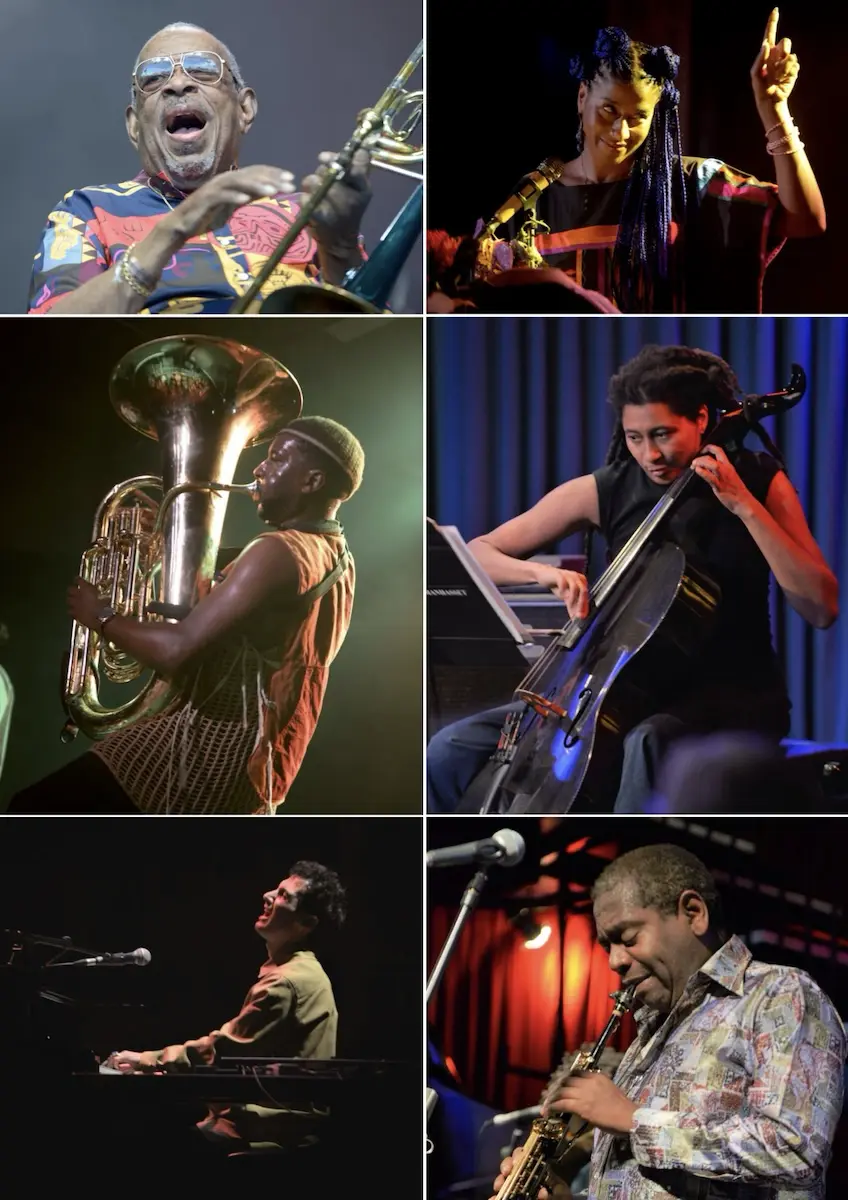
Fred Wesley and the New JBs were the support act. Wesley, rightly billed as a funk legend, was backed by a very accomplished band, including a powerhouse and hard-hitting young drummer, Bryan Morris, hailing from Wesley’s hometown of Mobile, Alabama. His youthful bluesy intensity was echoed in other forays across the festival. Wesley told the audience – a bit thin on the ground before the main act – that he was there to “funk it up”. And he did. He demonstrated he still has all his trombone chops, dived deep into the George Clinton catalogue and rattled off a medley of memorable James Brown horn arrangements he had written.
In smaller club and concert hall venues that followed throughout the city over the next nine days, the festival producers made a determined attempt to demonstrate that modern jazz is not only alive and well, but is branching out into new and inventive cross-genre collaborations.
MIJF’s artistic director, Michael Tortoni, a bass player himself, has a remarkable talent for building world-class club venues. He has been running jazz clubs in Melbourne since 1992, and his clubs have featured in the festival since its inception in 1999. In 2017 he moved the highly regarded Bennetts Lane Club in the city centre about five kilometres north to what is now the hipster suburb of Brunswick. He named this new club JazzLab, and this year he added a second and slightly larger venue at the Brunswick site. Reprising the Bennetts Lane moniker, this new club builds on the tried and tested design elements of previous clubs. By adding a second tiered viewing area to both table and balcony seating, and with easy access to the bar, kitchen and external bathrooms to avoid distractions from the high-end sound and moody lighting, Tortoni has created a template for late-night jazz clubs anywhere in the world.
For MIJF 2026, Tortoni picked the eyes out of modern jazz from New York and Chicago. As he explained when introducing the Kris Davis Trio, “As soon as I saw this band playing in New York, I knew I had to bring them to my club.” Indeed, Kris Davis on piano was inventive, melodic and occasionally angular; Johnathan Blake was dynamic and free flowing on drums; and Robert Hurst bridged piano and drums with carefully considered solos and bass lines that held the pocket.
The standout show among a string of exceptional performances at this club was the Tomeka Reid Quartet. Tomeka Reid is a cellist and composer with deep roots in the Chicago jazz and improvisation scene through the Art Ensemble of Chicago, the Association for the Advancement of Creative Musicians and the Chicago Jazz String Summit. She performed two sets showcasing her quartet’s two latest albums. It was a privilege to hear such consummate shared musicianship in such an intimate setting. There was technical mastery and precision with all four instrumentalists in their performance of their latest album, Dance! Skip! Hop!. They allowed space while building a subtle and understated collective sound that washed the room with waves of sound. Reid shared lead and rhythm with Mary Halvorson on guitar. The two women, each at the top of their game, were precise and inventive. They were backed by an all-male rhythm section, Jason Roebke on bass and Tomas Fujiwara on drums. Roebke was probably the most animated of the four musicians, but what stood out was the grace and care with which each individual contribution was respected. This was possibly one of the most mature modern jazz performances I have seen in decades.
Cuban saxophonist Yosvany Terry has been based in New York since 1999. His performance built on his Latin roots with a piercing set in the adjacent JazzLab venue. He is a very physical player, seeming to coax sounds and textures from his alto and soprano saxophones. He was backed by his brother, Yunior Terry, who now lives and teaches in Melbourne. He anchored the set on bass, particularly as emerging New York drummer Julien Miltenebrger tended to use his drum kit as a lead instrument in its own right. The quartet was filled out by local pianist Brett Williams, also teaching in Melbourne – the room was filled with aspiring young musicians. Williams provided one of the many highlights of the night with a sparse and poignant solo. The portents for the Melbourne jazz scene, shaped as it now is by local and visiting teachers of significant standing, are very promising. They were mirrored by the local artists who presented free festival concerts in a range of venues from performance spaces to food markets and wine bars dotted around the city.
Back in the city centre’s mid-size venues, MIJF showcased a number of emerging artists, with a loose focus on the London music scene and the role of poetry and narrative in cross-genre performance.
Benedict Clementine was probably the star-turn among artists making their Melbourne debut. His solo gig, as part of his Back to Basics tour, began with a spotlit piano at centre stage, which was wrapped in the same white muslin that covered the stage floor and walls. Barefooted, and wearing his trademark greatcoat and sunglasses, Clementine combined classical piano technique, vocal dexterity and audience call and response with what can only be described as mumbled chatter between songs. In contrast to the stark theatricality of the show’s beginning, Clementine slowly built warmth, humour and connection through lengthy audience sing-a-longs as he coaxed, coached and cajoled from the stage. In performance, his piano playing was dexterous; his poetry was poignant, if occasionally obtuse; and his much-lauded vocals were controlled and impressive, particularly when he reached for operatic effect. The comparison with Nina Simone is apt – he did indeed sound uncannily like her on at least one song. Overall, however, the hype attributed to Clementine has probably created unrealistic expectations. He is a fine and even an unforgettable artist, but he is no once-in-a-generation male vocalist in the company of the likes of a Bobby Blue Bland, Bobby McFerrin or Gregory Porter – voices that linger forever on first hearing.
Poetry and narrative were also showcased with Aja Monet and the Australian Art Orchestra. Brooklyn-born, Californian-based Monet is at the leading edge of contemporary poets using multiple musical genres for performance. She is arguably best known for her work championing the #Say Her Name movement and Palestinian rights, and this concert was carefully built on foregrounding love and respect. While it was impossible not to be reminded of the antecedents of the Last Poets or Gil Scott Heron, she branched out to traverse a range of contemporary musical styles and was careful to avoid being didactic. One of the most impressive songs of the night was Working Class Musicians, a poem dedicated to working musicians and their support staff. She pronounced this rousing rendition as the best version she had ever performed live, a remarkable accolade for the young Melbourne drummer, Ebs Daramola, who was sitting in on this gig with just 24 hours’ notice. Like Bryan Morris with Fred Wesley, Daramola has a raw intensity, particularly with his hard-edged cymbal sound, and this singles him out as one of the brightest new talents on the Australian jazz scene.
The Australian Art Orchestra’s production of Saltwater, Sugar required a 45-kilometre trek to a new and otherwise very impressive arts and culture centre on the outskirts of Melbourne’s south-east. Described as a “scored fictional narrative”, this was an orchestral composition in the style of Duke Ellington, over which voice-over and song described the love story of a young couple caught up in the mayhem of Pacific Islander workers rioting against slave-trade conditions in the sugar plantations of northern Queensland in the 1880s.
Musically, the 16-piece orchestra gave ample room for Melbourne’s leading improvisers, including Julien Wilson (tenor saxophone) and Scott Tinkler and Eugene Ball (trumpet). Composer and pianist Aaron Choulai chose Ellington and swing as a nod to the shared experiences between Pacific Islanders and African Americans.
While this production came across as a work-in-progress, with different elements seemingly either underdone or somewhat disconnected, it represented an intriguing and compelling musical narrative telling a powerful story of loss, love and struggle. Saltwater, Sugar may ultimately find its home on the musical stage, in film or television, or as the soundtrack to modern dance.
Back in the city, Tigran Hamasyan had a sold-out show at the Melbourne Recital Centre. His last visit to Melbourne was a solo piano performance. This time the Armenian virtuoso brings his Manifeste album, backed by Yessai Karapetian on keys, Marc Karapetian on bass and Aman Mnatsakanyan on drums. There are glimpses of his solo piano genius blending classical and jazz techniques with Armenian folklore. Yerevan Sunset, for example, was an evocative melody while other tracks veered towards a heady mix of choral and progressive rock. Much of the concert stretched the vernacular further towards hard rock and heavy metal. The 1,000 people who attended were enthralled, but it was not a direction that I enjoyed, even if I could respect and appreciate the fact that he was single-mindedly transcending boundaries.
Also in the city, Jazz re:freshed brought two of its London-based stablemates to what is now a multi-year partnership with the festival. Pearl Summer is a singular voice, possibly best described as a conscious rapper with a streetwise jungle sound. She supported Theon Cross, one of the key figures in London’s Tomorrow’s Warriors, out of which the ascendant Ezra Collective has emerged. Interestingly, the Ezra Collective had headlined just a few weeks earlier at a new festival, Move My Way, in both Melbourne and Sydney.
A week prior to the Theon Cross gig, and following a street parade through Melbourne to signal the opening of the festival, Rebirth Brass Band had powered their way through an evening club set that leant heavily on the sousaphone for its driving bass sound and New Orleans dance beat.
Theon Cross did something similar with his tuba, but he took the instrument into places that pushed boundaries and defied any reasonable expectations. Cross does not harness the tuba to his shoulder and waist in the manner of the New Orleans marching band and the sousaphone, so the performance was very physical. To Cross, the tuba was a lead instrument that also played rhythm. He ranged across musical styles, traded lead with James Akers on tenor saxophone, and relied on the spacey guitar work of Nikos Ziarkas to provide colour, balance and occasional respite from the demands of being a tuba-toting front-man.
Theon Cross was a fitting new-generation prelude to the closing gig the following evening by four modern jazz giants at Melbourne’s premier indoor concert venue, the Hamer Hall. This was Aziza’s first concert on their tenth anniversary tour to Australia, Asia and then London. Lionel Loueke was typically evocative on guitar and occasional vocals – he brought a lyrical African feel to the band. Chris Potter brought form and clarity to his saxophone, and for much of the gig was the primary soloist. The rhythmic dream team of Dave Holland on bass and Eric Harland on drums demonstrated that power and strength can come from precision and mastery of the craft, as compared to the youthful intensity of some of the emerging drummers in earlier festival sets. They performed with a style and panache that exuded confidence and professionalism. Aziza were a timely reminder that the very best of modern jazz can showcase unique individual voices as elements of a more rounded, collective and meaningful whole.