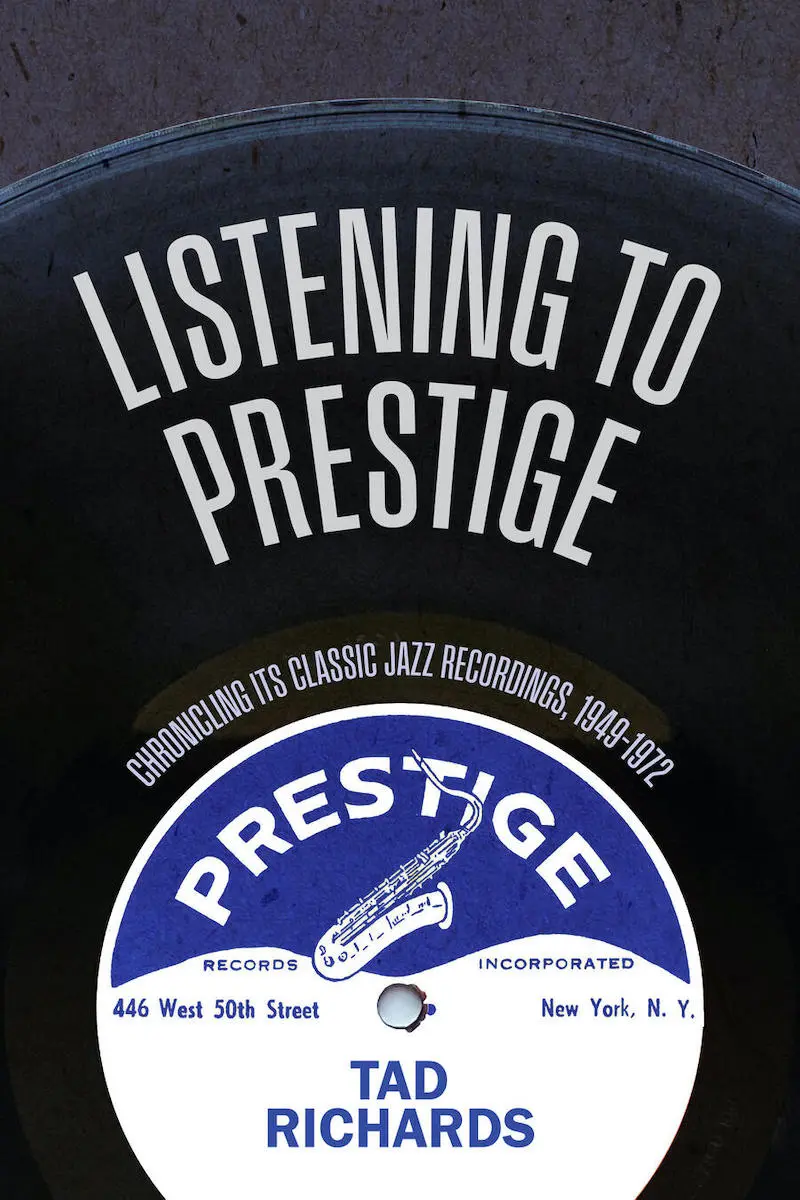
American author, artist and poet Tadd Richards has written over 30 books in the last 50 years. His most recent, Listening To Prestige, recounts the 22-year history of the Prestige record label.
Richards describes how Prestige was created by Bob Weinstock, a precocious collector of jazz records from flea markets. Weinstock established a mail-order record business when he was 15 and three years later opened a record store in Manhattan. We read how the times encouraged the growth of independent record labels because availability of materials previously prioritised for the war effort had made production of 78 rpm records easier. Now, “anyone could get a record pressed” and at the age of 20, Weinstock decided to do just this. He was encouraged by Kenny Clarke, a customer at his record shop, who said he could get all the bebop artists he could handle, and also by Lee Konitz, who pestered Weinstock to record him playing alto with Lennie Tristano. And so, in January 1949 the young entrepreneur entered a rented studio with the Lennie Tristano Quintet and the rest, as they say, is history.
Alongside the tale of the birth, life and eventual demise of Prestige, Richards reveals how the label’s constantly evolving artist-register reflected the shifting styles and tastes of jazz over two decades – from bebop, hard bop and post-bop to free jazz and soul jazz. He relates how Prestige became one of the first recording companies to work with recording engineer Rudy Van Gelder, who revolutionised the way jazz was recorded, and documents in detail the musicians who moulded postwar jazz.
The book charts how modern jazz became recognised in the 50s as part of mainstream American music and reveals the extent of Prestige’s success in signing up the foremost artists of the era. The list is too extensive for this review but includes the likes of the Modern Jazz Quartet, Stan Getz, Sonny Rollins, Thelonious Monk, John Coltrane, Miles Davis and Sonny Stitt, many of whom did their most significant work for the label during this period.
Richards goes on to describe the development of free jazz in the 60s as embodied by Prestige artists such as Eric Dolphy and Booker Ervin and relates how the label became central to the recording of “new” soul-jazz artists like Shirley Scott, Gene Ammons, Brother Jack McDuff, George Benson and Eddie “Lockjaw” Davis.
He supplies potted histories and engaging anecdotes about the artists, together with details of band personnel, recording session dates and record analysis. Much of the material is drawn from Richards’ “Listening To Prestige” blogs, compiled over 10 years, and from four subsequent volumes, similarly named, that he self-published covering the periods 1949-1953, 1954-1956, 1957-1958 and 1959-60. The new book has reproductions from his blog entries interspersed throughout the text.
Richards tells us that when you finally sit down to write a book about a subject you’ve been interested in all your life, “a lot of what goes in is stuff you just know”, from books read way back, from listening to a radio or TV interview years ago or from things told you by a musician or music industry professional. On this basis, he says, any bibliography is incomplete; however, he does add a substantial list of sources that he’s accessed in writing this book. A lot of work has clearly gone into listening to this particular label over the years, resulting in an interesting, densely packed read.
Listening to Prestige – Chronicling Its Classic Jazz Recordings, 1949–1972, by Tad Richards. SUNY Press, 278 pp, pb, $24.95. ISBN 9798855804959