Hytta Trio: Vindespel
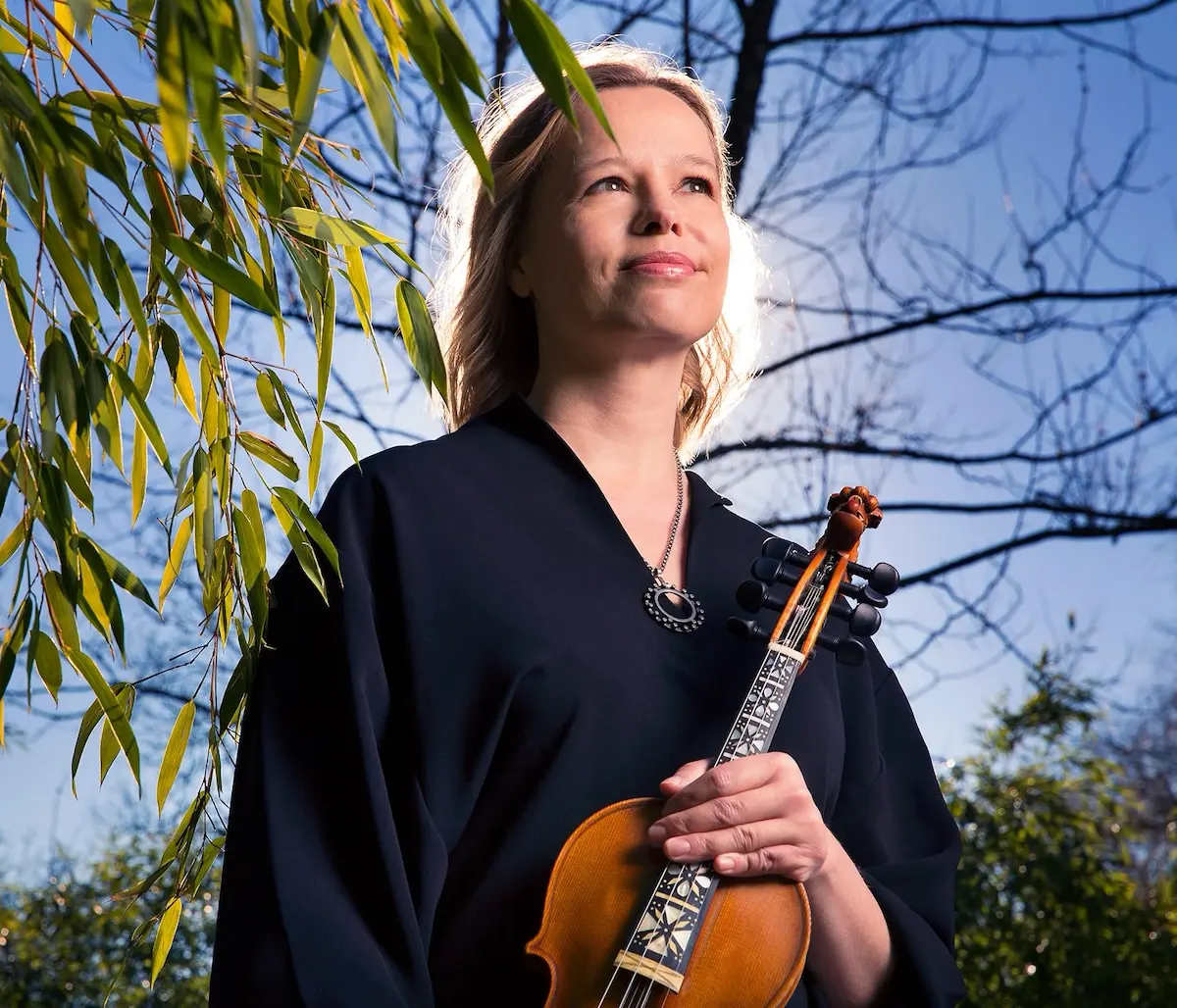
Vindespel – Twining Tunes – is the debut of The Hytta Trio. The trio were formed in 2018, and explore Norwegian traditional music, searching for space to improvise. Anna Hytta plays Hardanger fiddle – strange that there’s no abbreviation in Jazz Journal’s style sheet. Jo Skaansar is on bass, while Ibsen Thorsrud’s percussion includes tin foil, glockenspiel and bass drum.
Hytta draws on the rich Hardanger fiddle tradition from Telemark, and other folk traditions. Skaansar and Thorsrud have backgrounds in jazz and improv. The publicity mentions the pull of dark forests as well as open fields, and I immediately think of Finnish master Sibelius.
The music is monochrome and hypnotic, and I think takes some effort to get into. But as the repetitive forms take over, the listener is drawn in. The brief opening Skrald features industrial sound produced by the percussionist. Dråpeslått switches to a metronomic waltz-time that becomes 6/8, with haunting minimalist fiddle. The polyrhythms are tricky – a wonderful effect. Døn opens with arco bass and fiddle, playing in ad lib tempo with brief ornaments, and – I imagine – a stroked cymbal. The results are magical and elusive.
Discography
Anne Hytta (Hardanger vn); Jo Skaansar (b); Ulrik Ibsen Thorsrud (pc). Nesbyen, Norway, September 2025.
Skrald; Dråpeslått; Døn; Løyn; Veime; Rull; Lyst Mørke; Sølondo; Sull; Sildreslått (42.18)
Krets
Myra Melford and Satoko Fujii: Katarahi
Katarahi is the Japanese word for heart-to-heart conversation between friends – an appropriate title for this duo album by veteran pianists Myra Melford and Satoko Fujii, who have a 30-year friendship. It’s their second duo album, recorded at Jazzfestival Leibnitz in Austria. Leibnitz was a rationalist philosopher, so… forget that, the philosopher is Leibniz.
They share an illustrious history. Fujii studied with Paul Bley at New England Conservatory in 1994, and he introduced her to Melford. Both pianists are inspired by free jazz, but with strong melodic content and driving rhythms, drawing on a wide range of influences. I’ve been listening to them for many years, though I’ve never heard them together live. In Newcastle over 20 years ago, I was surprised to find her playing harmonium, in the collective Equal Interest she’d formed in 1999 with Leroy Jenkins on violin and viola, and Joseph Jarman on alto saxophone, flute and oboe.
Both musicians are “polystylists”, in contrast with artists who have a strong signature style, that listeners can identify after a few bars. Bill Evans, McCoy Tyner, Miles Davis, Lee Konitz, John Coltrane, Ornette Coleman – all these have a strong signature style, apparent in everything they produce. Perhaps jazz, with historic connections to the entertainment industry, favours artists with a strong signature style, which in lesser hands becomes a mere branding device. Great players without a strong signature style include John Zorn, Ethan Iverson and Dave Douglas. On this issue, Melford says “I’ve certainly listened to a lot of music from Africa and the Diaspora in the Americas – elements of which have found their way into my own music.”
Duet recordings usually state who’s on the right channel and who’s on the left. But the pair switched pianos during the concert, and in any case, this music involves a total collaboration. The plangent Chalk is one of my favourite tracks here; Kaiwa is a scurrilous free exploration. An outstanding release.
Discography
Interlude I; Signpost; Pairs; Chalk; Kaiwa; IV; From Sometime (33.46)
Melford, Fujii (p). Leibnitz, Austria, September 2024.
Rogue Art
Tomasz Stańko: Balladyna
An essential document of 70s European jazz, by one of its great signature stylists, Tomasz Stańko (1940-2018), Balladyna was the Polish trumpeter’s first recording for ECM, and it’s the latest instalment in their Luminessence vinyl series. The leader became indelibly associated with the ECM aesthetic.
Stańko had been refining his sound and style on albums for other labels. For his ECM debut he leads a chordless quartet with saxophonist Tomasz Szukalski, longtime collaborator Edward Vesala on drums, and young bassist Dave Holland. What a band! For the trumpeter, “No one played percussion like Edward Vesala. His playing had scope and colour… He played melodically and provided an excellent counterpoint to my lyrical language.” Vesala (1945-99) recorded with Jan Garbarek and led a group mostly of his own students called Sound & Fury. I recall hearing them at RNCM Manchester on a memorable Contemporary Music Network tour – now the initials CMN are as dead as focused Arts Council support for jazz.
I’d not heard of tenor and soprano saxophonist Tomasz Szukalski (1947-2012) – I should have known him through this album, but he remains under appreciated. He must be a Lee Konitz or Warne Marsh figure in Polish jazz – a musician’s musician, for some reason not willing or able to push his claims. Dave Holland (born 1946) is the only surviving member of the quartet, and the most famous through his early association with Miles Davis.
Holland plays Duet with Stańko, while the Ornette Coleman infused Tale features a trio of trumpet, bass and drums. The title track is a ballad in ad lib tempo, with the leader’s mournful, flared trumpet prominent. I’m not sure it’s my favourite Stańko album, but it’s certainly a landmark one. It was another 20 years before Stańko and ECM’s Eicher worked together again, on Leosia (1997).
Discography
Tomasz Stańko (t); Tomasz Szukalski (ts, ss); Dave Holland (b); Edward Vesala (d). Ludwigsburg, December 1975.
First Song; Tale; Num; Duet; Balladyna; Last Song; Nenaliina (39.26)
ECM 602475981169