
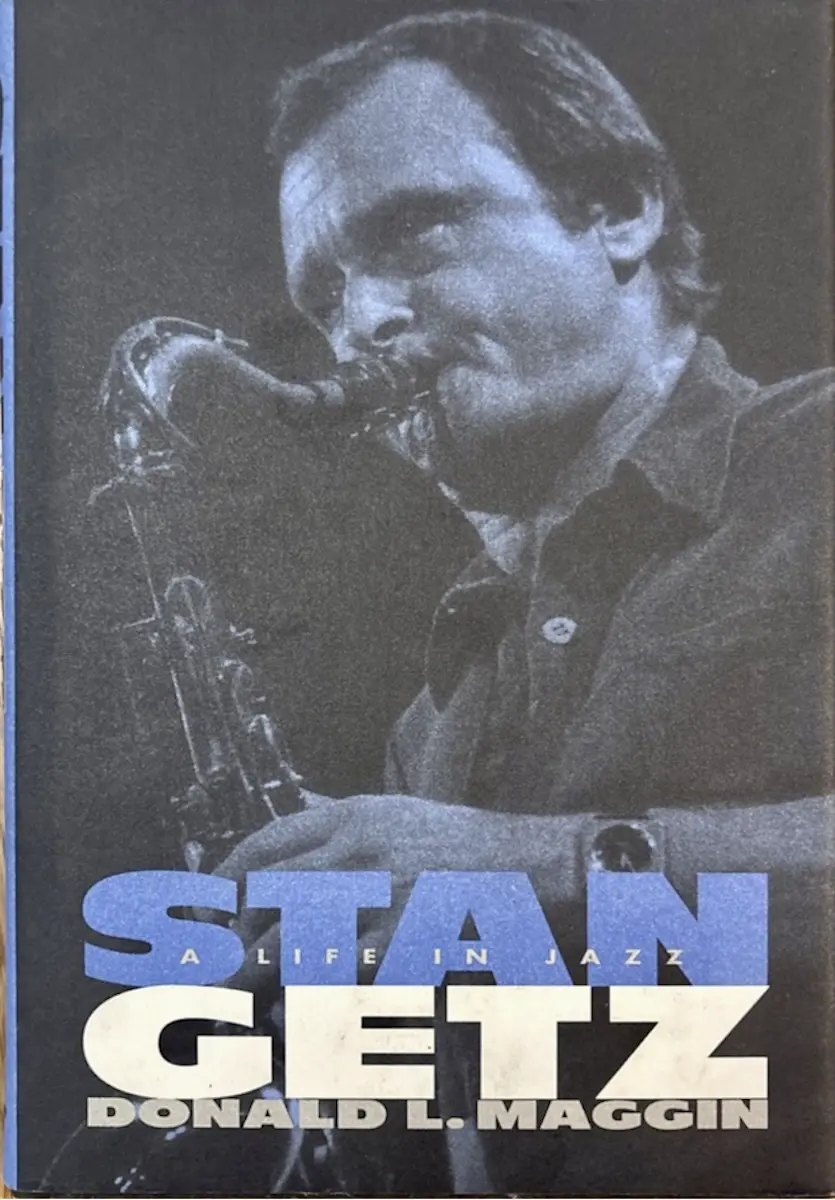
This impressively substantial biography of the greatest tenor of them all occasions mixed feelings in me. To accentuate the positive first: it is densely researched and thus highly informative, fascinating if often harrowing about Stan’s marital and family life, near-comprehensive in its coverage of Stan’s recorded work and generally very well written (though I wince every time at that ghastly US illiteracy ‘different than’). Certainly, any Getz enthusiast will get a lot out of the book, and I suppose that is a recommendation enough. I have two major reservations nonetheless. Although the many intimate revelations are arresting, they rarely seem complete because Maggin makes no attempt to explore the reasons for Getz’s often appalling behaviour other than to ascribe it to the twin evils of drugs and booze. As a result, the narrative is cumulatively reductive, and the family – in particular Monica Getz, who apparently referred to herself as ‘the Mother Theresa of jazz’ – seem to have been almost unbelievably long-suffering. I do not doubt the truth of Maggin’s accounts but they increasingly fail to satisfy.
A related and further cause for regret is the paucity of anti-Getz comment from his fellow musicians. Towards the end of his life, when he’d at last quit drinking for good, Stan told Herb Ellis that he was going to call up everyone he’d ever been bad to and square things with them, to which the guitarist replied tartly ‘I hope you’re not going to use a pay-phone.’ One would like that marvellous anecdote given proper chapter and verse – not out of a masochistic desire to hear a hero bad-mouthed, but from considerations of balance and the whole picture. It stands to reason – as Ellis’s reaction confirms – that Stan can’t have been ‘difficult’ only with his family, and while the many tributes by musicians to his genius, caringness as a boss and open-mindedness to the ideas of the young are of course as justified as they are cheering, the portrait is one-sided and once again incomplete. Lastly in this ‘Stan the Man’ section, Maggin disappoints in his cursory attempt to explain how a man who was so impossible (indeed downright ugly) at times could produce – time after time, year in year out – music of such ravishing and profound beauty, at once lyrical, tender, pulsatingly affirmative and, in a word, lovely. I’m not saying there is an answer – it has bewildered me all my Getzophile life – but one wishes that the question had been more searchingly addressed.
My second major criticism is that there is hardly a new insight about Getz’s music. Maggin warmly acknowledges the work of Steve Voce, Alun Morgan, Ron Kirkpatrick and myself (though not Neil Tesser, on whose superb sleeve-booklet accompanying the four-CD The Bossa Nova Years he appears to draw extensively) and I wonder why he quotes us so often rather than trust his own ears and judgement. Furthermore, the separate mysteries of precisely how Stan arrived at his sound, and why nobody (apart perhaps from altoist Paul Desmond) has ever been able to approximate it, are also left unilluminated.
A final observation – more a quibble than something crucial – would be that Maggin lays great stress on Getz’s showing in the various jazz polls across the years without explaining why he bothers with such ephemera. Did Getz himself care that much about them? If so, fine; but Maggin never demonstrates any such concern: he just prints the information and leaves us to infer that it mattered to his subject.
In sum: the value – which for all my reservations is considerable – of this book lies in its wealth of information and piecemeal insight rather than as a truly rounded and authoritative appraisal. That said, it may be many years before the proper sense of distance often required for a definitive biography transpires in Getz’s case, and in the meantime Maggin’s work is to be welcomed. Incidentally, its publication is accompanied by a Verve CD bearing the same title whose programme was selected and annotated by Maggin and which is reviewed in this issue.
Stan Getz – A Life In Jazz, by Donald L. Maggin. William Morrow, hb, 417 pp; illustrated, £18.99. ISBN 0 688 12315 5