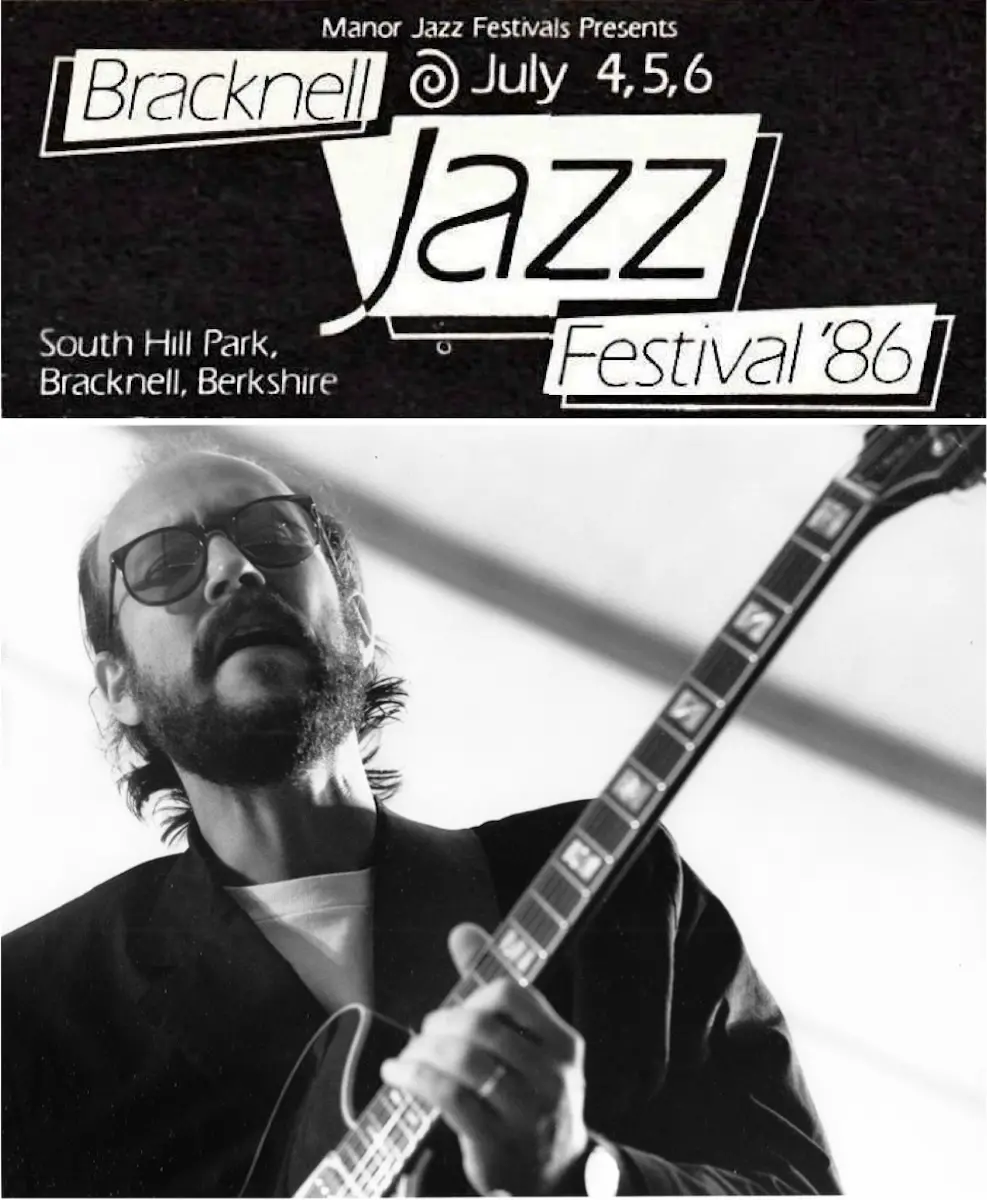
FRIDAY – The opening night of this year’s festival, which was sponsored by Red Stripe, got off to a slow start in the main tent with a fairly lacklustre performance from vocalist Carmel, who dabbles in things pertaining to the ‘crossover’ field; most people had turned up to hear another outing by the hugely popular Charlie Watts Big Band.
Sporting on this occasion 34 pieces, the band kicked off with Skyliner into a mad whirl of big band standards delivered with awesome power and no little enthusiasm. Inevitably there were ragged moments but bearing in mind the lack of rehearsal time for an aggregation of this magnitude, these were really rare. Apart from the three drummers – Watts, the magnificent John Stevens and Bill Eyden – just about everybody got at least one solo, many of them of the rabble-rousing, crowd pleasing variety but under these conditions perfectly appropriate.
Robbins’ Nest swung mightily, all the trombones given the chance to show their paces and Danny Moss coming on like a tenor giant, using that big tone to good effect. Love Me Or Leave Me had a forgettable vocal which was soon erased from the memory by Bobby Wellins’ sensitive reading of Midnight Sun.
The trumpet section took over Stompin’ At The Savoy as their own, with Dave DeFries heading into the stratosphere, but everything came down to earth for singer Gail Dorsey’s more than creditable rendition of Spring Can Really Hang You Up The Most. A six tenor tear-up brought things to boiling point again and Ray Warleigh barely nodded to Bostic in a particularly effective version of Flamingo.
The Flying Home finale proved to be slightly anticlimactic but in no way marred the overall impression of an evening enjoyed by audience and musician alike. Charlie Watts may not be the outstanding member of the outfit he leads but he sure as hell deserves congratulations for getting together such a disparate bunch of musicians in such a worthwhile project. Where else could you see tenor players Courtney Pine, Evan Parker, Bobby Wellins and Danny Moss sitting in a section together? – Pete Gamble
SATURDAY – Jazz is all about sleazy, smoky subterranean late nights, of course, and Bracknell did not overlook this important aspect of the jazz craft, laying on nocturnal binges on Friday and Saturday. Among those featured were the meteoric Courtney Pine, the r’n’b flavoured Team Ten, Lennie Best, Dick Morrissey, Kathy Stobart, Gail Thompson, Voice Of God III, Norma Winstone and Jeff Clyne.
Saturday lunchtime saw the start of the festival proper, with a wealth of major concerts in the marquee and the new Wilde Theatre. Iain Ballamy’s Quartet, featuring the ubiquitous Steve Arguelles, on drums, Django Bates on keyboards and Mick Hutton on bass tuned us into their vaguely bizarre vision of modern jazz, epitomised by the jagged Rats On Stilts, which owes its title to those rodent-like toy dogs beloved of elderly dowagers. Guitarists Gary Boyle and John Etheridge hewed a straighter course, and together with Nic France (drums) and Dill Katz (bass) ran the changes on a series of bop and fusion standards and originals. The accent was on things American and their choice of John Scofield’s Looks Like Meringue was an appropriate preface to an appearance by the ex-Miles guitarist later in the day.
Next came Lol Coxhill and friends in Standard Conversions – not a firm of building contractors but a group that took a sidelong glance at familiar jazz material, and as is the true jazz man’s wont, could not resist the temptation to distort, parody and ridicule.
Fully recovered from the previous evening’s Watts extravaganza, drummer John Stevens led his own bebop and free jazz fusion band, called, sensibly enough, Freebop. Amongst other things, the band provided a platform for a headturning dogfight between British free jazz veteran, Evan Parker and young Turk Courtney Pine.
Meanwhile, in the contemplative cool of the Wilde Theatre, Eberhard Weber went solo after a set with Ian Carr and the Kreisler String Orchestra. He coaxed lugubrious arabesque melodies from his skeletal upright bass, including items from his recent ECM album, Chorus. In the absence of other instruments, he supplied his own counterpoint and imbued his line with a surprising degree of rhythmic variety.
Round about teatime percussionist Nana Vasconcelos meshed intuitively with ex-Ornette drummer Ed Blackwell in a quintet by the name of Nu, which was completed by Mark Helias (bass), Don Cherry (trumpet) and Carlos Ward (reeds). Cherry was outstanding, spinning a line that made scant reference to the past; Ward was a little less surprising, but formed a fine foil for the revivified Cherry.
Saturday’s two finalists could have been transposed to provide a more dramatic climax. Colourful and energetic as Loose Tubes can be, their special festival commission was rather circumspect, and didn’t generate the same head of steam as the preceding set by the John Scofield Band. After Scofield’s storming marathon, with the heat at 90C from the opening bar, the Tubes seemed a bit leaky, and the pressure dropped. Later in their set they did reprise some of their old chestnuts, but for all the fine musicianship their zaniness is beginning to wear thin.
Scofield doesn’t bother too much with showmanship, but the intensity of the music gave him stage presence enough. The set was based around Still Warm, his latest Gramavision album, and the live situation allowed him time to elaborate on that showing. We heard the familiar monstrous mutations of rock, funk and bebop, but the sensitive acappella reading of Georgia which closed the set said it all. – Mark Gilbert
SUNDAY – The Sunday programme got under way with a healthy slice of provincial fusion from Bullitt, an 11-piece Bristol band. What came next turned out to be the best act on the main stage all day. It was a weekend of good tenor players but Tommy Smith, with his hard-driving, Trane sounding style, was the player who most disturbed Bracknell’s day of rest. He showed himself to be a mature saxophonist prepared to attack his material vigorously and, as part of the four-piece Forward Motion, he provided an early afternoon shake-up that deserved a later billing.
Pianist Chris McGregor took the inside lane. He played tunes and spiced them with the flavour of his native South Africa. His tenor Bheki Mseleku was an assertive, straightahead player although his solos had a certain sameness about their development and, perhaps as a result, the set lacked a little in variety. Third Kind Of Blue flattered only to deceive. The young Americans seemed rather too concerned to reproduce the sound of their recent record and this meant rather too much of drummer Ronnie Burrage’s vocal efforts. Reedman John Purcell played well on soprano and tenor, but the trio were only strong when he was soloing and when Burrage and bassist Anthony Cox were surging from the back in their orthodox roles.
A far more balanced set stole the honours in the adjacent Wilde Theatre. A quartet with trumpeter Bobby Bradford, reed man Frode Gjerstad and the reliable rhythm team of bassist Johnny Dyani and drummer John Stevens played an immaculate set to a near full theatre. Dyani busied himself throughout and, with Stevens his normal urgently propulsive self, the rhythmic backdrops contained just the right amount of sword play. The front line were inventively composed rather than wild, with Bradford conjuring up some lovely free patterns and Gjerstad avoiding jagged edges as he stretched out in his solos.
Back in the tent, Maggie Nichols and Pete Nu made their own contribution to the fencing simile as voice and piano sparred through a wide range of bouts that took us from near straight to abstract. They were followed by Full Circle, a band that suggested its all round ability but, on the day, became a backing group for the uncomplicated talents of trombonist Rick Taylor. Fortunately, he was on a musical ‘high’ and he generated a tremendous atmosphere in time for the star attraction.
In the event, this was perhaps something of a let-down. Again the need seemed to be that of getting as near to the studio sound as possible. The Randy Brecker/Eliane Elias Group, with Jukkis Uotila on drums and the talented Barry Finnerty on guitar, looked well equipped to provide a rousing climax. Instead they played a safe set, the rhythm took the comfortable fusion route and Elias’ piano solos were tidy rather than inspired. Brecker played well but there were few surprises in his solos. It was as if he wanted to avoid mistakes rather than allow them to take him into uncharted territory. The audience seemed well enough pleased though there were a few drifting away before the finish.
As always the show was presented by the inimitable Lol Coxhill, who joked, played, remonstrated and introduced as can nobody else. Somebody backstage asked me if I had seen Lol Bracknell. I took it as a Freudian error. – Barry McRae