
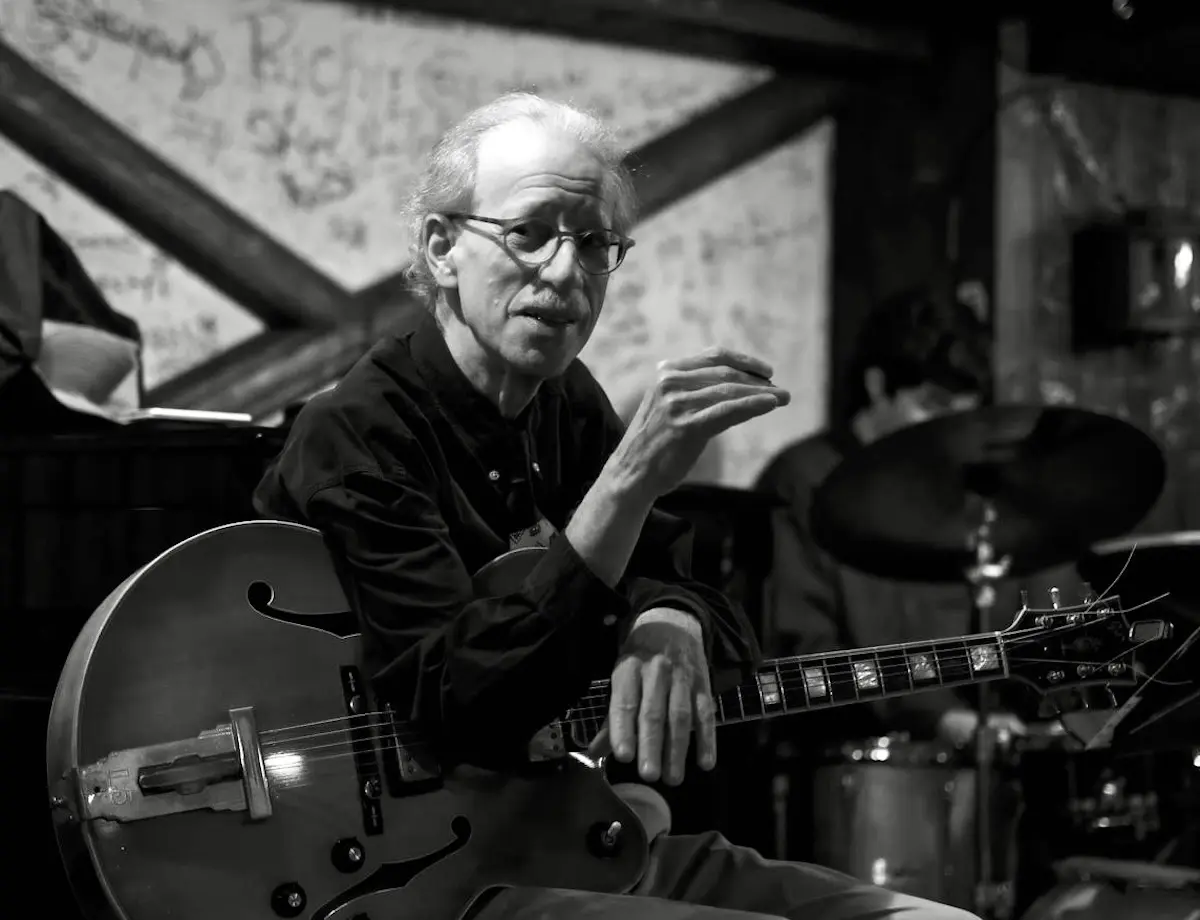
Joshua Breakstone Quartet: Wonderful!
In his brief sleeve notes, Joshua Breakstone regrets not being able to advise his younger self about phrasing and use of space as well as listening to and working more closely with his fellow musicians. He was to address these elements subsequently but hearing this early album by him, none of these are obvious. What we have is a balanced piece of work.
The material is a mixture – a couple of standards (’S Wonderful – incorrectly rendered on the cover, as so often, as S’Wonderful – and Time On My Hands), two from his personal influences (Django’s Castle and Tristano’s Two Not One), originals by him, both expansively bebop and taken at a fast tempo (Sevens-Up and This Is It), and a 10-minute version of Tadd Dameron’s Soultrane (here referred to as Soul Train).
Always a precise, thoughtful player, Breakstone delivers with his usual clear single-note lines, intense but without histrionics, and avoiding anything that might clutter or compete with the piano. Barry Harris more than compensates with his clusters of chords and the result is the perfect foil for Breakstone. Oddly enough, despite their obvious rapport, on future albums Breakstone favoured Kenny Barron as his preferred choice.
Stylistically, Breakstone follows a path which ties a mainstream approach, clear of the distractions of fusion or rock, with the great tradition laid down by players such as Jimmy Raney, Tal Farlow, Johnny Smith, Wes Montgomery and Grant Green.
Originally recorded for the Sonora label, the album was apparently recorded in a very short session, due to studio problems, and as a result it has an immediacy and freshness. It heralded the start of an impressive career for the guitarist, although often underrated and possibly underappreciated. Perhaps this will serve as a catalyst and trigger a re-evaluation of a melodic and imaginative player.
Discography
S’Wonderful (sic); Soul Train (sic); Sevens-Up; This Is It!; Time On My Hands; Two Not One; Django’s Castle. (43.58)
Breakstone (g); Barry Harris (p); Leroy Williams (b); Earl Souls (d). NYC, 24 May 1983.
Capri Records 71006-2
Art Pepper: The Return Of Art Pepper
Generally not regarded as highly as other Art Pepper albums, and unfairly compared with those made later for Contemporary, it’s hardly surprising this might not be quite up there, coming at one of the worst periods of Pepper’s diabolically chaotic life.
Released from serving nearly two years in Terminal Island penitentiary in late spring 1956, Pepper was in an abyss. His marriage (to Patti) had failed, he was estranged from his daughter Patricia, lost his house and car, was physically strung out and was trying to piece his life together. His situation was widely publicised, not least in the brutally frank interview with John Tynan in Downbeat (September 1956). His first gig was at Paul Nero’s Cottage in Malibu in June 1956 and he managed to scrape together a few recording sessions for Shorty Rogers and with Chet Baker (Playboys, on Pacific Jazz).
On his first night at Jazz City he met Diane Suriaga, with whom he was to live in a turbulent relationship for several years, although Pepper himself valued it for helping get his self-respect and career back: “Diane gave me back my life,” he told Downbeat in January 1958. It wasn’t to last. Old habits die hard.
This album, recorded in August 1956, saw him with a solid line-up. Pepper Returns, a fast number based on Lover Come Back To Me, sees them go through their paces, guided by Shelly Manne, lively and responsive in his set of fours. Pepper is slightly understated on Broadway, almost reticent, but it helped having Freeman, Vinnegar and Manne as the rhythm section, as they’d played together regularly and they drive the band along.
The slow ballads are significant in showing a glimpse of Pepper’s fragility, anguish teetering on the edge, then the ability to recover, finding inner depths to cut through and run off a salvo of rapid-fire notes (You Go To My Head); others simply express heartfelt sorrow and tenderness (Patricia).
Sheldon injects a degree of lightheartedness through odd trills, bent notes and asides, as he and Pepper play off each other (Five More), but for me, the picks of the session are Minority, with straightahead contributions from Pepper, Sheldon and Freeman, and Walkin’ Out Blues, on which Vinnegar provides the platform for their solos.
A worthwhile addition to any collection, even when not considering the context in which it was made. Despite the dissipation, and maybe a reaction against it, a spark is there, waiting to be ignited. As usual on Jazz Wax, the sound is very good and the original cover is used. Of the sombre photo by William Caxton, Pepper admitted he was “sick . . . unable to score . . . he snapped this picture of me in agony.” (Straight Life, 1979)
As an extra track, Raising Caen is included, with a Pepper solo, from André Previn’s film soundtrack to Jack Kerouac’s story, The Subterraneans.
Discography
(1) Pepper Returns; Broadway; You Go To My Head; Angel Wings; Funny Blues (23.06) – Five More; Minority; Patricia; Mambo De La Pinta; Walkin’ Out Blues; (2) Raising Caen (25.59)
(1) Pepper (as); Jack Sheldon (t); Russ Freeman (p); Leroy Vinnegar (b); Shelly Manne (d). Hollywood, 6 August 1956. (2) Andre Previn (p); Red Mitchell (b) replace Freeman and Vinegar. Hollywood, November 1959.
Jazz Wax 4648
Ernest Ranglin: The Indispensable, 1958-1962
Jamaican guitarist Ernest Ranglin started his musical career as a youngster in the late 40s but first recorded with calypso band The Wrigglers and several of their numbers are included on this anthology of his early work.
He veered towards rhythm & blues and jump music with Theophilus Beckford’s City Slickers, which at various times included pianist Monty Alexander (with whom he established a long musical friendship) and trombonist Emmanuel (Rico) Rodriguez, who was later to gain wider recognition with Count Ossie, Georgie Fame, The Specials and others – he can be heard here soloing on Silky.
Ranglin tends to provide a rock/R&B guitar sound over a ska beat for Beckford, although his blues playing is never far away, as heard on Jack And Jill Shuffle. The raunchy tenor sax of Roland Alphonso is also featured, Don’t Want Me No More indicative of his style of delivery; it’s one of several songs in which Beckford sings of his trials in relationships.
The accompanying booklet mentions the importance of Chris Blackwell. He came on the scene in Jamaica as a young producer (and, later, founder of Island Records), responsible for Ranglin’s debut album Guitar In Ernest (1961). The seven trio tracks are included here, taking up 35 minutes and well worth getting. Showing great finesse, lyricism and swing, Ranglin isn’t far away from the style of Wes Montgomery in his single-note runs and block chords. There’s a long version of Tenderly, played true to its title, and appropriately Dexter Gordon’s Ernie’s Tune. Although Dahoud is credited to Ranglin, it’s Clifford Brown’s 1954 Daahoud.
The album is filled out with a few oddities, all with a guitar solo. Although the booklet suggests it’s Monty Alexander playing piano on Yellow Bird by the Sonny Bradshaw Quartet, it’s more likely to be trumpeter and multi-instrumentalist Bradshaw, also a pianist, here soloing and gently interacting with Ranglin – there’s no indication otherwise on the original 45 rpm Duke record label, and anyway, Alexander would have been very young at the time.
Unfortunately there are no details of the horn section for Azie Lawrence’s expression of homesickness on the jazz-orientated Jamaica Blues. For film buffs there’s the Cecil Lloyd Group’s version of the theme from Exodus and The Boy’s Chase, from the Dr. No soundtrack, on which Ranglin played.
A good representation of Ranglin’s early work but most noticeable for the fine Guitar In Ernest inclusion.
Discography
(1) Bloodshot Eyes; Calypso Medley; Don’t Touch Me Tomato; Limbo; (2) Georgie And The Old Shoe; Jack And Jill Shuffle; Don’t Want Me No More; She’s Gone; That’s Me; Silky; (3) Jamaica Blues; I Want To Be In Love; (4) Ernie’s Delight; Tenderly; Drink To Me Only With Thine Eyes; Ernie’s Tune; Polka Dots And Moonbeams; One For Fred; Dahoud; (5) Yellow Bird; (6) Exodus; (7) The Boy’s Chase (79.10)
Ranglin (g) with (1) Denzil Laing (v) and The Wrigglers. (2) Theophilus Beckford (v) & the Blues Blasters (aka The City Slickers) inc. Roland Alphonso (ts); Monty Alexander (p); Emmanuel Rodriguez (tb). (3) Azie Lawrence (v) & unknown musicians. (4) Thaddy Mowatt (b); Tootsie Bean (d). (5) Sonny Bradshaw (p); Mowatt (b); Bean (d). (6) Cecil Lloyd (p) & his Group. (7) Monty Norman. Jamaica, 1958-1962 except (7) London, 1962.
Frémeaux & Associés FA5920