
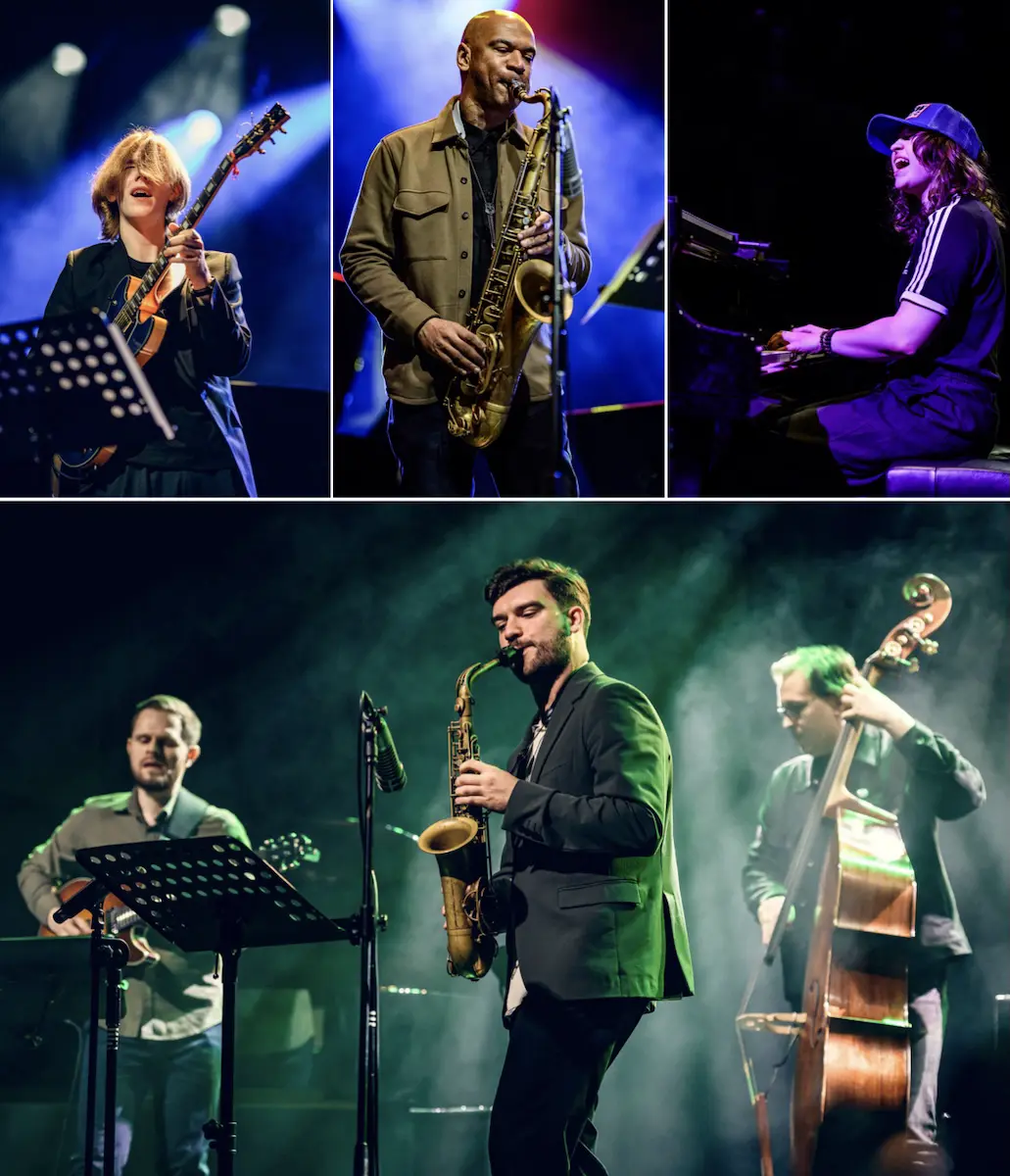
The second edition of the Kalisz Ptaszyn Fest, held 21 March 2026, confirmed that this young festival, organised by the Centre for Culture and Art in Kalisz, has ambitions that extend well beyond commemorating Jan “Ptaszyn” Wróblewski. While firmly rooted in the legacy of its patron – one of the towering figures of Polish jazz – the festival also embraces another, equally important aspect of his work. Throughout his career, Ptaszyn was a tireless advocate for emerging musicians, introducing generations of new talent to audiences through his long-running radio programme Trzy Kwadranse Jazzu (Three Quarters Of An Hour Of Jazz). Fittingly, the second edition once again placed young artists at the heart of its programme, demonstrating that Ptaszyn’s music and ideas continue to resonate with a new generation of jazz musicians.
Opening the evening was the BMB Quintet, a remarkably young ensemble comprising 17-year-old guitarist Bartosz Wawrzyniak, 19-year-old double bassist Piotr Helwing, 20-year-old tenor saxophonist Bartosz Dorosiewicz, and two musicians from Kalisz: 17-year-old pianist Maciej Kujawa and 17-year-old drummer Borys Wdowczyk. Their set drew entirely on the music of Jan Ptaszyn Wróblewski, with original arrangements of Driving, Mack The Knife, Pokaż Dołeczki, Głód Na Pokładzie, Jakie Chcesz Mieć Dzisiaj Sny? and To Kiss The Ivory, followed by Zielono Mi as an encore.
Any initial nerves soon disappeared, giving way to confidence and a refreshing sense of adventure. Rather than treating Ptaszyn’s compositions as museum pieces to be carefully preserved, the young musicians used them as raw material for narratives of their own, opening up space for improvisation and reshaping familiar themes with considerable freedom. In that respect, theirs was an ideal opening set, encapsulating the festival’s central premise: tradition not as a fixed set of rules, but as a starting point for further exploration. What stood out most was the group’s youthful energy and the sheer pleasure they took in playing together – qualities that easily outweighed their understandably limited stage experience.
Next came the Kaczmarczyk/Tokłowicz “Ptaszynology” Quintet, featuring Michał Kaczmarczyk on guitar, Dawid Tokłowicz on saxophone, Mateusz Kaszuba on piano, Michał Rutkowski on double bass and Artur Małecki on drums. Their point of departure was the almost forgotten 1959 album Kwintet Barowy – Do Widzenia, a fascinating excursion into the early history of Polish jazz and a reminder of how much music from that period still awaits rediscovery.
Most of the programme featured new arrangements by Dawid Tokłowicz, including Do Widzenia, Zielonooka Dziewczyna, Medium Swing, Marracca, Figlarny Nosorożec, Bandoska In Blue, a standard by Ben Oakland and Oscar Hammerstein II, and the closing Milion Złotych. The sole departure from the album was Zakochana We Śnie, arranged by Michał Kaczmarczyk and originating from a long-lost session by the Jan Ptaszyn Wróblewski’s orchestra with Irena Santor, rediscovered only decades later. The quintet returned for an encore with Ulice Wielkich Miast.
There was nothing overly reverential about their approach. The musicians remained faithful to the stylistic character of the material while filtering it through a contemporary harmonic and improvisational sensibility. Tokłowicz and Kaczmarczyk fashioned a coherent arranging language in which respect for the originals never became a constraint. Humour, lightness and an easy swing ran throughout the performance – qualities deeply embedded in Ptaszyn’s own musical personality. Here, too, tradition was not the destination, but a springboard for something new.
The final set belonged to Hania Derej and her trio, joined by special guest Walter Smith III. Derej was already familiar to the Kalisz audience from her appearance at the festival club during the 51st International Jazz Piano Festival which also takes place in Kalisz. This time she arrived with a new trio featuring Mateusz Szewczyk on electric and double bass and Gniewomir Tomczyk on drums, fresh from a concert tour of Mexico that had concluded immediately before their Kalisz appearance.
The programme centred on Derej’s original compositions – Hope, The Closer The Farther, RUSH, Now It’s Okay, Life In Upside Down, Remember and Don’t Look Behind – alongside three pieces by Walter Smith III: Pup Pow, Misanthrope’s Hymn and the encore, ACE.
Derej’s set was easily the most contemporary and stylistically open of the festival. Moving between contemporary jazz, fusion and the electric textures of keyboards, the music remained spacious enough to allow improvisation to shape its direction. At times, the interplay seemed almost telepathic, perhaps reflecting the musical rapport developed during the preceding tour. Walter Smith III, meanwhile, was never simply a star name added to the bill. From the first notes, he became an integral voice within the ensemble, engaging in a particularly absorbing dialogue with Derej’s piano. There was a palpable sense of music being created in the moment – alive, unpredictable and driven by the musicians’ collective energy.
The second Kalisz Ptaszyn Fest ultimately confirmed the strength of the concept established by its organisers. Rather than relying solely on established names, the festival continues to place younger musicians at the centre of its programme, inviting them to engage creatively with the work and legacy of Jan “Ptaszyn” Wróblewski. The result is something more meaningful than simple commemoration. Ptaszyn’s legacy is not preserved as a monument to the past; it is allowed to evolve, inspire and generate new music. And that may well be the festival’s greatest strength.
Text and photos: Szymon Ratajczyk (ratajczyk.art)
Editor: Damian Kacprzak