(A later, 1996 interview by Mark Gilbert with Wayne Shorter, alluded to in the introduction above, is here.)
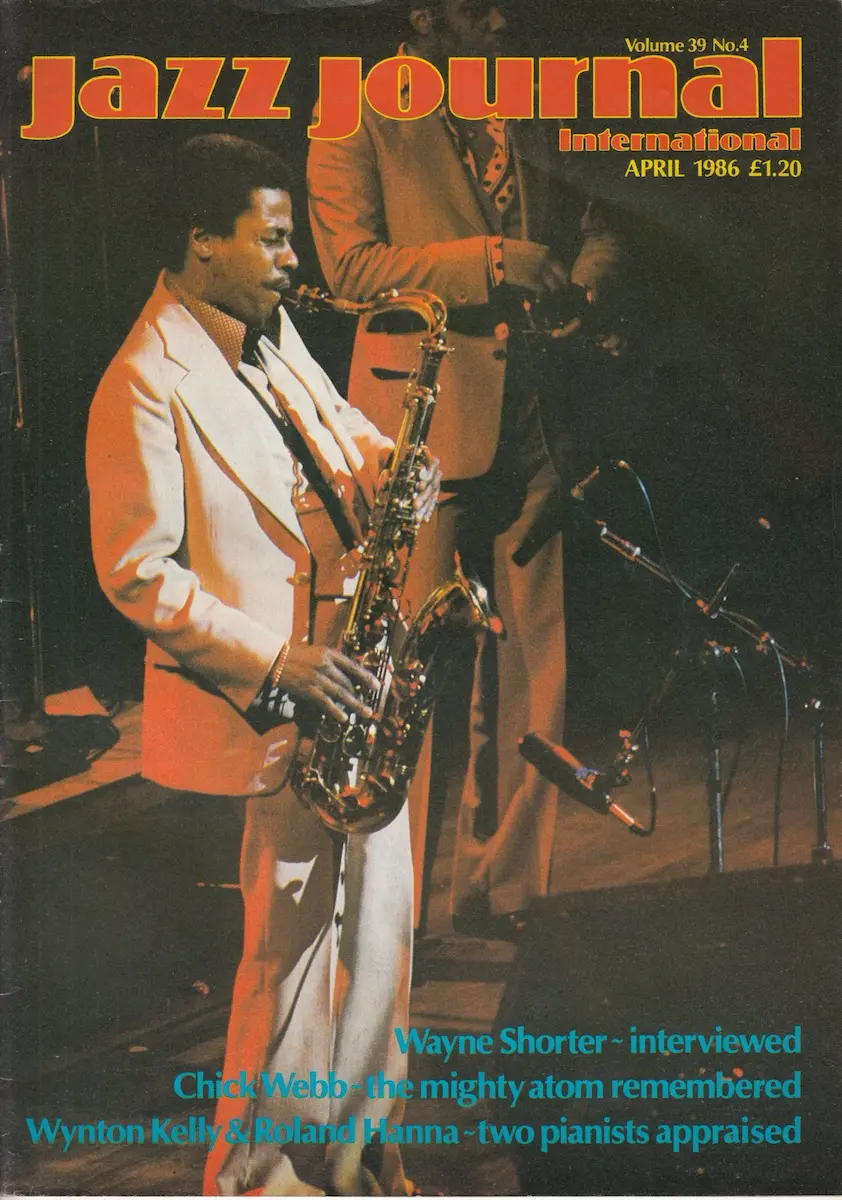
Late last year, Wayne Shorter played two sets at London’s Logan Hall with his new electric band. The second house in this modestly sized venue almost drew a respectable audience, but the first was so poorly attended that it was enough to make you believe the accepted wisdom that he’d had his best days in the early sixties. Certainly, with the benefit of hindsight, we can see that his achievements between 1959 and 1969 with Art Blakey, Miles Davis and as a leader on Blue Note were unique in modern jazz and established him as a pivotal figure. This emphasis on his early phase is not intended to devalue the ground breaking efforts of Weather Report, but it seems fair to suggest that much of Shorter’s work with Zawinul was an extension of a musical vision that was already fully matured by 1965.
Perhaps the most cogent and concise assessment of Shorter’s art is to be found in the recently published second edition of Mark C Gridley’s Jazz Styles: History And Analysis (published by Prentice-Hall) and readers are urged to consult the relevant passages themselves. I am indebted to Mr Gridley for inspiring the following brief synopsis of Shorter’s work.
One of the most striking things about Shorter is that as far as jazz is concerned he seems to have been much more influence than influenced. Gridley draws several comparisons between Shorter and Lester Young, one of which suggests that because both have rather obscure roots, they might be the most original improvisers on their instrument. During the early sixties, Shorter quickly grew into a distinctive improviser, expunged bop licks from his playing, developed an economic ‘floating’ phraseology and extended his range of peculiarly saxophonic expressive devices, using various kinds of attack and tonal manipulation. These were indeed significant and influential developments, but we should not forget that Shorter was also an extremely original composer, who effected a complete revision of style, affecting structure, chord movement, rhythm and melody and the relationships between these elements. His innovations were not piecemeal additions or alterations to mainstream tradition, but rather embodied a wholesale shift in perception.
However, though he may strike us as highly singular, few could honestly believe that Shorter developed in a musical vacuum, without any precedent, and it was with this notion uppermost in my mind that I spoke to him last October.
Shorter was born August 25th, 1933 into a family of non-musicians in New Jersey and raised and educated there. His first encounters with music seem to have resulted from a fascination with movies and soundtracks and childhood attempts to mimic the fantasy world of films:
‘I think it started with going to the movies. My brother and I used to get up in the middle of the night, at two or three o’clock. We’d sit up in the bed and rock back and forth and imitate what we had heard in the movies. Like, the sound effects – we’d soundtrack the things we’d seen. And then we’d make up plays, create names and characters. We wished we could fly like Captain Marvel, but couldn’t, so we put music to the idea. I guess Mozart and his sister did the same thing. He’d do the music and she’d do the libretti. I think Joseph Haydn did it too, with his father. Of course, we didn’t know these would be the building blocks for a life’s profession. We had no intentions of becoming musicians. I was supposed to be a painter.’
‘So bebop was the word that was hitting me, and the music had a velocity in there, something that meant more than music to me’
Shorter’s description of his early involvement with sound rather than music per se was one of several abstract explanations of his musical origins. It often seemed that he was unaware of specific musical precedents for his style. However, by his mid-teens he had discovered jazz, in form if not name:
‘When I was in my mid-teens, the word “jazz” wasn’t really part of my vocabulary. But my father would listen to a programme on WNEW called Make Believe Ballroom, with Martin Block, and he’d play Billie Holiday, Fletcher Henderson, Chick Webb, Bobby Sherwood and so on. Then one night he said “I’m gonna play something different” and it was Thelonious Monk. Then he played Charlie Parker. He said “This new music is called bebop”, and then played Bud Powell. So bebop was the word that was hitting me, and the music had a velocity in there, something that meant more than music to me. It was the same kind of velocity that would go on in certain sections of a symphony, but with bebop, this velocity was all in a box – you could take it in your lunch pail!
‘The differences and samenesses of types of music didn’t seem to matter – that wasn’t an impact. It was something that was all-inclusive. When I was growing up, I didn’t separate classical from jazz. I separated music that made me feel real sad from music that made me feel good. If I heard something that made me feel sad, I’d leave the room. For instance, on Sunday my father would put on that sanctified church music. I had to leave the room, get out of the house. He also liked cowboy music, like Crash Corrigan, and I suppose the nearest I got to separating music would to isolate cowboy music.’
Shorter’s eclecticism and love of cinematic fantasy might go some way to explaining the originality, spaciousness and dream-like qualities of his work, but another possible influence that has been cited is 20th century classicism, and indeed Shorter did enjoy a specialist classical education. I suggested that impressionists like Ravel and Debussy might have had an effect on him, but he was reluctant to specifically connect the ‘floating’ aspect of his styles to that school.
‘In my last year at high school in Newark I did a fine arts major, but I minored in music under Achilles D’Amico. Achilles’ observations were what really caught my attention’
‘You might say that floating thing of mine is the kind of thing I like through the whole history of movie soundtracks. Also the philosophy, the way things have gone in music. In my last year at high school in Newark I did a fine arts major, but I minored in music under Achilles D’Amico. One day in class he had three albums, and he said “Music’s gonna go these three ways.” He held up Stravinsky’s Rite Of Spring, a Charlie Parker record and a record by a female Peruvian singer with a seven-octave range. Then he said “OK, let’s begin class” and started teaching harmony. He reminded me of Toscanini; he was a good conductor, and we would do parts of operas like II Trovatore. Then someone in the back would be practising bebop. Achilles would hear it and say “You do that at the dance on Friday.” Achilles’ observations were what really caught my attention.’
After high school, Shorter attended New York University for four years and majored in music education: ‘The idea was to teach, and see my mother and father smile.’ The course dealt entirely in classical music and based all discussion of theory on classical precepts. Shorter said: ‘There was no jazz department at all, but they had guest artists who would come in and play. I remember one time Cootie Williams visited us.’
The seeds of Shorter’s compositional style appear to have been sown by that time, as the following tale illustrates: ‘We used to have to write something like modern harmony players, and the opening of Elegant People came from a little thing that I wrote then for one of my teachers. I played it to her on the piano and she objected because I’d mixed styles. I said to myself “What’s wrong with mixing styles? If you don’t know you’re mixing styles, what’s wrong with it?” But she was trying to get me to follow the prescribed route for final examination time. They think you have to know one style from another if you’re teaching kids.’
When he left NYU, Shorter did military service in New Jersey and played in the army band. ‘Some of those guys were like 20-year guys. They had it, but let it go, just by staying in the army. The army became their mother and father and they became afraid of the outside and admitted it. They’d say “Look at me, I’m a big bad soldier, but I’m afraid to go out.”’
While he was in the army, around 1957, Shorter met Coltrane in Washington, while the latter was playing with Miles, Cannonball Adderley and Abbey Lincoln, but it wasn’t until he’d left the army and joined Horace Silver that he got to know Coltrane more closely. I asked him about similarities in their playing.
‘Trane and I used to talk, and he’d say “I wish I could talk backwards. It’d be really nice if you could start a sentence in the middle and go both ways at the same time”’
‘While I was working with Horace one Sunday afternoon, Coltrane’s wife came up to me and said “I want you to meet my husband. We’ve been following you.” John came up, and she said “You all got something in common.” She didn’t say that we played alike, just that we had something in common. Trane told me “You play that funny kind of stuff all over the horn.” He didn’t say “You play like me” but “We both playing some funny stuff.” I started to go over to his house. I remember it was November, because my mother cooked a Thanksgiving Dinner and invited Trane and his wife over. She’s never forgotten that to this day. She said “They were a nice couple”.
‘Trane and I used to talk, and he’d say “I wish I could talk backwards. It’d be really nice if you could start a sentence in the middle and go both ways at the same time.”’
Had Shorter any idea why Trane’s wife should think they were coming from a similar direction?
‘I don’t know. We didn’t really talk about music. Like, I’d sit down at his house and play the piano and he’d play the saxophone. I’d go anywhere on the piano, then he’d sit down and play the piano, and I’d play my horn. We’d talk about different things. I think Trane would have loved science fiction, or did, especially the way it’s gone today, with Steven Spielberg and all that stuff. That would have been another of his involvements, besides the religious experience.’
Though he’d spent time with Silver and Maynard Ferguson after the army, it was Art Blakey who gave Shorter his first big break. I wondered if he’d felt conscious of the novelty of his compositions in those early days. Did he feel any sense of trepidation in presenting these unusual forms to a band?
‘Yeah, I kind of wondered. When I joined Art Blakey, we did a couple of things of mine, Lester Left Town and Sakeena’s Vision. We played them live, and then went into the studio to record them for Blue Note, and Alfred Lion said “I wonder if this is too avant-garde? Can you give me some grease?” in his European accent. And Art Blakey said, and this is what I like about Art: “This is my band, and we’re gonna do these tunes.” No matter how different something was, Art would stay with it, perhaps because he was formerly with Monk, who had some tricky and odd accents. Art knew the uncanniness of what was happening, and he protected it. He said “This music must be recorded.” In any case, if Blue Note hadn’t done it, there were Impulse and Riverside waiting in the wings.
‘When all those records came out, I didn’t know that they would be thought of as classics or ABCs of modern jazz. Most of those tunes came just like that – real quick. And if anything was behind them, it was like a wish, that was manifested musically: maybe a wish for eternity or a beautiful girl.’
Shorter’s recent CBS release, Atlantis, is his first date as leader for 11 years, and marks the suspension of his activities with Weather Report.
‘As far as Weather Report is concerned, the audience will probably get the best of what they like in the band from us as individuals now. My new record doesn’t sound like Weather Report, and the only similarity I can see is that I’ve done the writing.
‘If we’d stayed together as Weather Report, it would have been another 11 years before I’d had time to do my own thing. You know, life is so vast that you can stay together so long, but like brothers and sisters, you can’t stay together all your life. There is so much that people would never find out or enjoy – things can’t be done that way.’
Over the years, Shorter has developed a reputation as being a reluctant interviewee, which might account for the apparent absence of any major feature on him in JJ over the past 25 years. Now, says Shorter, things have changed:
‘In the last year I’ve been doing quite a lot of talking, because this is a new project and a new me. There’s a definite happening in my whole life now. I’m still practising Buddhism, which I picked up about 13 years ago. Then I was told that things would manifest in my life through the action of cause and effect, and practising Buddhism for that period has been preparing me for what is manifesting now.’
Recommended records
Blues A La Carte (Affinity AFF 144)
Juju (Blue Note BST84182)
Adam’s Apple (Blue Note BST 84232)
Native Dancer (CBS)
Atlantis (CBS 26669)
With Miles Davis:
ESP (CBS 62577)
ln A Silent Way(CBS63630)
With Weather Report:
Black Market (CBS 32226)
Heavy Weather (CBS 32358)