Kenny Barron, Ray Drummond, Ben Riley: So Many Lovely Things, Live In Brecon
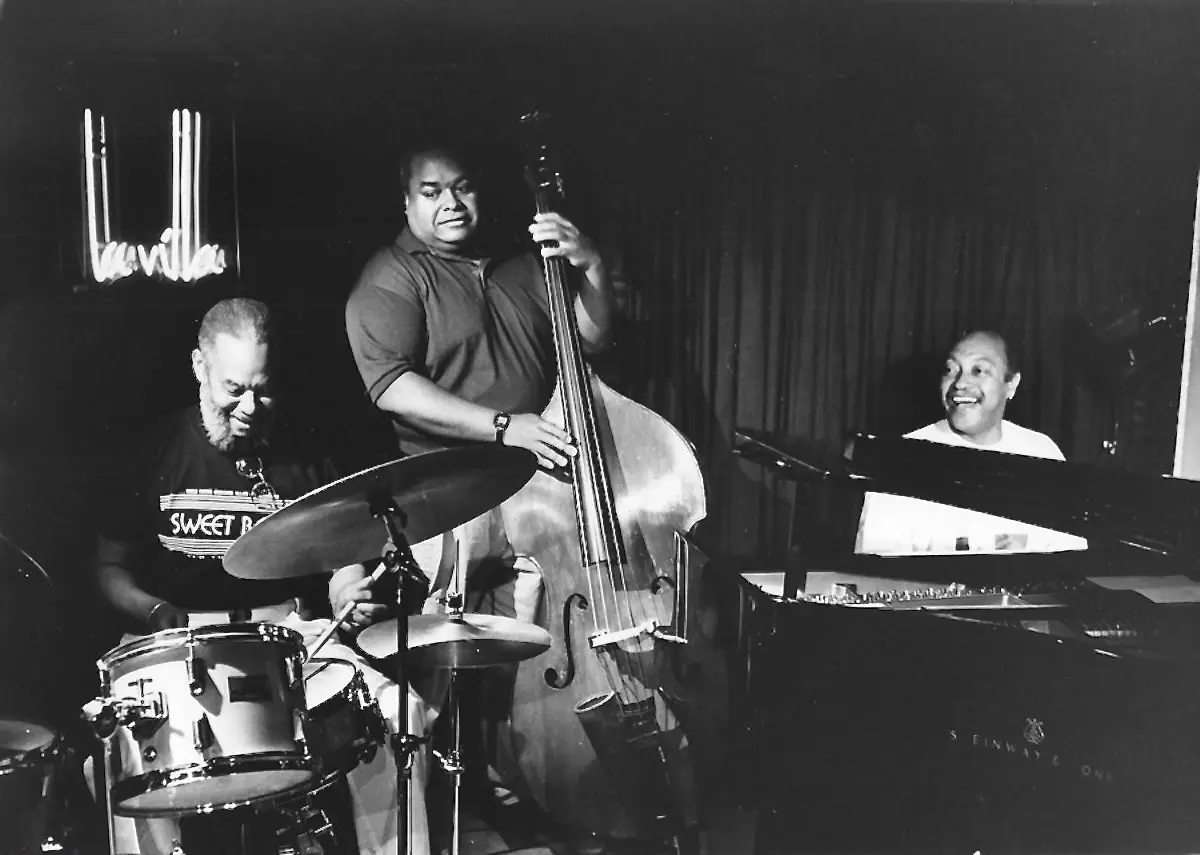
This previously unreleased concert was recorded at the Brecon Jazz Festival in Christ College Auditorium, Brecon, Wales in August 1995. It’s yet another “excavated” date by producer Zev Feldman and jazz archivist Jordi Suñol. It is also pure joy from beginning to end, and belongs in every jazz piano collection. Telepathically accompanied by bassist Ray Drummond and drummer Ben Riley, Barron offers two unaccompanied solos: Shuffleboil, a Monk composition, and his own gentle and fleet-fingered Silent Rain. The attractive package includes informative comments by jazz historian and writer Ted Panken.
The opening number Oh, Look At Me Now is an extended (10.44) tour de force with spirited exchanges between Barron and Riley. Up Jumped Spring (a Freddie Hubbard original) opens with a pensive solo by Barron before the contributions of Drummond and Riley combine to create a satisfying outing. The longest track on CD1 is Monk’s Ask Me Now, with a rhythmic dialogue between bass and drums. Barron’s extended (12.27) tribute to his granddaughter, Nikara’s Song, displays his lyricism and unfailing inventiveness. As Drummond commented in 2005, “I’ve always admired his sense of harmony and melodic development – redeploying melody in complex ways. He’s so flexible and knowledgeable that he’s authentic in any style of the jazz universe.” Barron recalled that this was a superlative trio: ”I don’t recall a sour moment. I loved the way Ray played – solid, with great time and personality. The way he and Ben grooved together was perfect. If this concert turned into something special, it happened organically.”
Every track on this enthusiastically applauded live recording illustrates and endorses these comments. The Surrey With The Fringe On Top showcases Drummond’s nimble and joyous fingering, while Canadian Sunset – the longest number (16.28) from the concert – also displays the trio’s remarkable empathy. Ted Panken deserves the last word(s) on this rediscovered jazz gem: “[T]he up-tempos are thrilling and vertiginous, the medium tempos groove mightily, and Barron twice fulfils his stated aspiration ‘to play a ballad and make people cry.’”
Discography
CD1: Oh, Look At Me Now; Up Jumped Spring: Shuffle Boil; Time Was; Silent Rain; Ask Me Now (54.10)
CD2: Nikara’s Song; The Surrey With The Fringe On Top; The Very Thought Of You; Canadian Sunset (58.40)
Barron (p); Drummond (b); Riley (d). Brecon Jazz Festival, Christ College Auditorium, Brecon, Wales. 12 August 1995.
Elemental Music 5990464
Smithsonian Jazz Masterworks Orchestra: Ellington Masterworks
Established by an Act of Congress in 1990, The Smithsonian Jazz Masterworks Orchestra (SJMO) is based at the National Museum of American History in Washington D.C. It has performed in 26 US states and nine foreign countries in addition to appearing at free live concerts, the White House and a 1999 US tour performing tributes on the 100th anniversary of Ellington’s birth. Gunther Schuller and David Baker were the first musical and artistic directors of the orchestra, which is currently led by Charlie Young, a saxophonist and teacher at Howard University.
This “live” recording begins with a brief (slightly frantic) performance of Ellington’s The Flaming Sword, but then settles into a longer and uptempo “reading” of his 1948 composition Tattooed Bride which includes a sensitive clarinet solo (from an unidentified player) and cohesive section interludes from the “trumpet section”. Race (1968), written for an unfinished film (about horses) as a feature for Johnny Hodges, presents altoist Steve Williams, who sounds remarkably like Rabbit himself. Ad Lib On Nippon, the longest piece in the concert, is also the best. Inspired by Ellington’s 1964 tour of Japan, it sticks closely to the original studio recording with extended contributions from bassist Amy Shook, pianist Tony Nalker and saxophonist Scott Silbert. Oclupaca (Acapulco spelled in reverse) from the 1968 Latin American Suite, was written as a feature for Paul Gonsalves; here it receives a more measured tenor solo by Luis Hernandez. Shepherd – a feature for Cootie Williams in the Second Sacred Concert – and dedicated to the Reverend John Gensel who ministered to New York City’s “night flock” – concludes with a growling solo from trumpeter Barbara Laronga. The final track, Jack The Bear (1940) featured Duke’s bassist Jimmy Blanton. This recreation includes spirited solos from Leigh Pilzer on baritone sax, Jennifer Krupa on trombone and Amy Shook on bass.
All the original compositions were written by Ellington, apart from Madness In Great Ones, co-composed with Billy Strayhorn. These are literally second hand reproductions but SJMO make a good fist of these pieces by an orchestra that includes three female instrumentalists – a sex notably absent from Duke’s various but justly famous aggregations. As the late Strayhorn might have commented “things [certainly] ain’t what they used to be”.
Discography
The Flaming Sword; Tattooed Bride; Race; Madness in Great Ones; Ad Lib on Nippon; Oclupaca; Shepherd; Jack the Bear (55.57)
Extensive personnel including: Charlie Young (cond); Steve Williams (as); Josh Kauffman (t); Jennifer Krupa (tb); Tony Nalker (p); Ken Kimery (d). MCG Jazz, Pittsburgh, PA, 6 April 2024.
MCGJ1062
Wes Montgomery: The Incredible Jazz Guitar Of Wes Montgomery
One of the best (and best-selling) recordings in jazz history was made in 1960 by Wes Montgomery, then in his mid-30s. It has been reissued in various formats at least 116 times. This latest edition on “180 Gram Crystal Clear Virgin Vinyl” is the best so far, with a better balance between Wes, Tommy Flanagan, Percy and Albert Heath, richer and more nuanced sound, and an additional short (2.16) “bonus track”, While We’re Young – an unaccompanied solo by Wes. The fulsome sleeve notes for this LP are the ones written by producer Orrin Keepnews for the original album, in which he declared “Make no mistake, Wes Montgomery is the best thing to happen to jazz guitar since Charlie Christian” – echoing Ralph J. Gleason who wrote after Wes died in 1968 “The two bosses of the jazz guitar were Charlie Christian and Wes Montgomery; he made that kind of a contribution”. In 2017 the album was inducted into the National Recording Registry of the Library of Congress for its artistic and cultural relevance. Praise and recognition indeed, as every track on this release bears out these commendations.
Anyone in doubt could try the inventive Mister Walker, the longer West Coast Blues and/or the hypnotic Four On Six (all Montgomery compositions). They should also applaud his trademark ”thumb picking” technique and simultaneous octave phrasing. On this – his second album for Riverside – Wes is the beneficiary of a hand-picked rhythm section: Percy Heath contributes plangent bass lines, Tootie Heath provides sensitive backings at all tempos, while Flanagan – already a consummate accompanist and dazzling soloist – is a worthy companion for Wes.
Despite justifiable claims that towards the end of his short life Wes became more of a “commercial” pop artist, his overall artistic stature is beyond category. A final and more considered verdict was delivered by the late Keepnews in 1973, when he reflected “Bluntly, I considered the small-group, strictly-jazz settings of almost all the Montgomery albums I produced to have been the most fertile musical soil for him”. ’Nuff said? The ayes definitely have it.
Discography
Airegin; D-Natural Blues; Polka Dots And Moonbeams; Four On Six; While We’re Young (22.42) – West Coast Blues; In Your Own Sweet Way; Mr. Walker; Gone With The Wind (22.46)
Montgomery (g); Tommy Flanagan (p); Percy Heath (b); Albert “Tootie” Heath (d). New York, 26 January 1960, except While We’re Young, 4 August 1961.
Waxtime Clear Vinyl 526034