
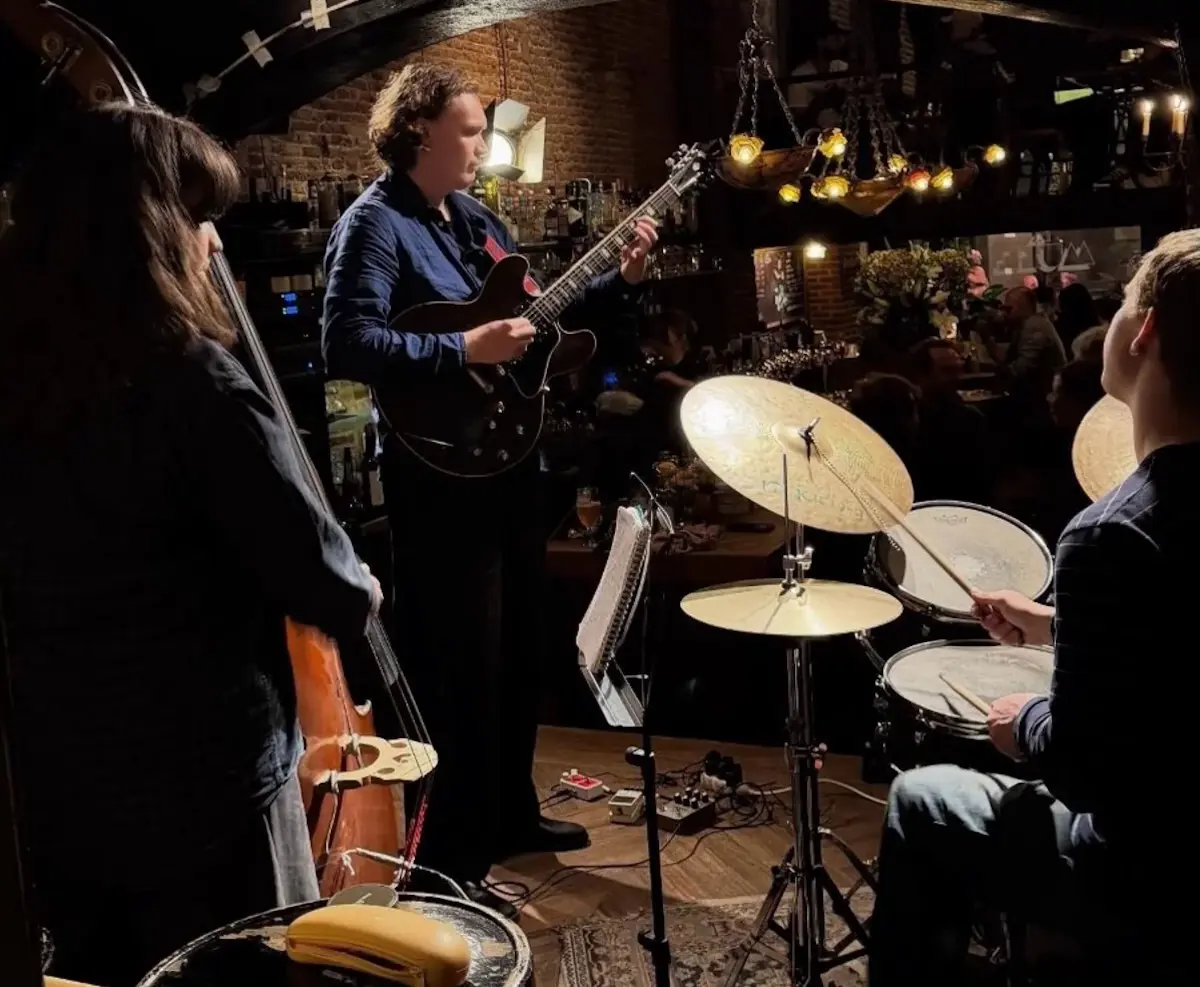
Joachim Lyche Trio: Primal Heuristics
Heuristics are the mental shortcuts that we use to make decisions and form judgements quickly, without the need for too much thinking. Applying the idea to music, one assumes that 27-year-old Norwegian guitarist and composer Joachin Lyche feels that it is easy to over-think music. In response, this is a very much in-the-moment collection of compositions from a young, up-and-coming trio. There is an open, free flowing sound to the trio, making it easy to enjoy the virtuosity of the playing, the relationship between the members of the trio and the inventiveness on display.
Lyche’s compositions swing with enthusiasm, and he is also a very nifty player, showing complete command of his instrument across songs that swing at a brisk tempo. Lyche has been influenced by the likes of Staffan William-Olsson, Bjorn Vidar Solli and Frode Kjekstad (Lonnie Liston Smith), but I also heard some Joe Pass-like phrasing in places. Bendik Johnk’s enthusiastic and sympathetic drumming adds a skiffle-like quality to some of the tracks. Sprinkled amongst Lyche’s own compositions are lively takes on John Coltrane’s Lazy Bird and Joe Henderson’s Punjab. At just under 38 minutes, Lyche’s debut album bristles with ideas, confidence and polished takes on original material as well as a couple of cover versions. You get the impression that here is a trio that has only just got started.
Discography
BIP; Muze; Spring Song; 17-25; Lazy Bird; Transition; Primal Heuristics; Punjab (37.53)
Joachim Lyche (g); Uma Morelia Bustos Reksten (b); Bendik Johnk (d). Asker, Norway 1-2 May and 31 October 2025.
Losen Records Los 322-2
Chuck Bergeron: Bass & Face
Subtitled Duets With Ten Premier Vocalists, Bass & Face collects several recordings Chuck Bergeron has made over the years with various musicians and friends. The range of vocalists may be broad, but there is a sameness to the tracks, especially those featuring the female vocalists. By his own admission, Bergeron comments that the bass is a little more limited in terms of the harmony it can provide with just vocal accompaniment, unlike guitar or piano duets. That certainly limits the possibilities, and the songs follow a similar pattern.
Bergeron usually opens with a smoky, roomy bass line to create some space, after which the vocalist comes in, often with some witty, reflective lyrics and some occasional scat singing. Some of the songs sound a bit forced in terms of humour, some of the vocals a little wobbly around the edges here and there. There is no question about Bergeron’s command of the bass; he is a fine, inventive and sympathetic accompanist, but the songs that work best broaden the range with the inclusion of piano, guitar, sax and drums. Vocals from the late Kevin Mahogany provide the strongest performances featuring just bass and voice.
Ironically, for an album called Bass & Face, the loveliest track is the bonus non-vocal finale, which only features Bergeron and pianist Phil Strange. This delicate duet reveals what the album might have been had it included a bit more variety like this. Over an hour of the stark-sounding partnership of voice and bass does start to lose its appeal fairly quickly, at least for this listener.
Discography
An Occasional Man; Emily; Devil May Care; I Thought About You; When I Drink; Two Degrees East, Three Degrees West; Detour Ahead; Audubon Zoo/Iko-Iko; Fair Weather; Take The Wrinkles Out Your Birthday Suit; Analog; Duke Ellington’s Sound Of Love; Do You Know What It Means (To Miss New Orleans) (66.15)
Bergeron (b); Richie Bravo (pc); John Hart (g); Charles Pillow (ts); Phil Strange, John Riley (p); Janis Siegel, Pete McGuinness, Kate Reid, George Rabbai; Kevin Mahogany, Lisanne Lyons, Nicole Yarling; Sheila Jordan, Roseanna Vitro, Deborah Silver (v). Various locations, 2005, October 2023, March-May 2024, March 2025.
Summit Records SMT 852
Steve Swallow: Winter Songs
“Music is elemental, like the air we breathe” says Steve Swallow in some explanatory notes on how Winter Songs came into being. There is a sense of music giving back something to Swallow at a point in his life when he needed it. Winter Songs marks the bassist’s first album as leader in over a decade and his first recorded appearance on ECM since working with John Scofield on Swallow Tales, and Carla Bley’s Life Goes On in 2020. Involving some close friends, Winter Songs conveys a gentle sense of connection between old musical comrades, bringing with it a sense of reflection, looking back and taking stock.
In a little under 45 minutes, the album generates a sense of calm, with undemanding compositions by Swallow being worked through with care and affection by what is essentially a chamber-jazz ensemble. The music is intricate and thoughtful, very much a sum of its parts, with no-one rushing to steal a solo or engage in a competitive exchange of ideas. The album whispers into being with Gil Goldstein and Steve Cardenas picking out a melody on piano and guitar, before Mike Rodriguez lays down some atmospheric, slightly melancholy lines on trumpet to open up the track. Swallow works away with subtlety in the background, content to let his fellow musicians take the lead. This is one of those albums that grows on the listener over repeated listens. Beautifully crafted, its strength lies in the understated connection between the players, and the emotional power that can be generated when it sounds like you are not really trying at all.
Discography
One; Two; Three; Four; Five; Six; Seven; Eight; Nine (42.00)
Swallow (b); Mike Rodriguez (t); Chris Cheek (ts); Gil Goldstein (p); Steve Cardenas (g); Adam Nussbaum (d). New York, September 2024.
ECM 2879