
John Lewis & Sacha Distel: Afternoon In Paris
During the 1970s French singer and entertainer Sacha Distel performed a number of times at the London Palladium and on British TV, and on these visits he would drop into Collets Jazz Shop. A friendly and modest man, he’d spend time browsing and buying the occasional record. When this first happened, I expressed some surprise, but my colleague, the late Ray Smith, enlightened me about Distel’s pre-showbiz career credentials, citing this album from 1956, issued originally on Atlantic SD1267. Long since deleted, it was a collectors’ piece, a second-hand copy rarely coming into our “Hens’ Teeth” section and if so, it’d go for serious money.
Since then it has reappeared, most recently on Poll Winners 27391, reviewed by John White (JJ March 2019) when it was paired with John Lewis & Albert Mangelsdorff’s Animal Dance (1962). Quite rightly, John mentioned how well the French contingent of Sacha Distel, Barney Wilen and Pierre Michelot reacted and combined with the Americans, quoting Leonard Feather’s Downbeat review comment that “if the MJQ were to ever have a guitarist, Distel would be the ideal choice”. His playing on Dear Old Stockholm and on the title track bears this out.
Although the album is in Lewis and Distel’s names, it’s the 19-year-old Wilen that catches the attention. It’s an indication of the trajectory of the young tenorist’s career, between his 1954 recording with Roy Haynes for the French Swing label, being a regular in Parisian clubs and accompanying notable visitors, and the following year (1957) seeing his own album Tilt appear, as well as his inclusion on Miles Davis’s Ascenseur Pour L’échafaud.
On this album he makes himself known from the off, with a strong solo (and duet with bassist Michelot) on I Cover The Waterfront. He dispenses with formalities and goes straight into improvisation and unpredictability on All The Things You Are, and takes Dear Old Stockholm by the scruff of the neck and pushes it into a hard-swinging number. His warmly expressive solo on Willow Weep For Me follows Distel’s laidback contribution, Kenny Clarke’s brushwork a treat.
Of the others, Lewis directs well from the front, soloing and moving the music along with little fuss and a light touch, eloquently evoking the mood of Paris. The rhythm sections, as you’d expect, are first rate. As usual with this label, extra tracks are included and here we have the two trio tracks recorded soon after, from The John Lewis Piano (Atlantic SD1272) with his fellow MJQ musicians Heath and Kay. An excellent reissue.
Discography
(1) I Cover The Waterfront; Dear Old Stockholm; Afternoon In Paris; (2) D & E. (26.43) (3) All The Things You Are; Bags’ Groove; Willow Weep For Me; (2) Little Girl Blue (25.42)
(1) Lewis (p); Distel (g); Barney Wilen (ts); Pierre Michelot (b); Connie Kay (d). Paris, 7 December 1956.
(2) Lewis (p); Percy Heath (b); Kay (d). NY, 21 February 1957.
(3) as (1) but Heath replaces Michelot; Kenny Clarke replaces Kay. Paris, 4 December 1956.
Jazz Wax LP JWR4642
McCoy Tyner: The Seeker
Pianist McCoy Tyner didn’t let his path falter after the years with John Coltrane, continuing with powerful, high energy hard bop, his piano style full of blocked chords and melodic runs, with the occasional ballad thrown in. He had crossed paths with vibist Bobby Hutcherson during the 60s, recording with him over the years, and this release is from a live performance at the Umbria Jazz Festival in 1993.
The listener might be forgiven for thinking that it’s recorded at the wrong speed initially, as it storms into the opener, I Wanna Stand Over There, but the occasional errors in plucking by bassist Avery Sharpe contradicts this as the quartet sets down its marker. Drummer Aaron Scott blazes into a five-minute drum solo, at times rather frenetic. Both Sharpe and Scott were regular members of Tyner’s groups during this period. Home is a long trio number, Tyner’s strong left hand dominating, almost belligerently pushing along, with unpredictable leaps and dynamic chord progressions thunderously crashing. Even when there’s a hint of changing to a lower gear, another seismic wave of sound appears.
Hutcherson’s presence lightens things, the shared percussive nature of vibes and piano giving a balanced, infectious propulsion on The Seeker and Peresina, although again Tyner shows no reluctance in taking charge. How Deep Is The Ocean gives Hutcherson more room for his sweeping arpeggios and Tyner even hints at Lullaby Of Birdland in his solo. Sharpe’s adept contribution includes slapping and strumming, his big sound eliciting audience approval. Tyner quietens things down with a piano solo on I Should Care, which he recorded on the earlier solo album Soliloquy (1991) and later on Live In San Francisco (2007), and this segues into a duet with Hutcherson on Monk’s Reflections. (The two were to record Manhattan Moods later in 1993, a duet album for Blue Note.)
Tyner only occasionally veers away from his powerful approach, but when he does there’s a noticeable nod towards earlier piano styles. The final track, Blues Stride, however, is more expansive than his later “proper” stride version, on the album Infinity in 1995. This well-recorded album that will appeal to the many Tyner followers, but some credit must go to bassist Sharpe who works heroically to keep it together, making his presence felt throughout.
Discography
I Wanna Stand Over There; I Should Care; Reflections; Home; The Seeker; Peresina; How Deep Is The Ocean; Blues Stride (71.47)
Tyner (p); Bobby Hutcherson (vib); Avery Sharpe (b); Aaron Scott (d). Umbria Jazz Festival, 17 July 1993.
Red Records CD RR123357-2
Melissa Aldana: Filin
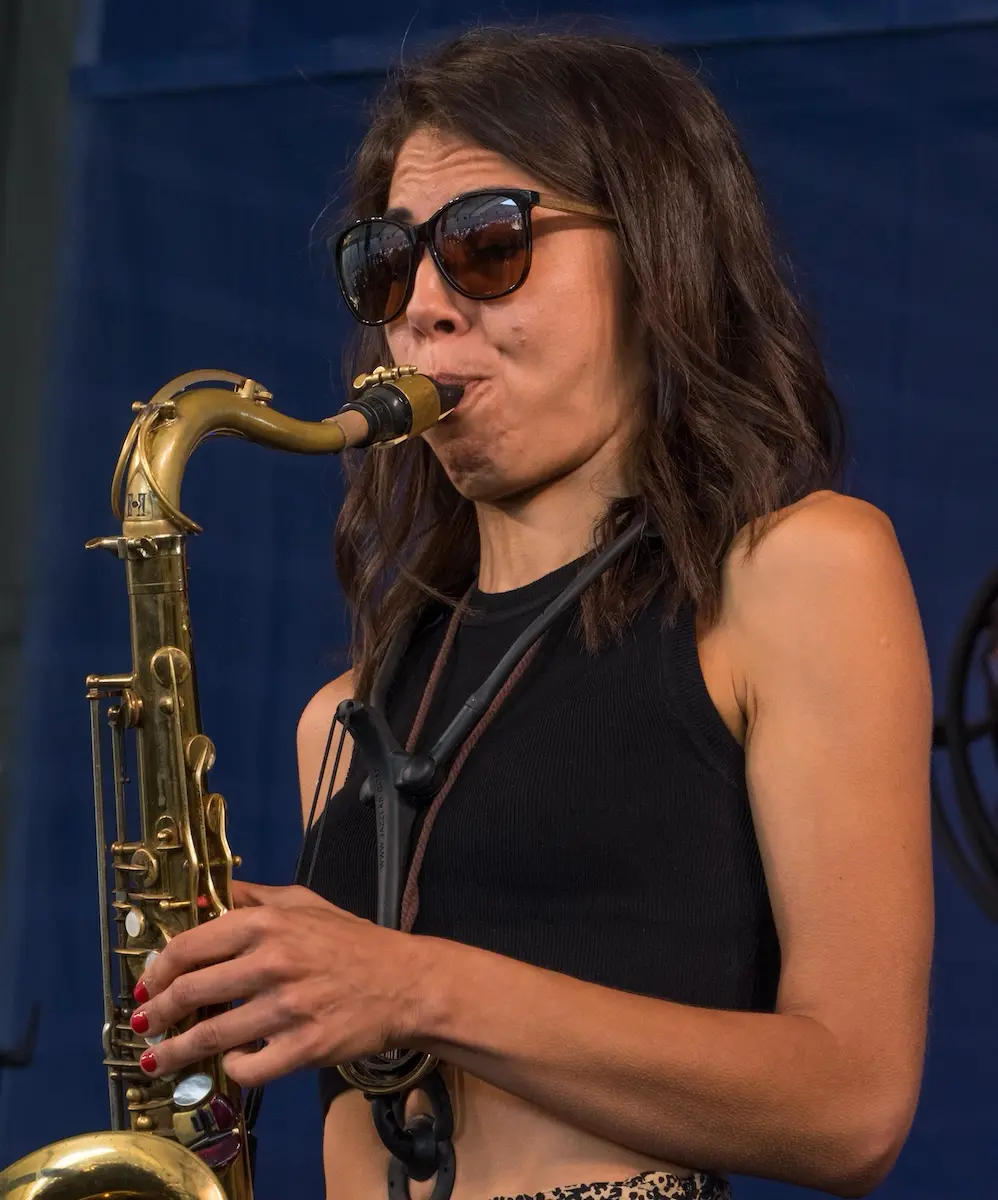
In sharp contrast, it’s not often these days that an album appears that is completely given over to ballads, with each one taken at a leisurely, restrained pace, but this is the response Melissa Aldana wanted to make to the Cuban musical tradition, “filin” (feeling). The inspiration came from her father, Marcos Aldana, who introduced her to this music, prevalent in Cuba from the 1940s to 60s, and to the saxophonists of that period – Coleman Hawkins, Don Byas, Lucky Thompson, Sonny Rollins and others.
For her, it was important to get the Cuban pianist Gonzalo Rubalcaba, who has strong connections with this style, as collaborator, and they open the set as a duet on La Sentencia, before the quartet is introduced. Her firm intent is apparent as she sets the agenda. There’s a slight change of tempo for Dime Si Eres Tú, and as with Imágenes, great rapport between the two. They are accompanied by drummer Kush Abadey, whose understated but deft cymbal and brushwork is completely appropriate, and bassist Peter Washington, who supplies a solid platform, taking a solo on Imágenes and on Ocaso, which moves with sinuous lines from Aldana and ends with beautifully sensitive interplay. Her rich breathiness and tender, slightly rasping lyricism, that, for me, has echoes of Ben Webster, is enhanced by Rubalcaba’s economic use of notes.
On Hermeto Pascoal’s composition Little Church, Aldana has a feel of Coltrane – she has pointed out how his ballad playing “just melts your heart” – but she shifts into a higher register. Rubalcaba’s expressive piano occasionally hints at fragmentation. The highly regarded Cécile McLorin Salvant contributes the vocals on No Te Empeñes Más, a song of heartfelt finality, and Las Rosas No Hablan, about the pointlessness of addressing the plants in the garden – roses don’t speak. Both are in Spanish and Aldana closely shadows the singer on them, her sadness of tone reflecting forlorn hope, maintaining the emotional essence of the song. Just as Rubalcaba was given prominence on the opening track, he’s called on to finalise proceedings on No Pidas Imposibles, which he does with a coda of sheer beauty which matches Aldana’s tender, wistful playing.
Aldana has shown stylistic variation on previous albums but Filin has her going deeper into an area of the music whose traditions she can relate to and which are highly personal to her. For the listener it’s also music for relaxing, to lean back to and let the warmth and mood of the music flow over.
Discography
La Sentencia; Dime Si Eres Tú; No Te Empeñes Más; Imágenes; Las Rosas No Hablan; Little Church; Ocaso; No Pidas Imposibles (38.58)
Aldana (ts); Gonzalo Rubalcaba (p); Peter Washington (b); Kush Abadey (d); Cécile McLorin Salvant (v). New York, April 2025.
Blue Note 0060248822822