Henri Texier: Healing Songs
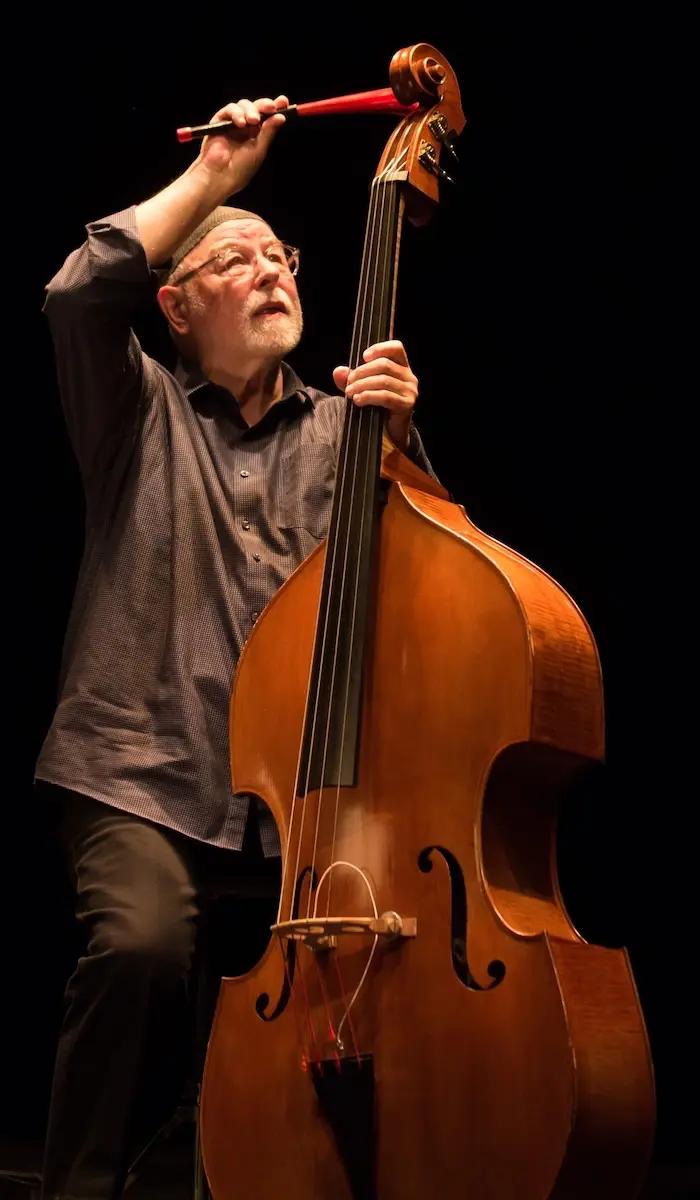
Veteran French bassist Henri Texier is calling on past compositions of his to be applied as balm to brows fevered by “the current anxiety-provoking atmosphere”. We assume he means a world riven by war and polluted by echoes of a past that still haunts us. His quintet, with guest drummer Manu Katché on three of the nine tracks, performs the music he found comforting when he wrote it. “May these musical songs bring you ease and deep lightness,” he declares, with the sincerity of a well-meaning homeopathist advocating music as therapy. Nothing wrong with that.
Octogenarian Texier has been in the music business for six decades. The vitality of Healing Songs and the way his band performs the album with affection testify to music as continuously inspirational if not a complete antidote to depressing newscasts; but maybe that, too. For a start, there’s Texier’s bass sound itself, deep-trawling one minute, lyrically aerial on solos the next, and throughout driving the dynamism of charts delivered purposefully by trumpeter Hermon Mehari, Texier’s son Sébastien on alto sax and clarinets, Gautier Garrigue on drums, and the ever-resourceful Emmanuel Borghi on piano and keys.
Discography
Amazone Blues; Greve Révolte; Chebika Courage; Decent Revolt; Leȉla; Vent Poussiere; Sarajevo Blues; Samba Loca; Quand Tout S’Arrete (57.38)
Texier (b); Sébastien Texier (as, cl, acl); Hermon Mehari (t) Emmanuel Borghi (p, kyb); Gautier Garrigue, Manu Katché (d). Amiens, June 2025.
Label Bleu LBLC6753
Anat Cohen Quartetinho: Bloom
There are times when clarinet-wielding Anat Cohen seems to have invaded and taken up residence with thanks in locations normally occupied by the saxophone, which she also plays. But she allows the clarinet both to maintain and extend its character in her celebrated foursome Quartetinho by establishing a chamber-jazz format, one willing and able on this album to deal with the melodic eccentricities of Thelonious Monk’s Trinkle, Tinkle and say something about complex chamber jazz and Monk at the same time.
Into the jewel box of chamber she empties the modified influences of every major figure from Jimmie Noone to Artie Shaw and Ken Peplowski, while never looking back to anything that might be considered moribund. Her view is always optimistic and spirited. Even what begins as an elegiac smouldering on pianist and accordionist Vitor Gonçalves’s Tango Para Guillermo ends as an exciting accumulation of tension and deep feeling. Such development is even more pronounced on the Allegro Solemne third movement from La Catedral, the suite for guitar by Paraguayan composer Barrios Mangoré, its contradiction in musical terms dissolving into the percussive gaiety of its arabesques. Bassist Tal Mashiach switches effortlessly to acoustic guitar duties here and on his own chart Paco.
Monk and the Paraguayan cede composition credits on the other six charts to members of the group, whose versatility as instrumentalists and writers is matched by the integrity of their cooperative arrangements. Those jewels shimmer and shine, often with a Brazilian warmth.
Discography
The Night Owl; Paco; Trinkle, Tinkle; Tango Para Guillermo; Coco Rococo; Allegro Solemne from La Catedral; Superheroes In The Gig Economy; Friends In Every Manner Of Conveyance (42.45)
Cohen (cl, arr); Vitor Gonçalves (p, acc, arr); Tal Mashiach (b, g, arr); James Shipp (vib, mar, pc, arr). New York, April 2024.
Anzic Records ANZ-0092-02
Mark Wade Trio: New Stages
Jazz pianists overburdened with a “classical” technique can do the music a disservice, A bass player with one, who’s also performed in a symphony orchestra, may be better placed to experiment with mixing genres. Mark Wade is one such. On this often mesmerising album he reimagines – or “re-stages” – inspiring music he’s experienced on the concert platform and asks if, when played by a conventional jazz piano trio, the result is jazz, classical or something different.
Well, it’s jazz. His recording label says so and is correct in its description. This is not a crassly commercial “jazzing the classics” album but a praiseworthy and entertaining exercise in taking themes from one place and exploring them without inhibition in another. Debussy, Rachmaninov, Chopin, Wagner and Gorecki, among others, are borrowed on charts for which Wade rightly claims compositional credit.
Wade, pianist Tom Harrison, and drummer Scott Neumann concentrate intently on what a jazz trio can do that a symphony orchestra or concert soloist cannot – and would not. The jazz subtleties pile tastefully one on another, with Wade’s lively bass ever on the go, Harrison unfazed by (theoretically) lion’s share duties, and Neumann locating ample space to do what a jazz drummer can do and an orchestra’s kitchen department wouldn’t want to unless it were daydreaming.
Discography
The Good Doctor Gradus; The Elephant’s Lullaby; The Shepherd Takes A Turn; Cakewalk; Saga; The Storm; Idyll; Iberia – Parts 1 and 2; Requiem – Judgement, Transition, At Rest; Waltz And Variation; Lament; Jesu (75.18)
Wade (b); Tim Harrison (p); Scott Neumann (d). New York, May 2025.
Dot Time Records DT 9178
Joe Lovano: A Raft, The Sky, The Wild Sea
“Genre-spanning” is the get-out label for music that comes to the notice of a jazz magazine but may not be jazz all. It may not even sound like jazz, or it may have jazz echoes. If it involves a jazz musician playing like a jazz musician, the genres, if not quite spanned, have at least been introduced to each other. Douglas J. Cuomo’s concerto for tenor saxophone and orchestra is conventional in having three movements on the classical model. Its echoes sound vaguely like the arrangements (with just symphonic strings), made to sell a named jazz soloist in a new and potentially lucrative marketplace.
But Cuomo’s work registers highly in allowing the soloist to do what comes naturally; and he had one particularly in mind. On this recording, it’s the dedicatee, Joe Lovano, but one can imagine other soloists taking on the role and making their mark. Cuomo, however, read Lovano’s personality well and clearly had it memorised when depicting the concerto’s ruminative interludes and inspired turbulence. Posterity might look upon Lovano’s effort as definitive. He certainly embraces the work’s lyricism, aerial freedom and unequivocal emotion.
Discography
Movement I; Movement II; Movement III (30.15)
Lovano (ts); Winston-Salem Symphony; Michelle Merrill (cond).
Blue Cloud Music BCM 100060V (LP)