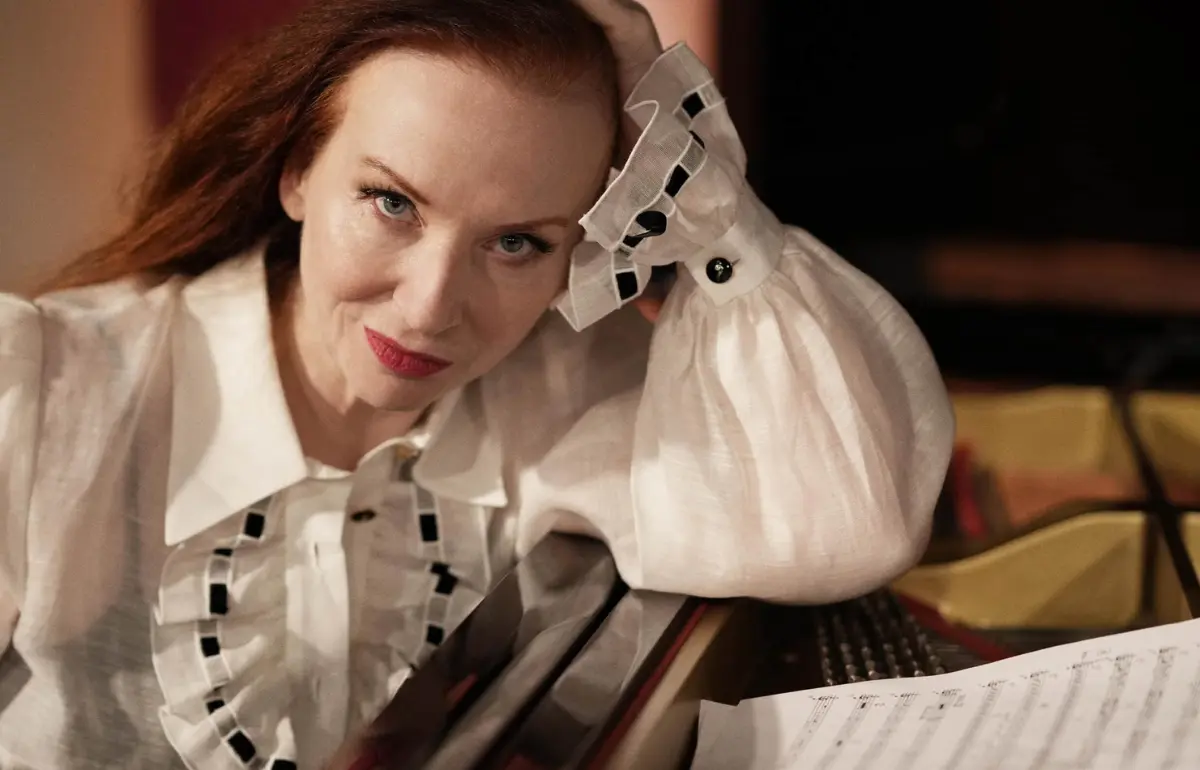
| Judith Owen plays two UK dates in June |
|---|
| Monday, 1st June – Bush Hall, London, UK |
| Thursday, 4th June – Cabaret at Wales Millenium Centre, Cardiff, UK |
When and how did you start singing? What was the inspiration?
I can’t remember a time I wasn’t singing, I think I came out the womb warbling. My opera-singer father started each morning doing his scales to warm up his voice, and that’s what my sister and I woke up to our entire childhoods. I saw the joy on his face when he sang; it was like he was transported, and that was the inspiration. [Judith’s father was Handel Owen, the Welsh operatic tenor, who performed in the chorus at Covent Garden for three decades. – Ed.]
Who were (a) your first and (b) your strongest influences as a jazz singer? What did you like about them?
Again, my dad was a very unusual classical musician, loving jazz and blues as much as he did, and everything else besides. It was his record of Nellie Lutcher’s Fine Brown Frame that began my love affair with deliciously bold women at the piano, with their unique stylings and fearless performative skills. The piano was my first love, and there were a lot of jazz piano recordings in his collection, which also taught me so much about phrasing and rhythm, like Oscar Peterson, and Erroll Garner. Add my mother’s love of the Nelson Riddle big-band albums with Sinatra and Ella, blend it with a bed-rock of classical music and it all makes sense!
Is it right you were singing rock for some while? Tell us something about that and about what occasioned the change of style and persona we have seen recently
I’ve never sung rock, I just love doing jazzy covers of rock classics, like my bossa version of Smoke On The Water, and 5/4 version of Soundgarden’s Black Hole Sun. I like to turn them on their heads and sing them from a female perspective. I believe that all covers should sound like they’re absolutely about my life, with a fresh meaning. I think the originals are always the greatest, so it’s necessary to shine new light through extraordinary songs. So, I really haven’t deviated so much. I had a wonderful five-minute pop career at Capitol records, but that was still infused with jazz and blues. I think the biggest shift has been my recent move from behind the piano to being up front and centre with my band The Callers. It’s afforded me a freedom and strength as an entertainer that I’ve always yearned for but could never experience behind the ”safety blanket” piano! Now I feel fearless to be my entire self, at the piano and as the front woman… hence the name of the new album… Suit Yourself.
How does Suit Yourself, which is notably relaxed and makes powerful use of control, restraint and space while staying strongly in the jazz-blues idiom, differ from your three previous jazz projects? Do you see a progression in your work?
I think the addition of my original songs and me returning to the piano has given the album a welcome sound, and a mood that leans into the space and relaxed restraint that comes from being a singer-songwriter all my life. I’ve always loved dynamics and the very classical push and pull that can go from all to nothing in a second. This album goes from duet to trio to sextet to big band and back again, and that’s what music is to me, a force that takes you wherever it wants you to go. Songs are about the shared experience, conveying to the listener or the live audience your emotions and feeling in words and sound. The style changes to suit the mood, and the needs of the story. My joy in this album is in reintroducing that dynamism and variety back into my work, and this time with all the confidence and musical freedom that making and touring the last three albums has given me.
Who did the arrangements for the album? How much thought went into arrangement, if any, or did you and the band largely improvise? How important is it to think hard about that in order to maximise variety in a constrained idiom?
Obviously, I arrange my own songs with the band, working out ideas for them and the covers at my studio and on the road with them, At this point they respond to this music like we share one brain! I also arranged If I Were A Bell and Since I Fell For You with my wonderful guitarist Dave Blenkhorn, as both are so guitar driven, and I wrote and arranged Inside Out with my drummer, the incredible artist Jamison Ross, who was a great ally on this record. The thrilling big-band arrangements were done by John Wasson, who also did the Judith Owen Swings Christmas album in 2025.
You’re often very exposed in these arrangements, as for example at the beginning of If I Were A Bell, singing over just guitar. Is this intimidating or challenging? You sound completely secure, however.
Nothing is as beautiful to me as space, and I’m entirely comfortable singing out there with a few guitar chords, completely exposed, so you can hear all the emotion in my voice. That’s why singing in a church or huge hall is so beautiful, hearing yourself fill the room with natural reverb. You have to have a good “instrument” and that’s really what it is, pure and strong. I love it!
I can’t sing anything that doesn’t speak about my own life. That’s how I choose the covers… knowing that I can make them my own
How did you choose the repertoire for the record? Did you write some yourself? You write at the piano? Which tracks on Suit Yourself are yours?
I wrote four – the first two singles, That’s Why I Love My Baby and To Your Door, as well as Have A Good Life and Inside Out with Jamison. I always write on the piano, I think it’s always been an extension of me since childhood. I chose the repertoire along with my label head Neil Greenberg, who has incredible ears. I can’t sing anything that doesn’t speak about my own life. That’s how I choose the covers… knowing that I can make them my own. That way the entire album, whether self-penned or re-imagined, sounds authentically me.
How did you find the musicians for the record, including the basic Callers band?
In New Orleans, my US home. There’s nowhere like it, with musicians who play with joy, depth, and what they call “grease”. I’d seen trumpeter Kevin Louis and saxophonist Ricardo play around town and was a big fan of both, so when I got together with my MD, pianist David Torkanowsky, who curated the band, these were the first two members, along with my own percussionist, Pedro Segundo. Next were Lex Warshawsky, a killer double-bass player, and Blenkhorn, who was making a record in Nola. After that Jamison joined as Pedro started touring with Jon Cleary, but both feature on this album. The JO Big Band are all NOLA players and swing like demons; it’s such a brass town, I was spoilt for choice. But so much was down to Tork’s incredible blending of the right players.
Are there any other musicians you’d particularly like to work with?
I got to record with one of my favourite artists – Davell Crawford, on Today I Sing The Blues on this album, so that’s a serious box ticked. He takes you to church in one note… such a joy. Then Joe Bonamassa was generous enough to guest on Your Mind is On Vacation, which was amazing. There’re so many incredible artists out there, but if I had to pick one, I’d say that having my childhood idol – Stevie Wonder – sing and play harmonica on one of my songs would be a dream come true.
Do you play any other instruments? Are there any other instruments you’d like to play?
I’d love to play guitar and be much better on the Hammond B3, but my love affair with the piano, and writing on it, makes me not want for anything else. As they say… it’s an orchestra at your fingertips.
Some biography: you’re described as Welsh but you were born in London. What’s the Welsh connection? How did the move to London occur, and when? And the moves to and around the US, what occasioned those?
My parents moved from Wales to London for my father’s operatic career. He joined the company at Royal Opera House, Covent Garden, I got to hang out at dress rehearsals most Saturday mornings since I was five. My parents were very homesick for their Wales and that really shaped my sense that we were always yearning for the times we could go “home” and see our Welsh family. So, I never thought of myself as English, my home life and identity was too Welsh for that.
How did you come to be in New Orleans? That seems like really living the dream that many project without actually doing. Or was there a more practical motive – business, personal reasons? Was there any culture shock?
Thanks to my dad I was hearing New Orleans music from an early age… Jelly Roll Morton, Armstrong, Mahalia, so when I eventually went there with my new husband for the jazz festival, my world exploded and I felt like I’d come home. There’s such a music scene there, not just jazz and blues. It inspires and encourages and the community is close and nurturing. Truly it changed my life, in it’s acceptance of me and of everything I could be.
Has there been a singer you’d like to have been? Is there still any singer you’d like to be?
I don’t want to be anyone else, but I certainly adore and worship at the feet of Ella, Joni Mitchell, Sinatra, Nellie, Stevie Wonder, Aretha. I’m in a constant state of wonder and gratitude that they accompanied me through life.
Is there anything in life you could be, or would like to be but a singer? What?
A better painter! I’m really being everything I ever wanted to be… singer, dancer, actress, entertainer, pianist, composer. It took until now, but it was worth the wait.
I think America takes for granted its greatest creation and export – jazz (that bore the blues, and therefore rock and roll) – and the city that bore it – New Orleans
What is jazz? What is not jazz? Do you draw a line anywhere? Do you ever hear anything described as jazz that you consider is not jazz? Are there any kinds of jazz you’d avoid? What’s your opinion of jazz in the UK and elsewhere?
After almost every live show I do, someone will come up to me and say “I didn’t know I liked jazz!” I always smile and reply ”There’s many kinds of jazz out there. I’m doing the most accessible version of it, a song-based one that you can leave singing. It’s what I love… melody and lyrics that connect with you. Don’t be scared of the word jazz, just know what you like and what moves you.” As far as jazz in the rest of the world, let’s just say thank god for Europe and the UK who adore jazz and blues. I think America takes for granted its greatest creation and export – jazz (that bore the blues, and therefore rock and roll) – and the city that bore it – New Orleans.
Is there any jazz you wouldn’t listen to?
I’m a melody lover, so you can assume the rest!
Is there any danger that your embrace of the raunchier end of female jazz singing now or in the past might be seen as politically incorrect or, as they used to say, “unladylike”?
I dream of being “unladylike”. (Did I mention I always wear suits, a fedora and swear like sailor?)
Is there anything you’d advise jazz players not to do?
No. The point of jazz is to improvise, and that means reaching incredible heights and sometimes bottoming out. That’s the risk and the joy.
What was the most unpleasant jazz experience you had?
Watching one of my idols being carried off stage drunk – bloody heartbreaking!
Is there anything you’d like to change about or develop in your voice? Do you practice? How?
My voice is naturally getting deeper and richer, so I’m just letting it evolve, as I get braver and less inhibited.
What’s your favourite non-musical activity?
Hanging with my darling labradors… dogs make us better people.
Do you envisage any change of musical direction in the future? If so, to what?
Definitely a classical project coming soon!
What would you have done if you hadn’t done the job you’re doing now?
Be an actor.
Where in the world are you happiest?
Anywhere my husband and dogs are.
Favourite thing in New Orleans?
Dinner with friends followed by at least one music show.
Last book you read?
I’m dyslexic, so audio books are my thing. I like autobiographies, especially about classic actors and musicians, so I’m just into the first chapters of Liza Minelli’s tell all.
Music you listen to in the car?
Jazz and classical and Radio 4.
First thing you’d do if you won £5 million?
Buy a Bosendorfer 9ft, or a Steinway B.
What makes you happy?
Dogs.
What makes you sad?
Them getting older.
What was the first album you ever bought?
Stevie Wonder’s Songs In The Key Of Life.
What is the best advice you have ever received, and who did it come from?
“If you can make a living from the thing you love, you’re the luckiest person alive.” – my dad.
What do you do to unwind?
Lie on two dogs and watch some TV show about making things.
Biggest regret?
Hiding my depression for so long.
What or who are you proudest of?
Being happy and well again.
What advice would you give to your younger self?
“You are enough”, so stop being a pleaser.
What’s the hardest thing you’ve ever had to do?
Get well, and live in the moment, doing what I love…
Who do you think is an underrated genius?
Underrated mega-talents… Living: Davell Crawford. Passed: Nellie Lutcher and Raymond Miles.