Alcyona Mick & Liam Noble: Distant Plains
There have been adaptations of Gustav Holst’s The Planets ever since its inception and the composer’s use of the two pianos of his assistants Vally Lasker and Nora Day. It has been popular with brass bands, was latterly used by rock bands such as Emerson, Lake and Palmer, King Crimson and Manfred Mann’s Earth Band, and a version appeared in 2020 by Jeremy Levy’s Jazz Orchestra.
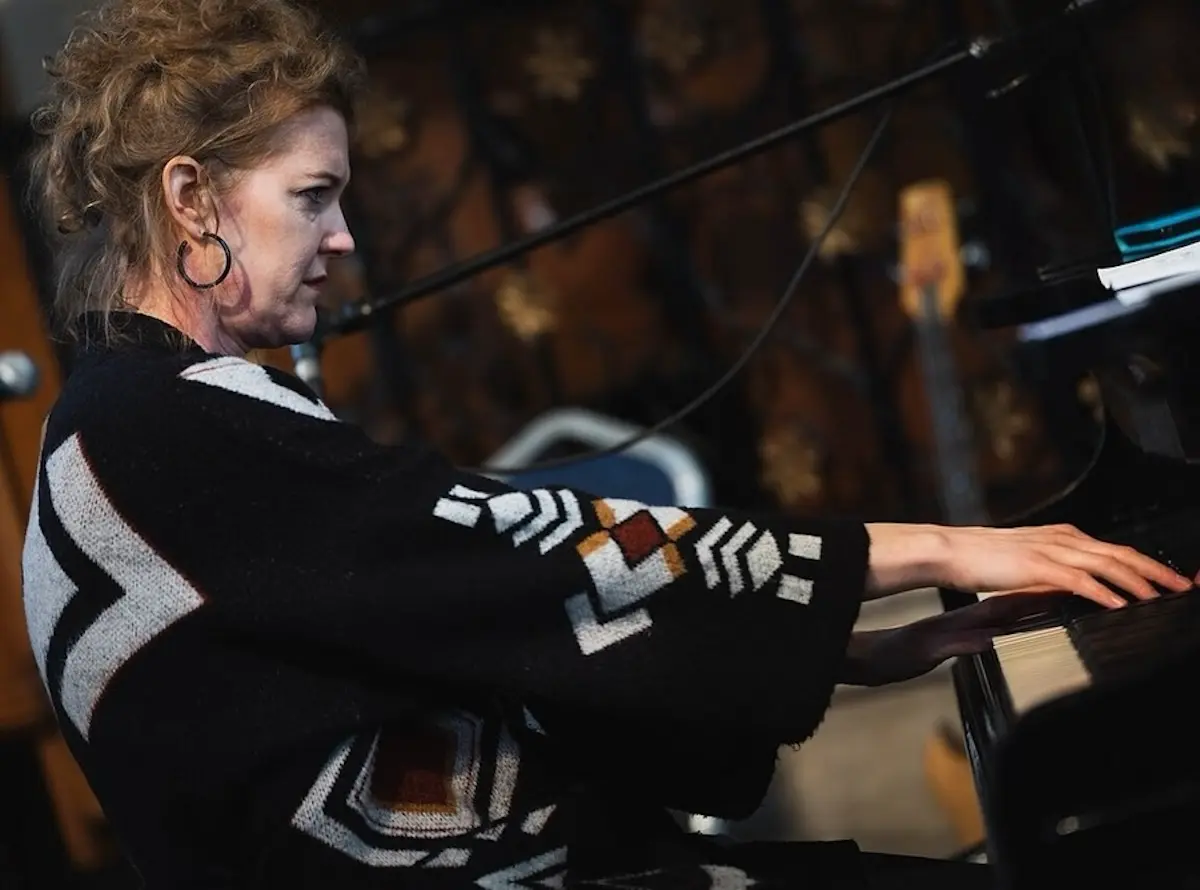
Most have followed the original music, but that’s not the case in this collaboration between pianists Alcyona Mick and Liam Noble. A project conjured up by alternative writer and artist Penny Rimbaud, it draws upon Holst’s music for inspiration but with no direct reference to it, an experimental, improvised work. Apparently nearly all was captured in first takes, with no overdubs or second thoughts, giving it spontaneity and immediacy. Understandably, there’s a musical rapport between the pianists as their connection goes back to 1999, when they were student and teacher.
With the original in mind, the two quickly establish a full, head-on improvisation for Mars, The Bringer Of War, clashes of chordal climaxes alternating with more spacial sections. Unlike Holst’s, there’s no recourse to motifs or themes. Similarly, Saturn ebbs and flows, and of all the movements it’s most closely aligned with, and most effectively captures, the spirit of Holst’s Bringer Of Old Age; a melancholic optimism. Uranus also uses contrast – outgoing light-heartedness with moods of constraint and contemplation.
Venus, The Bringer Of Peace, is balanced, slow and tranquil. Mercury is light, lively and elusive. Jupiter is full of vitality and exuberance, although an oddly darker passage belies its subtitle as Bringer Of Jollity; a slower section avoids the formality of I Vow To Thee My Country. Neptune is quiet and reflective, teetering on the rhapsodic, and like Holst’s arrangement, uses an unearthly wordless chorus, taking the listener to the far reaches of the universe. Holst believed that expressing emotion was “the fundamental necessity in all art” and this is achieved here.
Discography
Mars, The Bringer Of War; Venus, The Bringer Of Peace; Mercury, The Winged Messenger; Jupiter, The Bringer Of Jollity; Saturn, The Bringer Of Old Age; Uranus, The Magician; Neptune, The Mystic (43.59)
Mick, Noble (p). London, autumn/winter 2024/5.
Caliban Sounds CAL012
Olivier Hutman & Lamine Cissokho (featuring Eric Bibb): The Following
When Double Skyline by French pianist Olivier Hutman and Senegalese kora player Lamine Cissokho appeared in 2023, it was overlooked – a pity if this recent release is anything to go on. As the first track, Klezmandingo, implies, it’s an amalgamation of what might seem like disparate traditions, those of Jewish klezmer and West African mandingo music, but there are shared characteristics in both, and not just in their emphasis of minor keys.
Both players contribute to the writing. Hutman’s compositions have strong jazz themes, bold and assertive, especially Streets Of Dakar, although his Syllabus Dilemma has a flavour of Bach, almost a contrapuntal fugue. In Cissokho’s case, the African influence is more dominant, and at times he gives his kora a harp-like fullness. He demonstrates how impressively adroit he is in facility and manipulation of his instrument, whether in his repetitive bass ostinati or in cascades of strings which lead into improvised solos.
There’s unity in their playing, whether in close interplay or when one assumes the lead (the other anchoring proceedings with persistent riffs or parallel runs, responding to and complementing the other’s lines as the music unfolds). When Cissokho’s kora comes to the fore, as on Kora Kouma, Hutman slowly shadows to create an evocative, atmospheric landscape. Horace Silver’s Song For My Father is included, another in a minor key, and appropriate for its Cape Verdean cultural blend of West African and European music. Cissokho provides the melody whilst the bass line is established by Hutman before exchanging roles.
The two are joined by American bluesman Eric Bibb, extending the scope by pitching in with his engaging voice and acoustic guitar on Flood Water and Rockin’ Chair – not the Hoagy Carmichael version but one with a similarly laidback sentiment.
Discography
(1) Klezmandingo; Kora Kouma; (2) Flood Water; (1) Streets Of Dakar; Tamalalou; Song For My Father; The Syllabus Dilemma; (2) Rocking Chair; (1) Simaya (47.13)
(1) Hutman (p); Cissokho (kora). (2) add Eric Bibb (g, v). Stockholm and Maurepas, Paris. June and September 2025.
Frémeaux & Associés FA8626
Roscoe Mitchell & Michele Rabbia: In 2
This is the most compelling of these three duo recordings. Arguably one of the most influential innovators in the area of improvisational music (from the early 60s and in his work with AACM and the Art Ensemble of Chicago), Roscoe Mitchell has explored an all-embracing vision rather than follow more accepted paths. He is joined here by Italian percussionist Michele Rabbia.
Here, it’s the journeys into the arboreal density of A Day In The Forest and A Night In The Forest that capture the imagination and attention. An unobtrusive electronic continuum pervades, onto which sounds are posted – bubbling drips of fluidity percolate over insect and animal noises and stridulation. Whistles, murmurs, clicks and trills utilise the gaps between the small sounds and silences. The biological sonar of nocturnal creatures, the high frequency of echo-location sound, predatory warnings, chirps and growls, mysterious rustling and enigmatic flutters – all are represented on the broad canvas which Rabbia and Mitchell create.
On other tracks there’s a conversational feel, with more expansive percussion. There’s bold bass saxophone, big-toned and resonant (Low Answer and Polyndrome) and excursions of contrasting sopranino with fusillades of tympani and tom-toms (Interaction and First Impression). All are used in the variations of sound patterns and movement.
As the sleeve notes say, this improvisation is seen as a method of working collectively, as a means for creating situations to which the musicians respond. Much of the music noticeably extends into meditative areas, a pointillist interaction between the two musicians and an intriguing and riveting experience for the listener.
Discography
A Day In The Forest; Interaction; Low Answer; In 2; A Night In The Forest; First Impression; Polyndrome (39.06)
Rabbia (pc, elec); Mitchell (bss, sps, pc). Udine, Italy, May 2024.
Rogue Art ROG0145