Peter Evans’ Being & Becoming: Ars Ludicra (More Is More Records MIM252)
The remarkable, enthralling Ars Ludicra – an unusual title – is the third studio album from trumpeter and composer Peter Evans’ Being & Becoming. The group was founded in 2017, and features Evans on trumpets, piano and electronics, Joel Ross on vibraphone and synth, Nick Jozwiak on bass and synth, and Michael Shekwoaga Ode on drums. It’s Evans’ primary band and compositional outlet. (In 2025, composer and percussionist Tyshawn Sorey joined the ensemble, but isn’t featured here.) All its recordings are on his label More Is More – their eponymous debut was in 2020.
The label title is wrong – more is often less… but not in this case! This album is even more polystylistic than its precursor Ars Memoria. There was a time when this approach – free but with a groove – was called freebop. Maybe it still is. What is most striking, at first listen, is Evans’ amazing trumpet playing – free, pure, fluent and… amazing. His partners are not far short in terms of “amazing”. It’s an incredible band.
The album features four of Evans’ compositions plus a Russian folk song, My Sorrow Is Luminous, by Yanka Dyagileva. The latter, “arranged and expanded to symphonic proportions”, as the blurb says, is haunting. Malibu – the highlight for me – has dramatic mood changes and manipulation of sound to create electronic effects. Images, with an eloquent contribution by flautist Alice Teyssier added, has a kind of orchestral Brazilian sound. On Hank’s, Evans varies the sonic palette with piccolo trumpet. Ars Ludicra features a group at the height of its powers following time on the road. A superb release, album-of-the-year material.
Johnny Richards & Dave King: The New Awkward (False Door Records FDR001)
An unusual, thought-provoking collaboration between British pianist Johnny Richards and Bad Plus drummer Dave King. The album was conceived and created during lockdown, necessitating long distance exchange of files. It has multiple layers of percussion and piano, both treated and untreated. Richards cites influences from Radiohead, the electronic/ambient weirdness of Warp Records, and the quirkiness of Zappa and Mr Bungle.
Richards’ treatments give a vivid range of sonorities – they include the Cageian technique of putting screws into the strings to create bell and chime sounds, use of the more recent technology of Blu-Tack to create a bass effect in the lower register, and – on Memory Man – using a knife to bow the strings. “Usually, there are around four piano layers – either thickening the texture or interweaving to create variation,” he comments. “Often there’s one texture in the left hand and another in the right.”
British pianist and composer Richards undertook a BA at Leeds Conservatoire, and has what he calls an anarchic experimental band Shatner’s Bassoon. He’s also recorded solo albums on Wasp Millionaire Records and New Jazz and Improvised Music. Drummer Dave King needs – as they say – no introduction, owing to his work with The Bad Plus. He was born in Minneapolis, moving briefly to New York in 1989 and Los Angeles in 1991, before returning to Minneapolis.
I’m not sure this album is exactly my cup of tea; at least, it’s not one I’d want to hear often. The method of construction is very evident in the result – that is, it doesn’t sound like two musicians in the same room – which could be good or less good. The sounds are brutal and strident, reflecting the torrid period of their creation. But I’m glad to have to heard Johnny Richards’ work, and will listen out for him, and of course Dave King, on future releases.
I Hold The Lion’s Paw: Potentially Interesting Jazz Music (Earshift Music EAR099)
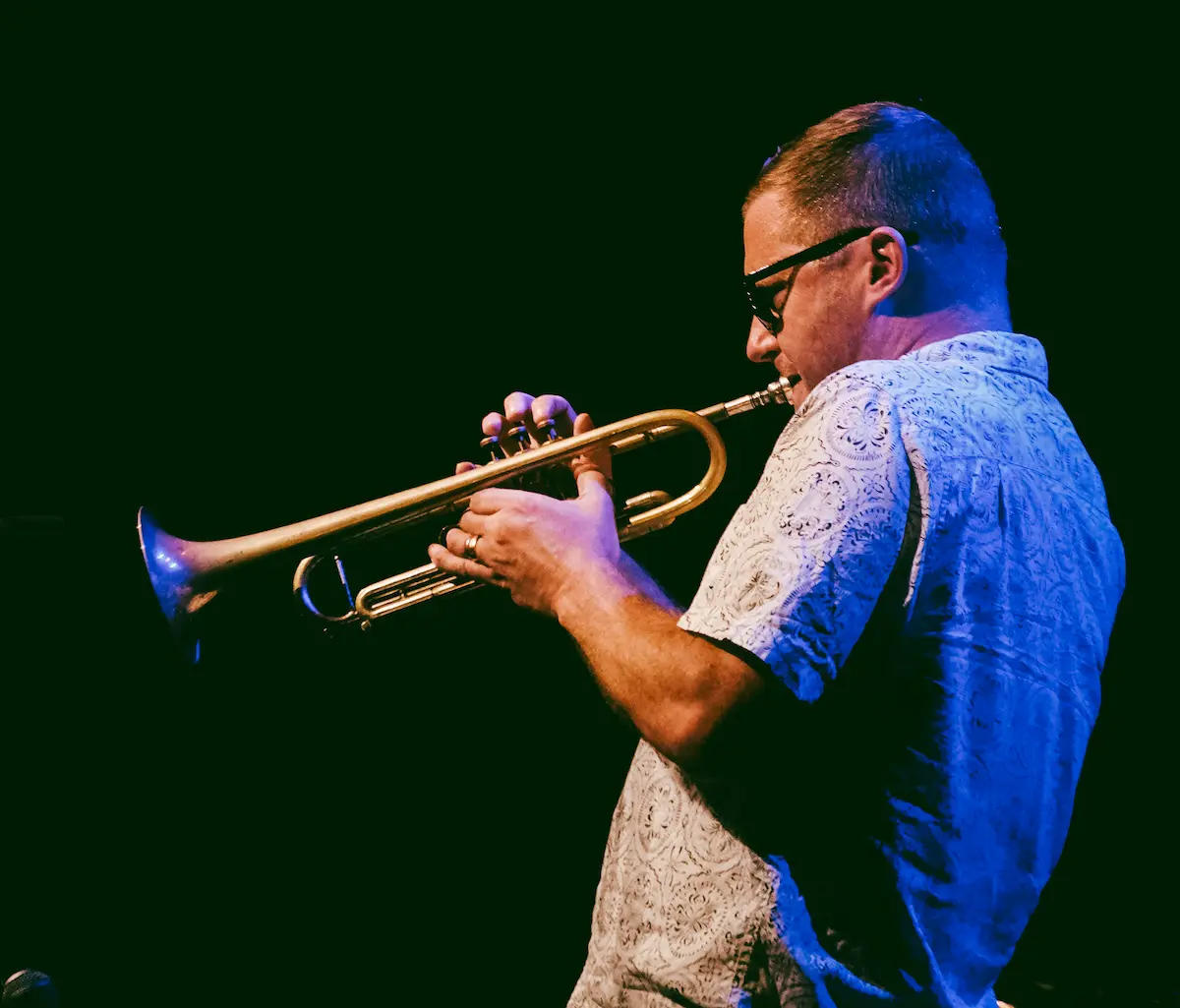
The third studio album by Melbourne psychedelic jazz ensemble I Hold the Lion’s Paw follows their releases Abstract Playgrounds (2018) and Lost In Place (2021). The ensemble was at one time a loose one, drawing on a rotating cast, but now it’s a fixed quartet of Reuben Lewis (trumpet, synthesisers), Emily Bennett (voice, synthesisers), Adam Halliwell (bass guitar, guitar) and Ronny Ferella (drums). Miles Davis’s early 1970s work remains a key influence. “After listening to Bitches Brew and In A Silent Way, Live-Evil changed everything for me”, Reuben Lewis commented to me by email.
He founded and leads the group, and is the main composer. Apart from Miles, influences include Ornette Coleman’s Free Jazz, Don Cherry, Sun Ra, Laurie Anderson and Jon Hassell. However, the overall impression is a lot grittier than Jon Hassell’s rather ambient releases. The new album features more use of electronics and synths, and also spoken word and vocalising.
On the opening Level Check/Voodoo, guest poet Tariro Mavondo – Zimbabwean-born but raised in Melbourne – recites rapidly and excitedly. The haunting Prime Time features Lewis’s Milesian trumpet. Mechanical Ghosts features spare, eerie electronics, drums and trumpet. The fractured Leave is nu-soul-influenced, with Emily Bennett’s synth-inflected vocals – too auto-tuned and humanoid for my taste, I’m afraid. The hallucinogenic Progressive Opposition highlights Adam Halliwell’s double-neck and 12-string guitars, as well as bass. When The Earth And Sky Conspired makes for a furious conclusion.
This is sophisticated, thought-provoking music. Though I’m not always a fan of the spoken words and vocalising, such developments show that Reuben Lewis is always posing new strategies, and new resolutions. Highly recommended.