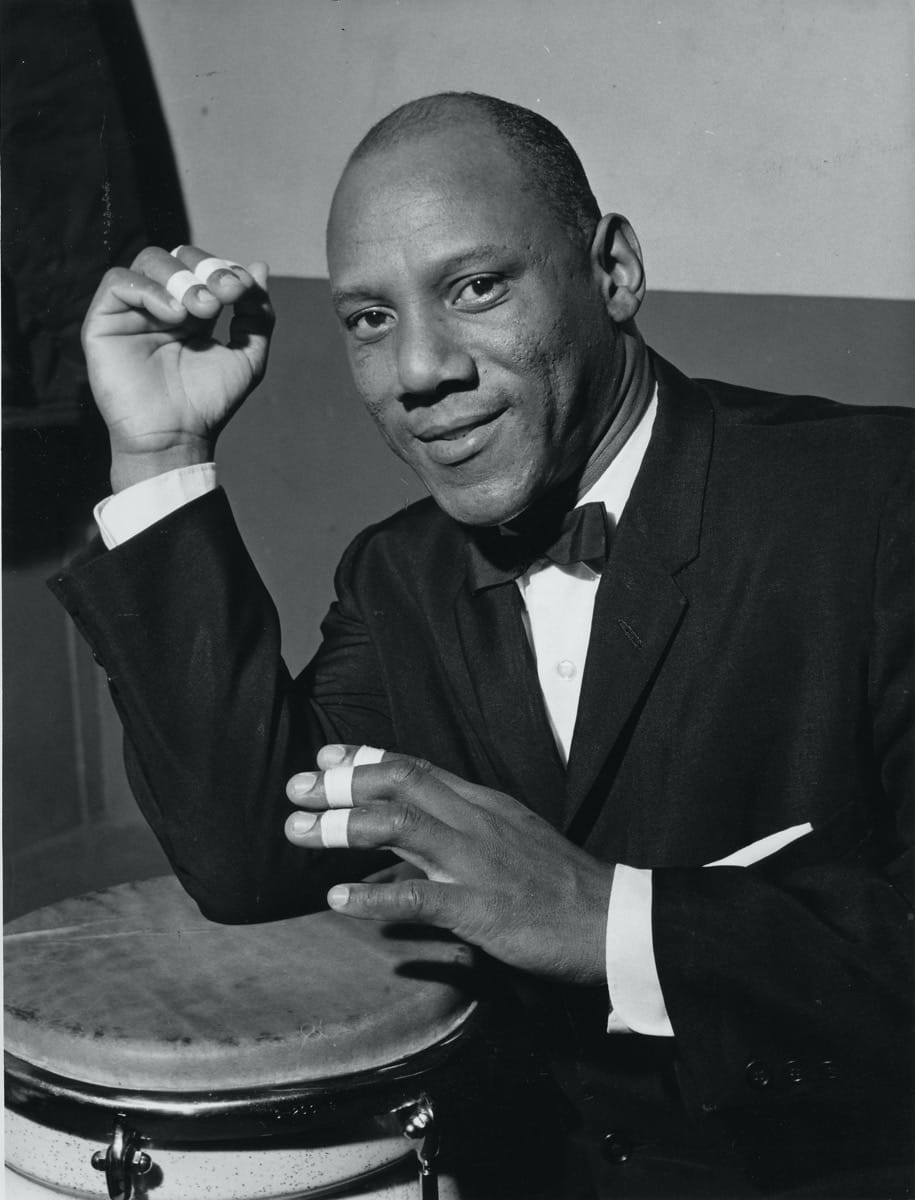
Candido: Conga Soul (Descarga Records 637012)
Cándido de Guerra Camero (Cándido), along with Chano Pozo, is one of the best-known conga players to have brought that instrument into the mainstream of the jazz idiom. Cándido himself played with Stan Kenton, Charlie Parker and Dizzy Gillespie amongst many others. He was often a “first call” percussionist from the mid-40s to the 60s, able to bring a slightly exotic atmosphere to many a live and recording session.
For this session from 1962, originally issued on the Roulette label, he had some quality company in Jimmy Cleveland, Jay Cameron, Lalo Schifrin, Charlie Persip, Milt Hinton and George Duvivier. Although the leader’s congas and bongos are mainly well-up in the mix and feature strongly in the solo department, his accompanying musicians do get space to air their talents. Cameron particularly figures strongly throughout, listed as playing baritone but presumably also responsible for the alto and flute breaks.
There are unusual takes on tunes like The Lady Is A Tramp, The Champ and Big Noise From Winnetka, Schifrin being the supplier of arrangements for each track on the album, including his own material plus the originals from Cándido who displays all his gifts, either alone or in conjunction with Persip. This release comes as a limited edition on 180-gram vinyl. Cándido died in 2020 at the grand age of 99 and was the subject of a JJ obituary by John White.
John Lee Hooker: House Of The Blues (Number One Essentials 291030)
Originally issued by Chess in 1959, House Of The Blues took a while to resonate with blues enthusiasts, eventually becoming a success due to the blues boom of the 1960s. It made the UK album charts in February 1967, being the first Hooker album to reach such popularity. On this latest manifestation, on 180-gm vinyl, the original front cover is reproduced and there are two bonus tracks.
Typical of bluesmen, much of the music revolves around problems with women, whether it be warning off predatory males from messing with one’s wife, as on Leave My Wife Alone, bemoaning the departure of a partner, as in Ramblin’ By Myself, or accepting the fact that some members of the female gender are High Priced Women. All the tunes are Hooker originals except the two extra items Union Station Blues and Groundhog Blues, regarded as traditional.
He is joined by Eddie Kirkland on four selections on second guitar, with Bob Thurman (piano), Boogie Woogie Red (piano) and Tom Whitehead (drums), who play on one track each. Their contributions seem almost unnecessary, for this is John Lee dominating all the way in a very basic but wholly authentic manner whatever the tempo or subject matter.
John Coltrane Quartet: Africa/Brass (20th Century Masterworks 350286)
In his short but highly perceptive sleeve-note, Brian Morton puts Africa/Brass in its correct context when he says “It stands perfectly poised between his [Coltrane’s] first experiments and the greater statements of his last years.” He also reminds us of the intention the saxophonist had of planning to work on the arrangements with Gil Evans but eventually settling for the relatively untested skills of McCoy Tyner and Eric Dolphy.
The regular quartet of the leader with Tyner, Reggie Workman and Elvin Jones was augmented by a distinguished cast of musicians including Booker Little, Freddie Hubbard, Pat Patrick, Julian Priester and Dolphy. The arrangements were clearly geared to the basic group’s ethic, with the extra personnel asked to deliver unfussy, effective springboards and backdrops on which Coltrane and co. could operate. The saxophonist uses both tenor and soprano, the latter only in evidence on Greensleeves, a dip into the familiar and sharing a degree of popularity with his version of My Favorite Things – maybe still a little controversial in Coltrane admiration circles.
The outstanding track is Africa, running near to 16½ minutes and heralding the similarly lengthy performances that would become the norm for Coltrane. He digs into his own composition in commanding fashion, leading critic Scott Yanow to say his effort was “quite rewarding and sometimes haunting”, whereas others might say simply spiritual. Whatever, this is the man delivering a message he became unashamedly associated with, buoyed up by the bold statements of Tyner and the muscular urgings of Jones.
On the original album, there were only three selections, Blues Minor being the other one, but for this release on red 180-gram vinyl we get two bonus tracks which come from the same sessions. The first of these is Cal Massey’s The Damned Don’t Cry and the second a traditional tune, Song Of The Underground Railway, the two fleshing out the programme beautifully.