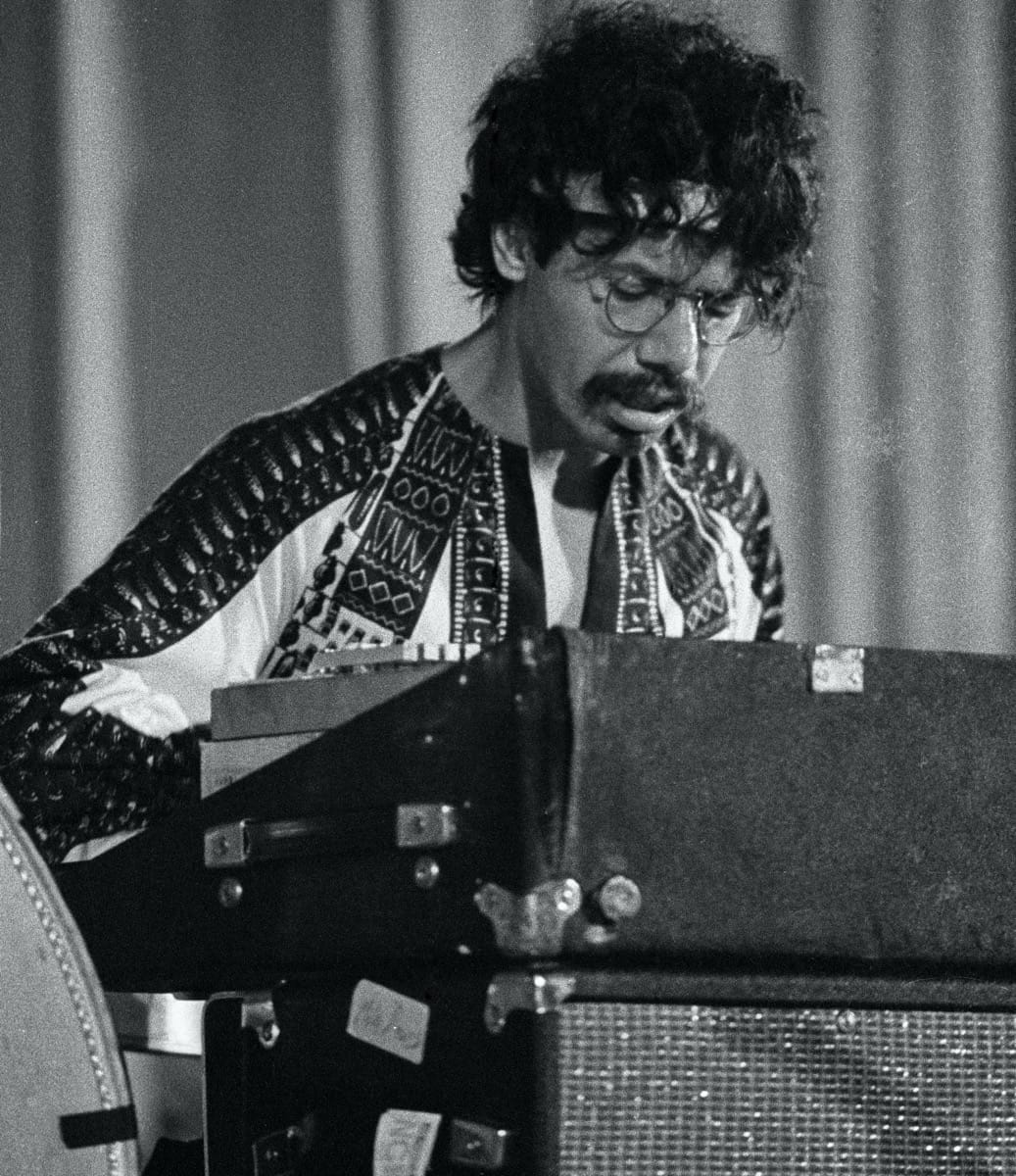
New York City may be the jazz centre of the world, but interviewing musicians there is less easy than it sounds. Many musicians live elsewhere and play infrequently in the New York clubs, some are buried anonymously in the city’s recording studios, while others are reluctant to give interviews for a variety of reasons and are more interested in playing their music than talking about it. Chick Corea is the interviewer’s dream. He is talented, successful, extremely articulate, and full of very positive and committed ideas as to the direction of his personal life and his music. Moreover, Chick is only too happy to make himself available to discuss these ideas and is deeply concerned about the problems of communication between the artist and his public.
Jazz polls are notoriously unreliable guides to musical quality but they do serve as useful barometers of critical and popular opinion. In this respect it is worth noting how Chick Corea has fared in polls conducted during the past couple of years by Downbeat magazine. In the International Critics Poll conducted in the summer of 1973 he came second in the piano category and first in the composer section. By the following summer he had alienated the critics to such an extent that he slumped to fifth place in both categories. In the meantime his popular stock rose proportionately and in the more recent Readers’ Poll Chick won both the piano and the composer’s awards, and in addition was voted jazzman of the year with 176 votes more than his nearest rival. It would seem that his efforts to reach more people with his music are proving successful whatever the critics may think.
For someone so obviously a key figure in the contemporary jazz scene Chick Corea’s musical roots go back further than one might expect. He was born in the Boston area in 1941 and since his father was a jazz musician Chick’s exposure to the music began at a very early age. ‘I was just surrounded by jazz. My father had all kinds of 78 records around the place. At that time he was listening to Dizzy Gillespie’s big band, Bud Powell, Charlie Parker, the Billy Eckstine band and Sarah Vaughan.’
Chick’s jazz education wasn’t confined to listening to records. Boston in the 1950s had its own jazz community centred on two clubs – The Stables, where Herby Pomeroy led a big band and organised jazz workshops, and George Wein’s club Storyville, which imported talent of the calibre of Miles Davis and Horace Silver. Horace Silver and Bud Powell were Chick’s two main influences at this time, but as he was quick to point out his interest wasn’t confined to pianists. ‘I was influenced by all the great bebop players to some degree. I studied their music. I studied Charlie Parker’s way of playing, and the music of people like Dizzy Gillespie and Fats Navarro.’
If Chick’s musical influences in his formative years were largely jazz oriented, his formal musical education was much more orthodox. He studied for three years with a classical pianist who didn’t like jazz, but who taught Chick a great deal about classical piano technique and the classical piano repertoire.
Corea has firm ideas as to the importance of the right kind of education for the jazz musician. ‘Education is the thing which enables us to grow and become more aware. A person becomes freer in any subject if he is literate in it. In music, illiteracy is simply the inability to read and write musical notation, and musicians who can’t do this are at a disadvantage. It’s more difficult for them to communicate what they create to other musicians and to work with them. So the ideal situation is to have some sort of balance between literacy in a subject and actual creative talent. Too often the educational systems are antiquated and mechanical, and they seem to put far too much emphasis on theory and not enough on what the student’s own personal goals are. People like Charlie Parker and Erroll Garner, who say they learnt on their own, give the impression that they had no education. But the fact is that they studied and worked hard to accomplish what they did – and that also is a form of education. If they practised for eight hours a day, they were educating themselves. No one gets any place without that sort of thing.’
Chick became a professional musician as soon as he graduated from high school. He started that first summer working with a Dixieland show band in Las Vegas, and made a living during the next few years playing with a variety of dance bands and Latin bands led by people like Mongo Santamaria and Willie Bobo. The chance to play jazz full time came when Chick joined Blue Mitchell’s quintet in 1964. This was the first of a number of rewarding musical experiences. Between 1965 and 1971 Chick worked mainly with Herbie Mann, Stan Getz, Sarah Vaughan and Miles Davis.
‘If everyone is interested only in their own creation we will continue to have chaos on this planet. There are basically two approaches to music. It can be art for art’s sake, music for music’s sake, or it can be music in order to communicate’
As one listens to the records which Chick Corea made under his own name during these years, and to the records he has made since leaving Miles and forming his own band, one is struck by the incredible variety of the music they contain. From a comparatively orthodox but brilliantly executed piano trio record like Now He Sings Now He Sobs to the more complex avant-garde music which Chick made as part of the group Circle to the singing swinging lyricism of the first edition of his band Return To Forever and finally to the high-energy electric-rock influenced music played by the present version of the band – the stylistic and emotional range of the music is enormous. It is in fact so varied that it doesn’t always sound like the music of the same person.
In fact this observation is not so far from the truth. For six years Chick Corea sought self-realisation through the practice of yoga and meditation, and for the past three years he has been deeply involved in the Scientology movement. Chick is quick to point out the influence of this involvement on himself and on his music. ‘I’ve changed incredibly as a person during this period, striving to find what’s true for me. Every new musical step that I’ve taken has been primarily begun by a change in myself and my own attitude towards life, and new realisations about myself in relationship to the world. This brings about a whole new approach to everything including my music, which is closest to me. The biggest change happened right towards the end of my period with Miles’s band and just before forming Return To Forever. I no longer felt good about being just an experimental musician. I wanted to change the relationship of my art to people and the world, not to be so detached, but to be able to create the kind of experience which enhances not just my dynamic urge but also helps my group, the audience, and society in general.’
In conversation, Chick Corea laid repeated emphasis on how much importance he and the members of his band attach to evolving a music which would communicate with more people and reach a broader audience. The dangers of such an attitude are obvious enough. Music is liable to suffer if its direction is determined by the tastes of an audience rather than by what the musicians themselves want to do. Moreover, nothing alienates the fraternity of jazz critics more than commercial success and Chick Corea has already come in for his share of condemnation as someone who has compromised his artistic integrity in the pursuit of fame and fortune. Chick interprets what he is doing in a very different way, however. ‘In the field of the arts, the artist has tended to put himself in another-worldly place where the thing that’s most precious is his own creation. To me the lie in that is that everyone has within them the ability to create. So to me what’s much more important is how we help one another get on in life. If everyone is interested only in their own creation we will continue to have chaos on this planet. There are basically two approaches to music. It can be art for art’s sake, music for music’s sake, or it can be music in order to communicate, music designed to enable people to experience pleasure and beauty, and to rekindle their own desire to communicate. Connected with all this, there’s another phobia which is called commerciality. Commerciality simply means availability to numbers of people, something that can be exchanged. I give you something, you give me something. Exchange is one of the operating procedures of life. Because there are artists who are money and success motivated, there is a tendency to equate success with dishonesty. But I propose to break that illusion down in this life-time.’
‘In this country I think the black and white issue is really over, it’s very passé right now, certainly among musicians. Colour of skin, ethnic origin or educational background are simply non-issues’
In a superficial sense there may appear to be a certain similarity between some of Chick Corea’s ideas about the potential role of music, and those expressed by many of the younger black writers and musicians in America. They too have rejected the concept of art for art’s sake and have emphasised the functional potential of art. There, however, the similarity ends, for while the more committed black artists try to use their art as a form of socio-political protest and a useful weapon in the development of black consciousness and the furtherance of the black revolution, Chick’s perspective is very different. ‘Revolution tends to cause more revolution, turmoil and upset. The revolutionary is too ready to enforce his own ideas on others, to change existing conditions by force rather than through reason and love.’ The disparity is also apparent when Chick talks about the racial problem in America in general and among musicians in particular. ‘In this country I think the black and white issue is really over, it’s very passé right now, certainly among musicians. I never think about it. If you just look at our group. There are about eleven people in it including management and musicians, and this includes Black people, English people and Italian people. Colour of skin, ethnic origin or educational background are simply non-issues. We laugh about it sometimes when we see people attempting to determine the value of someone by his ethnic background, because it’s so ridiculous, it’s an insane attitude.’
If the direction of Chick Corea’s music has been determined in part by philosophical and spiritual consideration, a wide variety of musical influences have also been important. In addition to the names of various jazz musicians Chick also mentions the influence on him of composers like Satie, Debussy, Ravel, Stravinsky and Bartok, and in a very different way, of certain rock musicians. ‘I think the music of Stevie Wonder has been an influence for all of us in the band. We all love him and his music. Sly Stone has influenced us too. It’s more than a technical thing. It’s more a matter of feeling and a way of communicating that we’ve got from these people. I’ve observed the way in which an artist like Stevie Wonder will take the form of his music and make it very available to people. It’s easy to get into his music because of how he creates it formally and because of the nature of his intentions. Technically we can do anything in this band. We’re musical professionals with a high level of technique on our instruments. But it’s sometimes difficult for us to play something very simply, that can be directly communicated, but it’s our goal to succeed in doing that.’
The success which Return To Forever has already enjoyed in this direction is reflected in the degree to which their audience has changed along with their music. ‘Our audience has changed vastly. Maybe it’s not so much changed as expanded. I don’t feel we’ve lost too many old fans. We have lost some jazz fans, at a rough guess maybe about 20% of the people who liked my earlier records and the first version of Return To Forever. We’re now commercial in their eyes. But we’ve retained 80% of them and we’ve reached a whole new group of people, especially the young rock audience.’
It would certainly be misleading to suggest that Chick Corea is unaware of the potential financial rewards of this kind of exposure. He talks quite openly about the fringe benefits of commercial success; the greater freedom which it could give him to spend more time on composition and on studying the use of the synthesiser; the fact that it would enable him to expand the size of his band. However, underlying much of our conversation was Chick’s sincerely held conviction that his priorities lay elsewhere, that success was simply a means to a very different kind of end. This came out most clearly when I asked him if he had any aspirations to join the select and highly paid world of jazz-rock superstar. ‘Not really, but I know it will happen, because I do have aspirations with this band to communicate very high quality music to a lot of people. I want to do it because the rewards of it are that people who don’t usually get into fine arts, people who don’t usually get the creative goals that are within them rekindled enough to do something in this lifetime, can be changed when they hear our music. They get into fine arts, they get into jazz and listening to classical music, they get into music as an aesthetic art form and they also get into wanting to do things themselves. And that for me is a great reward for doing the kind of thing that we’re going to do. Another reward that I’m seeking to get is firm acceptance of the idea that it’s not necessary to be dishonest in order to communicate. That you can really be yourself and still communicate to everybody without compromising your own true goals and your own creative reality. I want to get agreement on that idea because I know it’s true. So the way I can get agreement on it, is by us doing it.’