John Coltrane: Ascension
Never as popular as A Love Supreme, its much celebrated predecessor, Ascension was a real shock when first released. Not long before this session Coltrane was still recording songs like Nature Boy and Chim Chim Cheree, although for quite some time radical developments had been evident in his music. The more conservative of his fans had been able to take comfort from albums like Ballads, and the meetings with Duke Ellington and crooner Johnny Hartman. Those recordings were probably attempts by the Impulse! label and producer Bob Thiele to hang on to customers who were getting uneasy about those radical tendencies, evident on live recordings like Chasin’ The Trane and the partnership with Eric Dolphy, as well as his association with the likes of Archie Shepp. It seemed a clear, somewhat unsettling case of the master learning from the pupils, but that was the kind of humble and generous-spirited guy that Coltrane was: it seems likely that he arranged the session as a leg-up for younger, lesser-known players, perhaps especially for Pharoah Sanders, just as he had been so open to letting anyone jam with his classic quartet, a practice that contributed to the departures of Elvin Jones and McCoy Tyner.
Ornette Coleman’s similarly controversial Free Jazz preceded it by five years, but Ascension seemed a more ferocious and nihilistic attack on the established jazz tradition, although there was some sort of formal guide, and it is periodically way-marked by ensemble passages founded on a five-note motif. The sleeve notes to the original mention that sheet music was handed out at the start of the session. At the time, Shepp recalled that the use of the chords (or was it modes?) that the sheets contained was optional. Later he suggested that most of the musicians didn’t even get these sheets. Several years ago I interviewed John Tchicai and he said that he had no recollection of getting anything on paper.
Confusion seemed to have surrounded the album. Trane spoke of being unaware of how the music was sounding overall because he was concentrating so hard on such structure and development that the music had. Early LP pressings contained the second take, which Coltrane is reported to have approved, but he changed his mind and subsequent pressings were of the first take. In that version Shepp moved down the batting order, soloing after John Tchicai, and Jones’s solo between the bass duet and closing ensemble is dropped. Coltrane’s change of mind seems to have been that he wanted to separate the two alto solos. However, the stimulating sleeve-notes to this reissue posit a few other possible explanations, but there’s no room to set those out here.
Sanders is more coherent than was usual at that time, his solos employing a degree of thematic development, forsaking his preference for freaky sounds like his remarkable underwater gurgle. Tchicai’s first solo stands out not only because of his marvellous tone but because of the more structural tendencies of his improvisation, his methodical examination of motifs coming closer to Trane’s own dog-with-a rabbit approach than the freer flurries of most of the others. Brown, probably the least celebrated of the participants, plays superbly throughout. Trane seemed to have put aside his anxiety about how the session was going, and his solo on the second take is outstanding, both adventurous and authoritative.
It became fashionable to dismiss hard-bop master Hubbard’s contribution as backward-looking and unadventurous. Although he relates to a more familiar style of improvisation (as, indeed, did Tyner) he struggles manfully to come to terms with the “New Thing”. On the first take he solos with considerable intensity (or desperation?) and produces some really riveting music.
See Jazz Journal’s first assessment of Ascension, 60 years ago.
Discography
Ascension (Edition II); Ascension (Edition I) (78.54)
Hubbard, Dewey Johnson (t); Brown, Tchicai (as); Coltrane, Sanders, Shepp (ts); Tyner (p); Art Davis, Jimmy Garrison (b); Jones (d). New York, 28 June 1965.
Verve Vault 00199957117982
Michel Portal: Any Way
The distinguished French boundary-crossing musician Michel Portal died 12 February this year at the age of 90. He was an accomplished reeds player and composer, and grew up in a musical household and discovered jazz through listening to the radio after World War 2. He went on to study clarinet and conducting at the Paris Conservatoire. His early career was in light music and he went on to work in classical music contexts as well as jazz. He also played on a recording of Karlheinz Stockhausen’s Aus Den Sieben Tagen which involved improvising, albeit within guidelines set by the controversial composer. Portal also won three Césars, the French counterpart to the Oscars, for his film scores. In the 60s he was experimenting with free jazz, playing with Sunny Murray and Anthony Braxton and participating in the free-jazz band New Phonic Art. He also worked with Stockhausen’s trumpet-playing son, and with the great British saxophonist John Surman. If memory serves, it was then that I first heard him. Like Surman he was part of a collection of musicians developing a new movement in European jazz.
Any Way is a collection of recordings from 1991 and 1992 and was originally released in 1993, when Portal was a stripling in his late 50s, and there was still considerable fire and adventurousness in his music. Except for Mino Cinelu’s Octaver all the compositions are Portal’s own and cover a wide range of moods and styles, reflecting that varied career. My rusty O-level French can’t make much of the sleeve-notes but the music speaks eloquently for itself and the distinguished performers do the compositions proud, not least on the funkier numbers, of which there are several. Altogether a fine and worthy memorial to Portal. Sorting out the discographical details was a bit of a nightmare though so I give only a collective roll-call here, and most of those listed appear on just one or two tracks.
Discography
Sons Mêlés; Toccata; Any Way; Octaver; James; Intranquilo (46.48)
Kenny Wheeler (t); Robin Eubanks, Yves Robert; (tb); Portal (s, bcl); Mino Cinelu (p, kyb); Andy Emler, Bernard Lubat, Gil Goldstein (kyb); Marc Ducret, Kevin Eubanks; Nguyên Lê (g); David Friedman (mar); Didier Lockwood (vn); Francois Moutin, Victor Bailey (elb); Daniel Humair (d, pc, syn); Trilok Gurtu (pc). Paris and New York, 1991 and 1992.
Label Bleu LBLC6544
Suncuts: Collective Heliophobic Dream
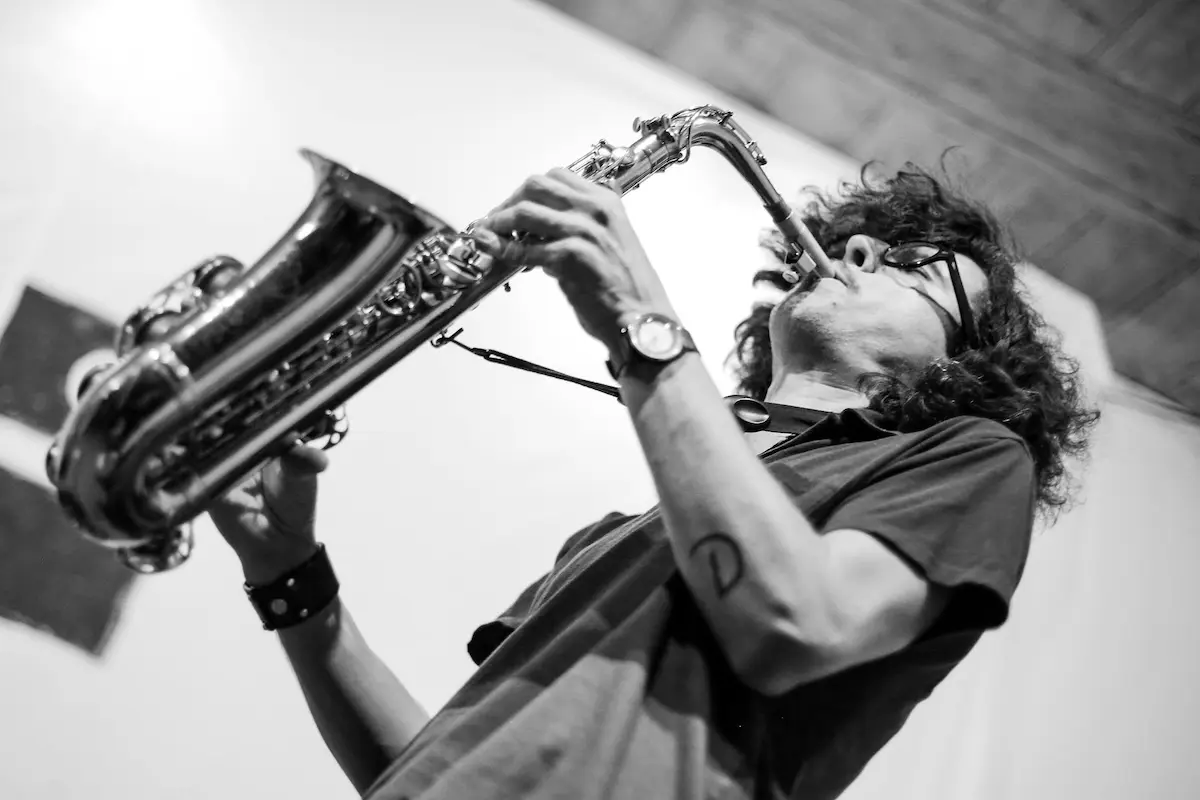
I think it was journalist Steve Lake who coined the term “Splatter Jazz” in the absence of any adequate label to describe the loud and intense music of all-star group Last Exit, the ferocious quartet active from 1986 to 1994 which consisted of saxophonist Peter Brotzmann, guitarist Sonny Sharrock, bassist Bill Laswell and drummer Ronald Shannon Jackson and which mixed free jazz, blues, heavy metal and hardcore. I think the term can reasonably be applied to Suncuts. Evolving from an earlier project called Tufelskeller, Suncuts emerged in 2023 when Tufelskeller was unable to field a full team for a gig at the Xciting Festival in Stuttgart. Anton Ponomarev brought in Swiss drummer Maxime Hänsenberger and Brazilian bassist Felipe Zenicola as substitutes.
The opening track struck me (an apt term) as being noise for noise’s sake and is fittingly titled as it throws you straight into the jaws of the beast. If you can cope with that the rest of the album won’t cause you any problems. Still raucous and anarchistic, the remaining tracks exhibit more evidence of genuine interaction. It’s invigorating or exhausting, depending on your mood and taste. I enjoyed it for its exuberance and edge-of-the-seat conviction. The album is available for streaming via Bandcamp, as a download, and on a limited edition LP. Diffused Memory does not appear on the LP.
Discography
Maw; Cut Through The Silence (parts 1 & 2); Diffused Memory; Broken Spectrum (43.26)
Anton Ponomarev (s, elec); Felipe Zenicola (b); Hänsenberger (d). Biel, Switzerland, 4–5 December 2023.
Unit Records UTR 5269