
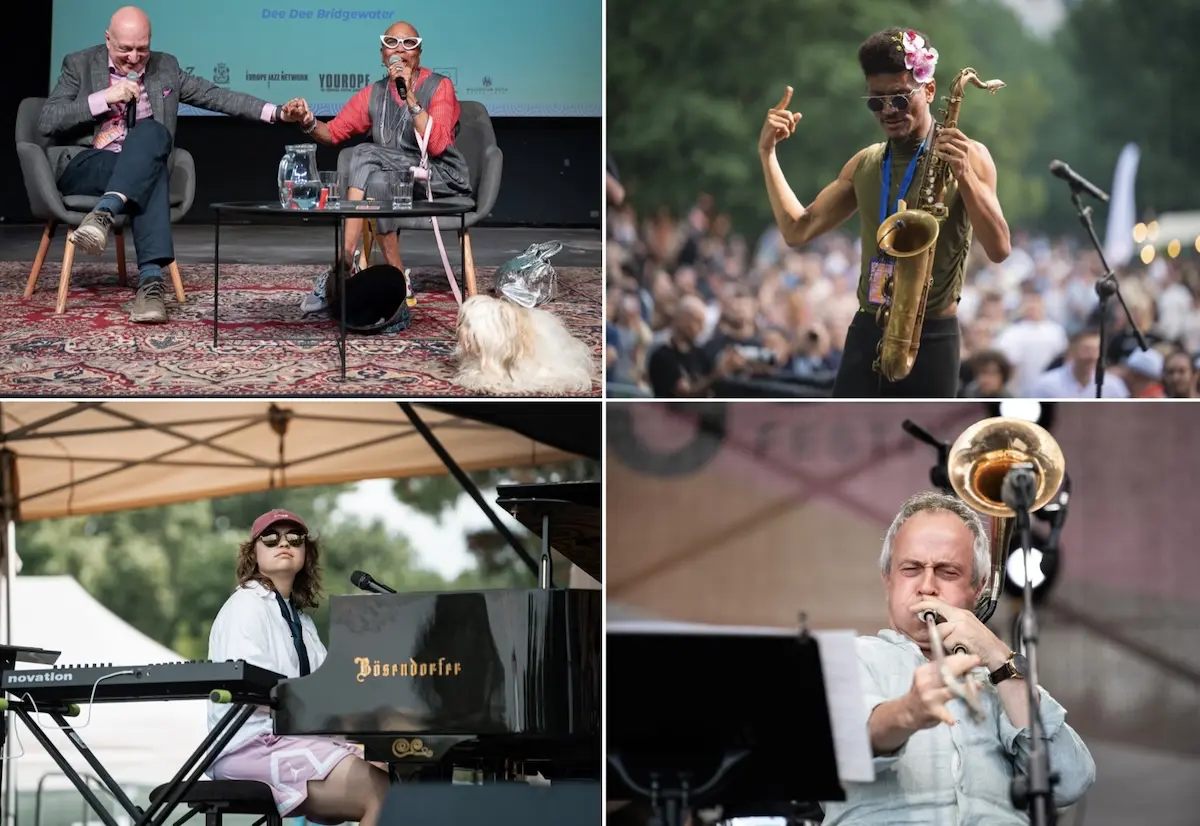
The A to JazZ Festival marked its 15th anniversary in Sofia’s South Park 2, a leafy setting in one of the few European capitals where mountains rise within easy reach of the city. Aptly named, A to JazZ tries to embrace jazz from A to Z (but also some world music), presenting an impressively eclectic programme every evening from 6 p.m. on its main stage. Free admission has always been one of the festival’s greatest strengths, successfully bringing jazz to a broad audience. Blessed with glorious summer weather, the park soon became an ocean of picnic blankets through which one almost had to surf to make any progress.
Although the festival officially opened on Thursday, the jazz programme truly came to life on Friday, as the opening day is dedicated to world-music showcases. Among the Thursday highlights was a deeply evocative Carnatic trialogue by Norway-based Indian vocalist Uma Ranganathan. Like flamenco, Carnatic music places improvisation at its core, creating a natural affinity with jazz. Another memorable performance came from the Nubras Ensemble, which built an inspired musical bridge between southern Italy and Bulgaria, featuring Diyana Vasileva of the renowned Mystery of the Bulgarian Voices.
Running alongside the concerts since 2018, the festival’s music conference once again brought together promoters, festival directors, venue programmers and other music industry professionals. Among the speakers was respected British jazz figure Paul Pace. At a time when musical nationalism appears to be gaining ground and international touring is becoming increasingly difficult, Pace recalled how Ronnie Scott’s co-founder Pete King negotiated a landmark agreement with the American Federation of Musicians, opening the doors for US musicians to perform in Britain. The rest, as they say, is history: Ronnie Scott’s became one of Europe’s legendary jazz clubs, thanks in no small part to the countless American jazz icons who continue to perform there during their European tours.
Towards the end of his presentation, Pace was unexpectedly joined by Dee Dee Bridgewater for an impromptu conversation. The legendary vocalist arrived accompanied by Daisy, the dog who helped her through medical depression. She fondly remembered her first performances at Ronnie Scott’s, recalling how cigarette smoke – still permitted in those days – affected her voice. Reflecting on a career spanning more than 56 years, Bridgewater also spoke candidly about the sexism she encountered throughout the jazz world. It was one of the reasons behind the creation of her all-female We Exist! project, which she describes as a direct challenge to the patriarchy that has long dominated jazz.
Later that evening, she closed Saturday’s programme with a commanding performance. Before delivering Nina Simone’s Mississippi Goddam, she reminded the audience of the circumstances that inspired the song and explained why its message continues to resonate in what she called Trump’s “Ununited States”. Bob Dylan’s Gotta Serve Somebody was dedicated to the “orange king”, leaving little doubt of whom she believes he chose to serve throughout his political career. Judging by the sheer joy she radiated before several thousand spectators, it was hardly surprising that Bridgewater seemed reluctant to leave the stage despite an early departure the following morning. An unaccompanied rendition of Amazing Grace provided a moving encore, perfectly suited to a concert held on the Fourth of July.
Among the younger artists making their debut on the festival’s main stage, Polish pianist Hania Derej was arguably one of the coolest performers of the weekend. Wearing a cap, sunglasses and sportswear, she opened her set in trio format before gradually expanding her sonic palette. Singing wordlessly over the Bösendorfer, she later moved to keyboards, giving her original compositions a more atmospheric dimension. Alternating between acoustic and electric textures, she eventually invited an alto saxophonist to join the trio, transforming it into a quartet and deliberately raising both the intensity and the volume.
Being the child of a jazz legend can be both a privilege and a burden, especially when following the same musical path. Such is the case for saxophonist Tomoki Sanders, son of the late Pharoah Sanders. Although his performance began promisingly, it gradually lost momentum, with the second half offering fewer genuinely compelling musical ideas.
Miles Davis’s legacy was represented by another family member. His nephew, drummer Vince Wilburn Jr., founded the Miles Electric Band (M.E.B.) in 2010, bringing together a rotating cast of accomplished musicians to celebrate Davis’s electric period. As festivals around the world mark the Miles Davis centennial this year, the 10-piece ensemble proved one of Friday evening’s undisputed highlights, revisiting repertoire ranging from Bitches Brew (1969) to the 1985 interpretation of Michael Jackson’s Human Nature.
Bulgarian jazz was naturally also featured in the festival. Now based in France and well established on the European scene, trombonist Gueorgui Kornazov presented his Autumn Impressions project with an unusual line-up featuring accordionist Didier Ithursarry, drummer Eric Echampard, tubist François Thuillier and trumpeter Quentin Ghomari.
Double bassist Victoria Kirilova, perhaps less familiar to international audiences, impressed with her quartet comprising clarinettist Oscar Antoli, pianist Dimitar Gorchakov and drummer Borislav Petrov. Her deeply expressive performance included several compositions from her album Roots & Skies, confirming the promise already evident on record. The album was reviewed by Jazz Journal.
She was followed on Saturday by drummer Emil Tassev, whose quartet offered one of the festival’s most intellectually intriguing performances. Also a physicist, Tassev drew inspiration for his debut album Tesseract from four-dimensional geometry, using the mathematical figure as a metaphor for realities beyond human perception. Listening to his music, one could almost imagine the shifting geometric visions often described during ayahuasca ceremonies.
Jazz itself is perceived differently depending on where one listens. Those stretched out on picnic blankets inevitably experience the music differently from listeners standing at the front of the stage or the VIP guests enjoying drinks in their private enclosure. Yet what ultimately matters is the collective energy flowing between musicians and audience. When the 11 p.m. curfew brought each evening on the main stage to a close, many festival-goers naturally migrated to Toplocentrala, the indoor venue located at the entrance to South Park 2. There, the music continued well into the wee small hours of the morning, with local bands joined by guest musicians from the festival programme and even a member of the organising team, Veleka Tsankova, who also happens to be an accomplished jazz vocalist.
Replying once to someone who thought jazz was dying, Dee Dee Bridgewater said “Look at me – I’m not dead.” The crowds at A to JazZ offer equally compelling evidence that jazz is here to stay. Over the past 15 years, founder and festival director Peter Dimitrov has succeeded not only in bringing jazz to the people, but also in bringing people to jazz. Judging by the atmosphere in South Park 2, there is every reason to wish him and his team many more years of success with one of Europe’s warmest and most welcoming jazz festivals.
A to JazZ, Sofia, Bulgaria, 2-5 July 2026. atojazz.bg/en