The Jazz in the Park Festival returns each year to the ethnographic park of Cluj-Napoca, Romania’s second-largest city. A daytime event running from early afternoon until around 11pm, it attracts some 7,000 visitors daily. Families, often accompanied by their dogs, mingle across the sprawling grounds, transforming the park into a vibrant village filled with activities for all ages. Spread across four stages in the vast Romulus Vuia Ethnographic Park, this year’s edition took place 5 to 7 June.
Artist-in-residence Nik Bärtsch was a constant presence throughout the festival, appearing each day in his trademark black robe. His residency opened on Friday with a solo piano performance, continued on Saturday with his celebrated quartet Ronin, and concluded on Sunday with a duo concert alongside Greek pianist Tania Gianouli.
At one point, Bärtsch’s decision to leave ECM and launch his own imprint, Ronin Rhythm Records, appeared risky. Yet the move ultimately granted him complete artistic freedom and enabled him to support fellow musicians, including long-time Ronin collaborator Sha. As Bärtsch wrote in a 2021 book, jazz is less a style governed by rules and prohibitions than a practice and an attitude. His captivating solo concert on Friday offered a compelling demonstration of that philosophy and set high expectations for Ronin’s appearance the following day.
Drawing extensively from the group’s latest album, Spin, Ronin delivered a festive and hypnotic performance. Bärtsch’s rhythm-driven modular compositions unfolded with remarkable precision while retaining enough surprises to keep the audience engaged throughout the set. On Sunday, back on the same stage beside a beautiful wooden church, Bärtsch and Gianouli faced one another across two pianos for the culminating event of the Swiss pianist’s residency.
The two musicians first met several years ago at the Enjoy Jazz Festival, and it was Gianouli who proposed the collaboration. Announcing that their first album together will be released in October, they enchanted a focused audience seated quietly on the grass. As a gentle breeze moved through the surrounding trees, jazz seemed to drift effortlessly across the park. Even children and dogs remained unusually silent until the final notes faded away. Rarely has the expression “communion with the music” felt so appropriate.
Shortly before the Gianouli–Bärtsch duo, Romanian pianists Teo Pop and Ștefan Rus delivered one of the weekend’s most memorable performances. Their approach was markedly different, rooted in groove and rhythmic momentum. Pop alternated between piano and organ, while Rus expanded the sonic palette with keyboards and electronics. The result was an energy-packed set so danceable that remaining still became nearly impossible.
The same could be said of drummer Ziggy Zeitgeist’s Berlin-based trio. From the outset, Zeitgeist made it clear that dance music would be the guiding principle, producing a sound that at times seemed as suited to a club as to a jazz festival, not unlike some of the DJ sets taking place on a nearby stage.
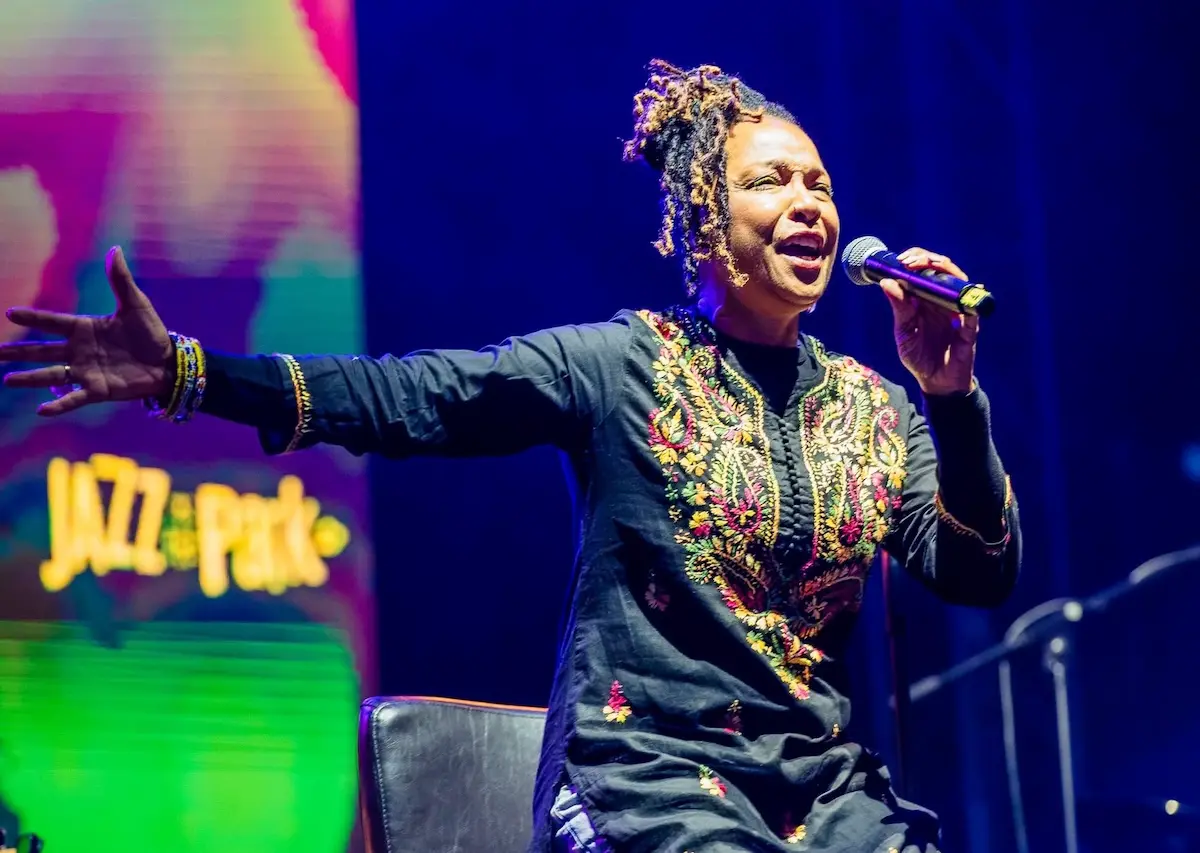
As the main act of the festival, Lisa Simone revisited the repertoire of her mother, Nina Simone. She was ably supported by veteran British drummer Paul Robinson, best known for performing with Nina Simone from 1984 until the singer’s death in 2003. As Lisa Simone recalled, her mother once told her that if she wished to become a singer, she would first have to learn piano – a challenge she never embraced. Beginning her musical career relatively late, the 64-year-old vocalist only started performing her mother’s repertoire a few years ago. Combining Nina Simone originals with songs the legendary artist helped make famous, Lisa Simone delivered the material in a voice entirely her own, bearing little resemblance to that of her mother.
Just as Nina Simone’s protest songs once challenged political and social norms, music throughout the 20th and 21st centuries has frequently found itself at odds with governments of all kinds, democratic and authoritarian alike. This theme resonates with Sounds of Resistance, an exhibition held at the Music Gallery, a project long developed by the festival organisers. Delayed by the Covid-19 pandemic, the venue finally opened last year in the heart of Cluj-Napoca. Among the highlights of the interactive exhibition, visitors can plug headphones into various points on a terrestrial globe. Select London, for example, and the Sex Pistols’ God Save the Queen immediately begins to play.
Back at the festival grounds, there was no shortage of outstanding performances. Particularly memorable was the Norwegian trio featuring pianist Bugge Wesseltoft, veteran bassist Arild Andersen and tabla virtuoso Sanskriti Shrestha. Sharing compositional duties, the musicians left ample room for improvisation, each demonstrating complete mastery of their instrument.
From the Indian textures of the tablas to the Middle Eastern sonorities of the oud, adventurous listeners were equally rewarded by Rabih Abou-Khalil’s quartet, arguably one of the finest ensembles the Lebanese oud master has assembled. Alongside long-time collaborator Jarrod Cagwin, who has toured and recorded with Abou-Khalil since 1999, the group featured two outstanding Polish musicians: violinist Mateusz Smoczyński and cellist Krzysztof Lenczowski. Together they created an eight-string counterpart to the oud’s own eight strings. Displaying his customary sense of humour, Abou-Khalil remarked that violin and cello are easier to play because they each have only four strings, and that whenever one invites a Polish musician, another inevitably comes along. Beyond their roles in the quartet, both musicians are members of the acclaimed Atom String Quartet.
Speaking of strings, Cuban violinist Yilian Cañizares repeatedly expressed her delight at performing at Jazz in the Park for the first time and her hope of returning in the future. She also offered a reflection that resonated strongly with the atmosphere of the weekend: the missions of musicians is to bring light and hope in this dark moment of human history.
As with any open-air festival, the weather remains a crucial factor. Apart from a few brief showers, conditions proved remarkably favourable. Umbrellas, incidentally, were confiscated at the entrance to prevent obstructing the view of fellow spectators in the event of rain.
Following a highly successful 2026 edition, organisers have already announced next year’s dates set from June 25 to 27. Around 1,400 tickets for the 2027 festival were sold on site, aided by an attractive early-bird offer available to the first 500 buyers. Jazz enthusiasts, however, will not have to wait until next summer. Before then, attention will turn to the Jazz in the Park Competition 2026, scheduled for 18–20 September in Cluj-Napoca’s Central Park.
Jazz in the Park, Cluj-Napoca, Romania, 5-7 June 2026