Freddie King: Feeling Alright – The Complete 1975 Nancy Pulsations Concert
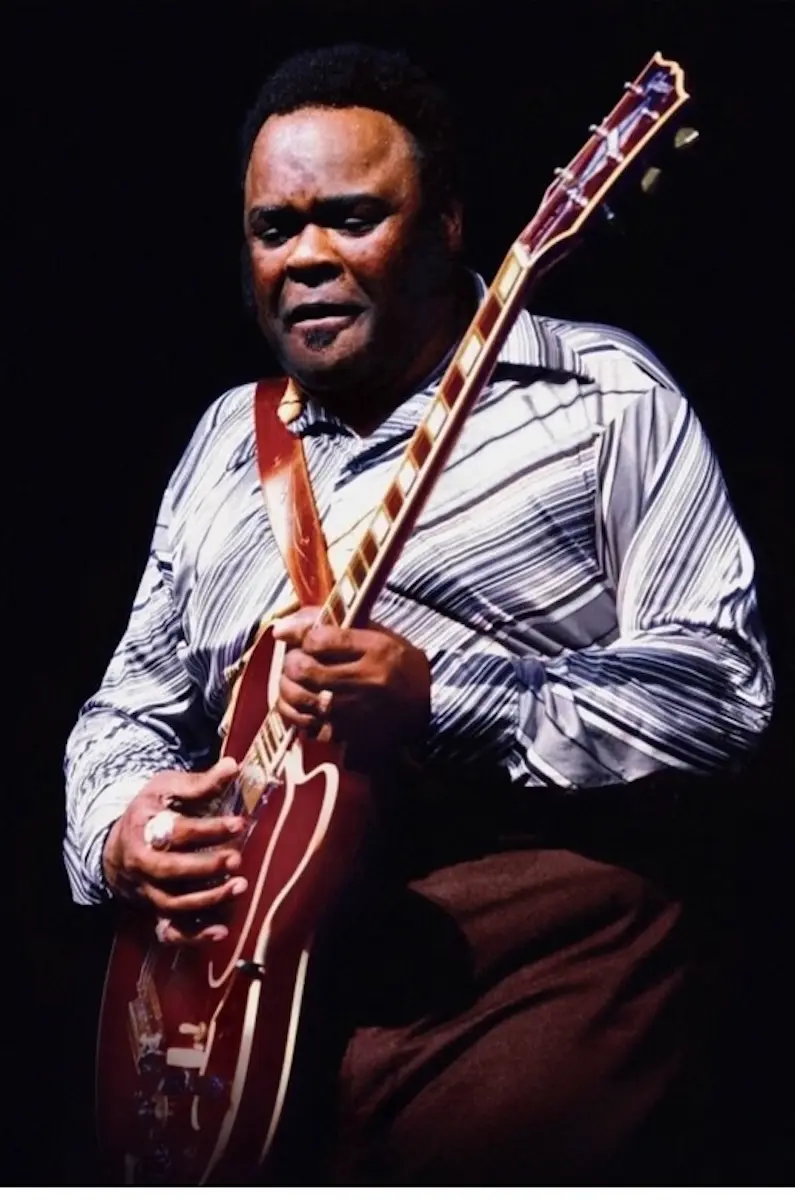
I need to watch Freddie King’s spirit-lifting appearance at the Beat ’66 TV-show on YouTube every now and then. His instrumental hit Hideaway is like a little feelgood movie, King jumping cheerfully on stage like South Park’s Chef on laughing gas, while goosebumps on slow blues I Love The Woman are utterly unavoidable. King’s biting guitar attack was matched by a raw voice that hurled dead cows into a truck.
At that time, the Texas-born, Chicago-bred guitarist, a major influence on the likes of Eric Clapton and Stevie Ray Vaughan, was standing at the crossroads in his career. Fresh out of his contract with the King/Federal label, which had spawned instrumental hits and classics like San-Ho-Zay and I’m Tore Down since the mid-1950s, King was making his bread in the chitlin’ circuit of black clubs. By the end of the 1960s and early 1970s, King had crossed over to the white audience on the strength of records on Leon Russell’s Shelter label and performances at hippie venues like The Fillmore East.
In 1975, the year of this concert in Nancy, King was in a good place, touring relentlessly to big and responsive crowds in Europe. While his namesake and friend, “king of the blues” B.B. King, played tightly orchestrated shows with high-calibre, big swinging ensembles, Freddie King’s format was more loose, his style at the core of small, hard-driving blues-rock bands and often spun-out songs that relied on high-octane grooves or loud-soft dynamics only a powerhouse performer like King could get away with.
Elemental presents the full two-hour set of King’s performance in France. While it’s a lot of the same which is best digested in small doses – uptempo and slow blues with little variation of chord progressions – it showcases a rare ability to keep up a high energy level. His signature song Have You Ever Loved A Woman never fails to draw out the best in King, deep feeling packed in razor-edge licks and scorching vocals. His funk-blues Going Down is brief and to the (breaking) point.
King solidly alternates Chicago blues classics such as Got My Mojo Workin’ with tunes by B. B. King and T-Bone Walker. Best of all, though, is his take on John Lee Hooker’s Boogie Chillun, the musical equivalent to a steam train that smashes through an ambush of hellbound robbers. Hard to beat, although Traffic’s Feeling Alright is a good contender, abundant proof that King, who’d done Bob Dylan and Creedence Clearwater Revival in his time as well, was perfectly able to make rock music his own.
Feeling Alright is the ultimate addition to the handful of posthumous issues of live recordings by Freddie King, boasting excellent sound and a top-notch package (2CD, 3LP) with beautiful photography and enlightening liner notes by, among others, daughter Wanda King.
Discography
CD1: Have You Ever Loved A Woman; Whole Lot Of Lovin’; Medley: Hey Baby / Mojo Boogie; The Things That I Used To Do; Messin’ With The Kid; That’s All Right; Going Down; Stormy Monday Blues (64,40)
CD2:Medley: Sen-Sa-Shun / Looking Good / Boogie Chillun; Sweeet Little Angel; Got My Mojo Working; Sweet Home Chicago; Wee Baby Blues; The Danger Zone; Feeling Alright; You’re The One / Finale (58.26)
King (g); Alvin Hemphill (org); Lewis Stephens (p); Benny Turner (b); Caleb Emphrey (d). Nancy, 10 October 1975.
Elemental 5990457
Charlie Wood: Your Love Is My Home
Memphis-born, New Orleans-bred Charlie Wood accompanied Albert King, George Coleman and Joey DeFrancesco, while maintaining a solo career at the intersection of jazz, R&B and pop. Wood is a soulful singer and keyboardist that instils Your Love Is My Home with heavy doses of wistfulness. There’s no better proof of Wood’s skills than opener A Timeless Place, actually the unforgettable The Peacocks by Jimmy Rowles: warm jug tone, sassy phrasing and a timbre as comforting as a purring cat compete for priority.
It is unmatched though there are various good ballads, including Elvis Costello’s Shipbuilding and Paul Simon’s Still Crazy After All These Years, alternating with Wood’s groovy organ-driven Love Can’t Love Alone and Sam Cooke’s You Send Me, which is fine but missing the x-factor. His rhythm and strings arrangements of Amy Winehouse’s Love Is A Losing Game are very original. In conclusion, though slow mood after slow mood becomes somewhat exhausting in the end, there’s obviously plenty to enjoy.
Discography
A Timeless Place; You Send Me; Shipbuilding; Still Crazy After All These Years; Love Can’t Love Alone; Stardust; Love Is A Losing Game; Home; Willow Weep For Me; Love (39.31)
Wood (v, p, org); Robin Aspland (p); Daniel Franck (b); Ian Thomas & Cornelia Nilsson (d); James McMillan (t); Villads Littauer Bendixen (vn); Lara Biancalana (clo); Ayoe Angelica & Sophie Ziedoy (choir). Sussex, October 2024 and Copenhagen, January 2025.
Stunt Records 257092
Caleb Wheeler Curtis: Ritual
Besides playing soprano and sopranino saxophones and trumpet, Caleb Wheeler Curtis renews interest in the stritch, decades after pioneer Roland Kirk, pulling a punchy and clear tone from the straight horn: pomegranate among orange, apple and tangerine. Curtis strikes a good balance between composition and freedom on Ritual, perhaps best described as cosmic post-bop.
I find the soloing on otherwise hypnotic space grooves such as Bleakout and Black Box Extraction too nervy for my taste, preferring plaintive melodies like Florence, which thrives on lingering horn ensembles and Emmanuel Michael’s taunting comments on guitar. I find myself enamoured by Ritual’s gritty interaction, bewildered by its headstrong inaccessibility.
Discography
Fantasmas; Bleakout; Florence; Black Box Extraction; You Can’t Just Keep The Music; Pond; Tenastic; The End Of Power; Ritual (40.59)
Wheeler Curtis (stritch, ss, sps, t); Hery Paz (ts, f); Emmanual Michael (g); Orrin Evans (p); Vicente Archer (b); Michael Sarin (d). Astoria, 13 October 2025.
Chill Tone Records 0007