
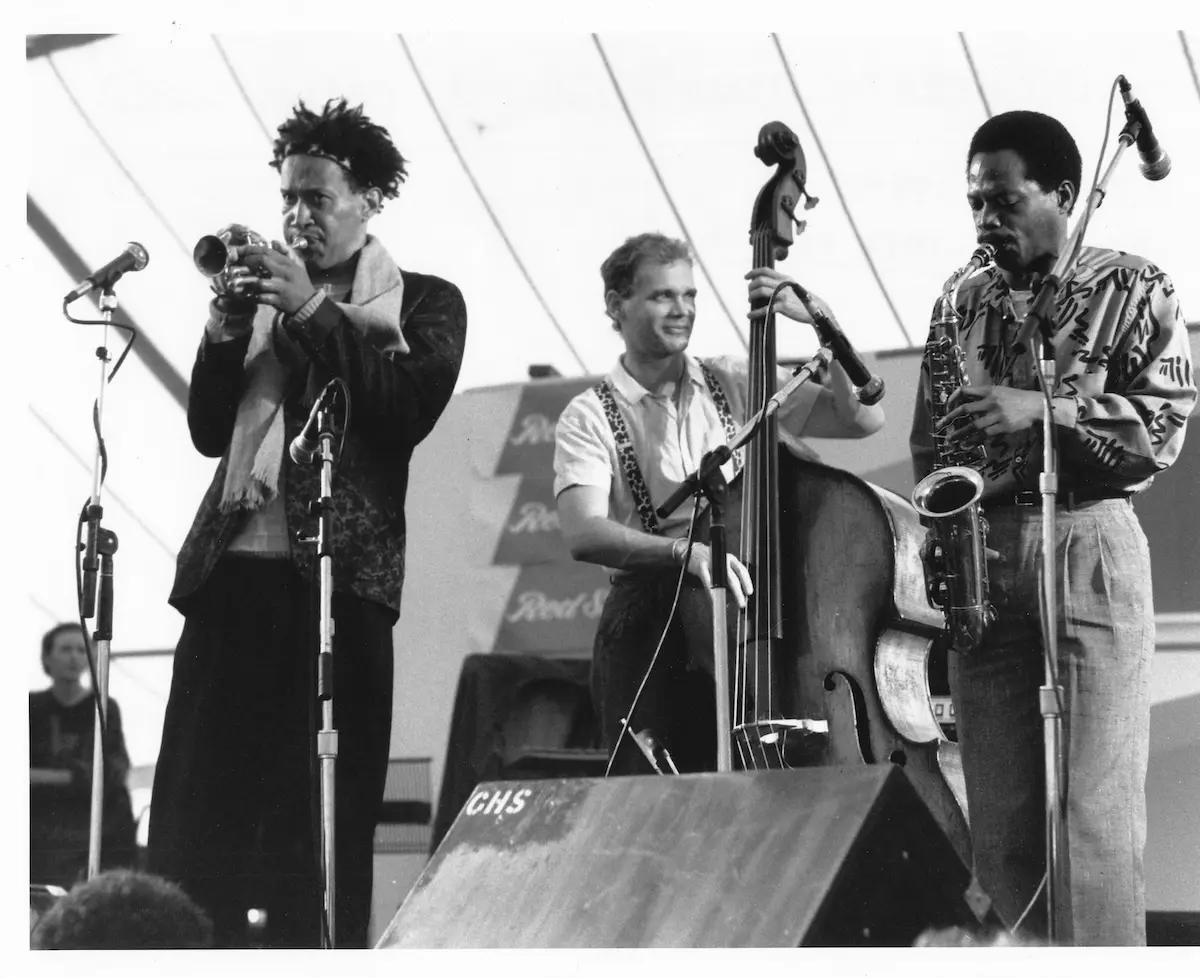
Dollar Brand, Don Cherry, Carlos Ward: The Third World-Underground
This album was originally released in 1974 on Trio Records, a Japanese label responsible for some seriously interesting discs during the 70s and 80s. This is the first time it has become available on an international basis, and it finds the pianist featured under his born name despite his conversion to Islam four years earlier. The three all had associations with the free-blowing movement of the period, Don Cherry being one of major figures in the loosely titled “avant-garde”, Ward spending many years in association with Brand (Ibrahim); the latter was an individualistic figure, much influenced by Ellington and Monk.
The music arrives with the pianist already in full flow, hammering out the bold theme of Don’s Song, a Cherry composition which the trumpeter joins in typical fashion, delivering two separate solos, the second full of extended notes embellished by those characteristic flutters and flurries. This piece is abruptly terminated by the onset of Brand’s Cherry, a medium-tempo tune; the composer’s repetitive figure underpins the work of the horns, whom both seem happy to be anchored by the theme and take a relatively melodic route, prior to a touch of call and response with the keyboard.
Bra Joe From Kilimanjaro is all about the pianist’s measured left hand, the rock for a solo carrying tinges of the blues, percussive passages and more expansive excursions. Once again there is a hasty transition, this time to Jabulani-Easter Joy. It’s jagged opening acts as a starting point for Cherry and Ward to engage in a touch of sparring based around the theme. Vocals are to be heard on Waya-Wa-Egoli and Swazi, both relatively short, as is Wayeah-Wayeah-O, carrying a semi-stately theme which sounds like a Brand original but was composed by one Victor Ndilzwana.
Discography
Don’s Song; Cherry; Bra Joe From Kilimanjaro; Jabulani-Easter Joy; Waya-Wa-Egoli; Swazi; Wayeah-Wayeah-O (40.03)
Dollar Brand (p, v); Don Cherry (t, v, pc); Carlos Ward (as, v, pc). Jazzhus Montmartre, Copenhagen, 14 November 1972.
Wewantsounds WWSCD125
James Chadwick: Walrws
Like it or not, the popular song has long been a source for improvisation, going back to the advent of recording. Jazz musicians of various hues have long trawled the marketplace for suitable material to either imbue with a light degree of adjustment, as a basis for their own compositions or to totally dissect a piece to make it almost unrecognisable.
This album is described as presenting “60s Pop Classics with a Jazz Twist”, seven out of the 13 selections being Lennon and McCartney songs, all of the choices being highly familiar to even those with a passing interest in popular music. The purpose here is to rework and reharmonise, adding some personal touches where appropriate. Some of these tunes lend themselves more readily to the intended process – the L & C items having been visited by many jazz musicians with varying results.
This quintet led by guitarist James Chadwick struggles manfully in its attempts to expand upon the chosen original resources but ultimately fal short. The ensemble sections lack drive, the solos are rather routine and the melodies, when delivered, lack boldness. Without wishing to add to the negativity, your reviewer has listed the titles correctly, rather than in the untidy manner they are presented on the case of the CD.
Discography
I Am The Walrys (Walrus); Stand By Me; Eleanor Rigby; Daydream Believer; Sound Of Silence; Mr. Tambourine Man; Blackbird; Penny Lane; God Only Knows; Fool On The Hill; I Feel Fine; Strawberry Fields Forever; Walk On By (69.44)
Chadwick (g, arr); Mark Sambell (p); Aidan Thorne (b); Liz Exell (d); Josh Heaton (ts). Abergavenny, 3 & 4 September 2025.
33 Records 33JAZZ321
Charles Mingus: Presents Charles Mingus
In the Wikipedia entry for this album, it is described as avant-garde jazz, which to some listeners at the time may have been an apposite description for the music therein, but in truth, the four constituent tunes were highly structured examples of Mingus at his creative best, far from the free-form explosion about to be unleashed on an unprepared jazz public.
This quartet was the bassist’s working group of the time. They had honed all the material in a long residency at The Showcase in New York, although at this juncture both Dolphy and Curson were making noises about leaving the unit just at a stage when the empathy factor had become an aural treat.
This reissue on 180-gram vinyl reminds us, if needed, what a potent force Mingus became, his compositions calling on the roots of the music, delivered by high-quality musicians whose talents sat beautifully next to his own forceful bass playing. This line-up had the potent mix of the outstandingly individual Dolphy, complemented by the boldness of Curson (who retained a noticeable awareness of his instrument’s forebears) and the ever-reliable Dannie Richmond, upon whom Mingus bestowed the ultimate accolade: “Unlike many drummers, Dannie is a musician.”
All this material became familiar over the years, apart from What Love, a construction that first saw the light of day some 15 years earlier – a fluctuating piece with its tempo changes and on this occasion having a section featuring a fascinating dialogue between bass and bass clarinet. Folk Forms No 1 is an exciting experience featuring some blues-fuelled solos from alto sax and trumpet apart from a touch of duelling to boot. Original Faubus Fables, a Mingus staple if ever there was one, carries that famous Mingus rant against the Arkansas governor Orval Faubus and All The Things You Could… weaves through passages of distinct tempo and the implied option.
Suffice to say, this music demands attention from first to last. Dolphy is full of quirky twists and turns throughout, common only to himself, while Curson mixes up his work in a mélange of clarion-call statements, fluttering extended runs and the odd growling comment; both are allied to the longstanding twosome of Mingus and Richmond.
Discography
Folk Forms No 1; Original Faubus Fables; What Love; All The Things You Could Be By Now If Sigmund Freud’s Wife Was Your Mother (45.71)
Mingus (b); Eric Dolphy (as, bcl); Ted Curson (t); Dannie Richmond (d). New York, 20 October 1960.
Wax Time Records 771730