Though events like the Montreal International Jazz Festival and the Newport Jazz Festival are longtime institutions, the DC Jazz Fest saw excellent participation and cheering crowds Labor Day weekend. The festival just completed its 22nd year, and it shows no signs of slowing down. Through a variety of weather, surging rains and hot temperatures, the fans came out to The Warf neighbourhood of Washington, DC. (as well as other spaces) to celebrate what’s new and what’s great about jazz – and music in general.
Though there were some smaller events during the week before September 5 and 6, the weekend lineup was the impressive main draw — Stevie Wonder even put in a special appearance. Both young and older musicians showed their stuff on the five different stages; for jazz fans, it was hard to decide whom to see and whom you had to miss. Do you sprint to the Arena Stage to see the bluesy Dee Dee Bridgewater or to the Transit Pier for the post-bop marvel Orrin Evans?
As one walked The Warf, there was an almost tangible excitement, though Saturday’s heat was a bit draining. The nearby restaurants were full of patrons, jazz fans and the uninitiated alike, tapping toes and bopping from side to side. There seemed to be a laidback air as the Potomac River breezes swept through the crowds. After all, good music is good music.
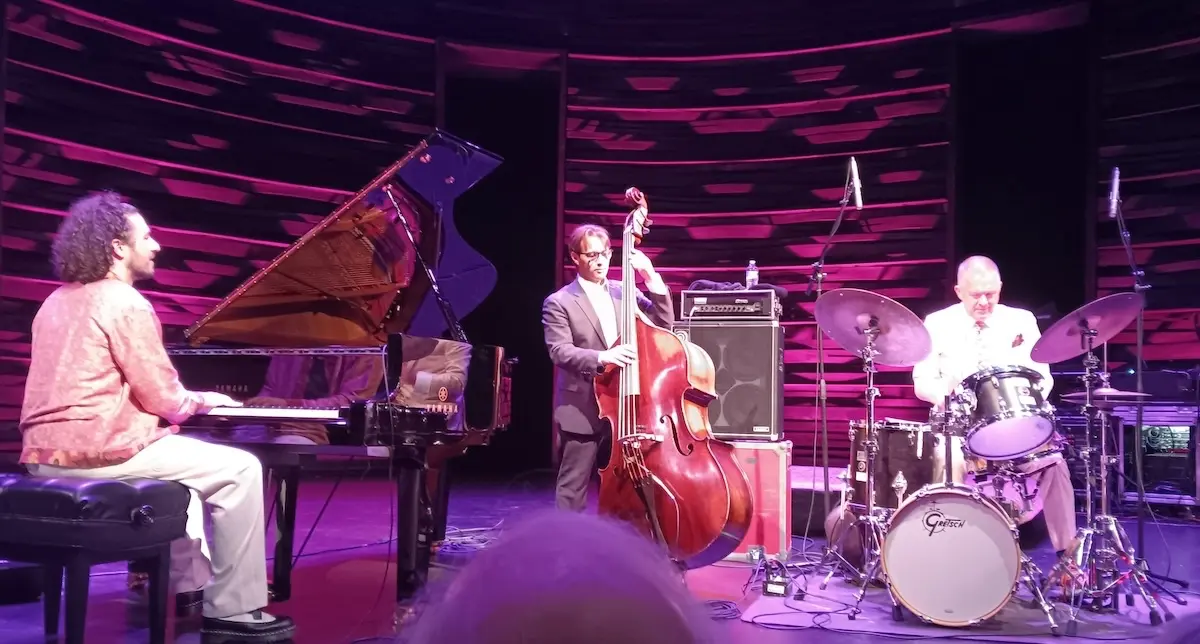
One star in particular played an impressive role throughout the festivities: pianist Emmet Cohen. He was artist-in-residence at the fest and his skills and overall energy showed that jazz is alive and well. His trio, completed by legendary drummer Joe Farnsworth and 24-year-old bassist Joey Ranieri, showcased not only a dynamic group of differing ages but also how jazz is a universal language that is made beautiful by collaboration and diversity. Furthermore, the set displayed a particular penchant for playful experimentation matched with melodic phrases. By this, I mean that the trio continually mixed up the tempo of their pieces; Farnsworth and Cohen particularly bounced back and forth, creating exciting interpretations of tunes and originals. The chemistry was clearly there, and the crowd loved every minute of it.
Overall, the whole festival’s lineup seemed to have this attitude of experimentation without alienating the audience. Saxophonist Joshua Redman is an interesting example. A talented player, the man clearly knows how to move in and out of his ensemble (percussion, piano and bass). However, early on in his set he took a rather long solo. Now, some solos can be both wandering and melodic; Redman’s was overly augmented and pierced with squeaks and squawks. This sort of “raw emotional show” is not anything new, but it can split listeners as to whether it’s all that enjoyable an experience. This type of sonic experimentation is not harmful, but it is not particularly pleasant either to those more used to the likes of Sinatra. Luckily, Redman performed a gorgeous ballad after the halfway point.
Towards the end of Sunday night’s schedule, pianist Danilo Pérez dazzled listeners with his Latin-jazz sound. One of the festival’s long-time participants, Pérez proudly talked about the power of jazz and its ability to bring people together. His set, which referenced a multitude of influences like Miles Davis and Thelonious Monk as well as the music of Panama, nearly had people on their feet after each piece. Even his more innovative material was full of humour and sophistication. (If you haven’t seen him live, you need to!) His trio supported him superbly, allowing Pérez to show his musical soul.
One aspect of the festival was its diverse array of artists. They hosted singers like the popular Kurt Elling as well as the bebopping newcomer Alfred Yun; they had funkier sounds by Cory Henry & The Funk Apostles and by the Muneer Nasser Quartet as well as delicious flavours from Louisiana via Etienne Charles & Creole Soul; they had more conservative players like Hannah Marks or Orrin Evans and more ethnically flavourful artists like Son Cubano Subterraneo or the African Rhythms Alumni Quintet. On Saturday, Bill Frisell also showed off his rather European (i.e., ECM Records) style of playing, pushing past traditional melodic concepts of music. Suffice to say, there was something for everyone. That is the one great thing about festivals: they can introduce you to so many new artists, such as Domas Žeromskas and Sakobi. I was unfamiliar with them but they have now been added to my own playlists.
Though the DC Jazz Fest is still coming into its own as an established event, this year’s lineup played their hearts out. Besides the music, there were opportunities to hear the artists and others in the music industry speak about what’s happening in these sonic spaces. There was a lot of talk about music education and about bringing music back into schools, which I think we can all cheer for. In these troubling times, it is heartwarming to see communities come together and celebrate music in such a positive, affirming way.
DC JazzFest, Washington DC, USA, 5-6 September 2026. dcjazzfest.org