Sam Braysher & Linus Eppinger: A Sinner Kissed An Angel
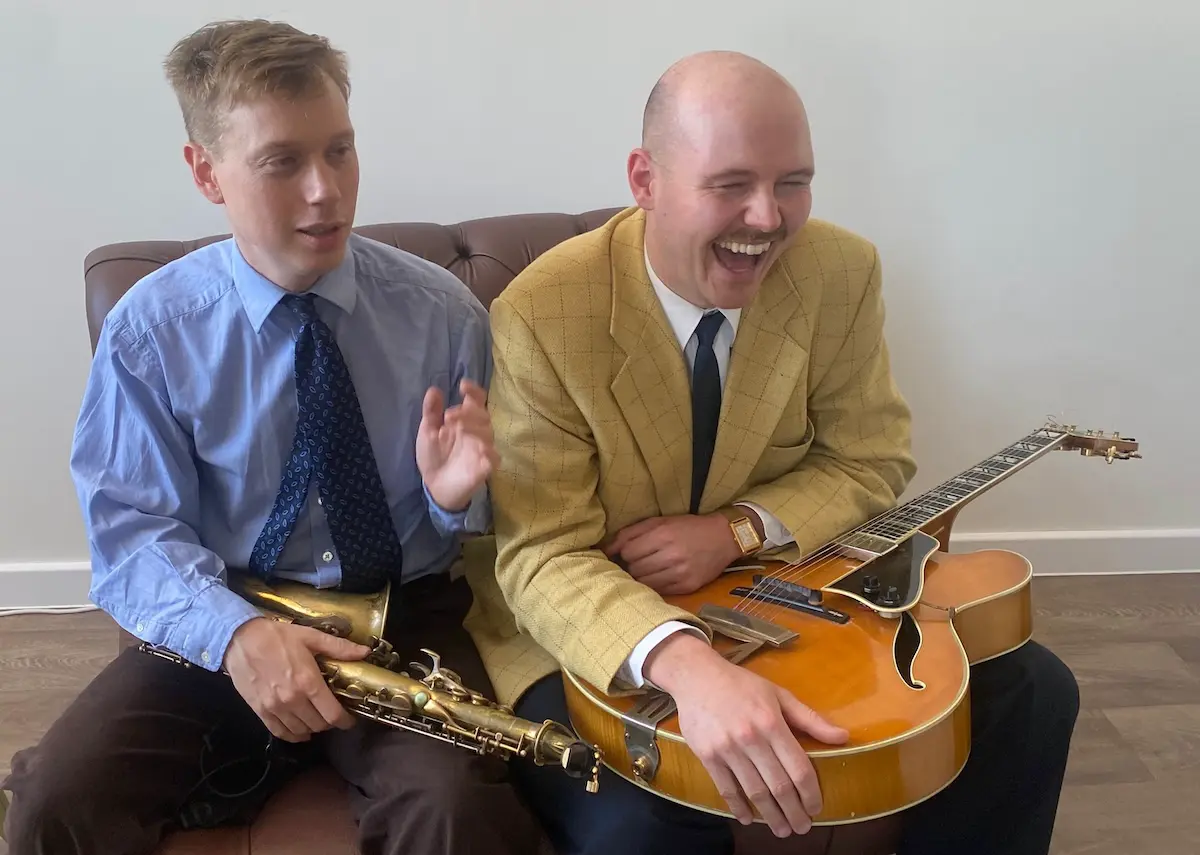
London-based alto saxophonist Sam Braysher is now on his fourth album, this time fronting an international quartet featuring his long-standing musical friend and colleague, the German-born, Amsterdam-based, guitarist Linus Eppinger alongside a rhythm section of American-born, French-resident Darryl Hall on bass and the veteran Dutch musician Eric Ineke on drums. Both Braysher and Eppinger had played with Ineke before, loving his glorious cymbal beat, but Hall was a lesser-known quantity, familiar only to Eppinger. But after a couple of gigs in Den Haag and Amsterdam, the group was quickly at one, and in a studio in Utrecht on only their third day together. Of necessity, the music could not be too complex, given the lack of rehearsal time, but the quartet captured perfectly the relaxed, in-the-moment atmosphere they’d felt together on stage.
Benny Goodman’s (or is it Charlie Christian’s?) A Smooth One starts proceedings in easy style, Braysher’s oblique style offset by Eppinger’s lilting notes. From the off, it is evident that this is a band that gels perfectly, Eppinger’s smooth lines floating easily over the unhurried accompaniment, Braysher a leisurely but always pertinent main voice. Hall is an interesting bassist, Ineke a quietly metronomic but inventive drummer. The choice of material is good, too, in particular Spooky, a groovy homage to Dusty Springfield, not someone whose name comes up regularly in JJ. Eppinger gets the chance to let rip a bit, Braysher an opportunity to mimic the sultry way Springfield sings the song! Vernon Duke’s Roundabout is taken at a suitably tear-jerkingly slow speed, Horace Silver’s Route 608 at a classic hard-bop clip. Perhaps best of all is the title track, once sung by a young Frank Sinatra with Tommy Dorsey’s Orchestra in 1941. Braysher plays it with feeling, as does Eppinger, while Ineke brushes the drums with the most subtle of caresses. A guitar-led Relaxing At Camarillo ends proceedings on a mid-tempo high.
This is a very well-behaved album, with no fuss to distract attention. It’s also hard to date, as it could have been recorded at any time in the past 50 years. Which makes it almost perfect. What a delight!
Discography
A Smooth One; I Told You So; Put On A Happy Face; Spooky; Roundabout; Never Let Me Go; Room 608; That Saturday That Summer; A Sinner Kissed An Angel; Relaxing At Camarillo (52:04)
Braysher (as); Eppinger (elg); Darryl Hall (b); Eric Ineke (d). Utrecht, Netherlands, 2025?
Fresh Sounds Records FSR-CD 514
Satoko Fujii’s Bunker Ulmenwall Orchestra
The ever youthful Japanese pianist Satoko Fujii doesn’t appear to have an off switch, for this rediscovered recording from 2014 – her 24th orchestral album overall – is the first of five orchestral albums she is releasing in 2026, largely making up for time lost during the pandemic. For more than a decade, this live recording from the Bunker Ulmenwall – a jazz venue in a converted WWII air raid shelter – in Bielefeld, northwest Germany, lay forgotten in the archive of concert promoter Wolfgang Gross. When he came across it again, he sent a recording to Fujii, who was amazed “at how beautifully we played, and with so much energy.” Gross had already produced many concerts by Fujii, but for this set, he had wanted to include not just professionals but also local music students, encouraging the young musicians to compose original music and to lead the band.
From the opening notes of Shiki, the orchestra is at home in Fujii’s unique sound world. Fujii cues in the soloists and the musical themes as the piece develops, involving the band as close collaborators to bring the music alive. Shiki is a vast and eventful composition, one of the most monumental pieces of musical architecture she has ever constructed, the quiet drone of its opening growing more urgent as the piece progresses. Drum duets, trumpet and saxophone solos, a sparking piano solo from Matthias Klause, all make their appearance, shouldering their way through the bold punctuation and tangled themes of the orchestra. The dialogue between soloists and orchestra continues until a celebratory ensemble theme concludes one of Fujii’s grandest creations.
On the second CD, Fujii gives up the podium to the orchestra’s other composers. Bass saxophonist Andreas Kaling conducts his riff-heavy Yamantaka, full of angular, interlocking themes, deep drones and a stonkingly heavy rock-guitar solo by Lucy Liebe. Trumpeter Natsuki Tamura’s Jasper restores quiet calm with its unusual timbres, before alto saxophonist Luise Vokmann’s Antischwarm hustles in in varied fashion. Leader Satoko ends proceedings with her serene and celestial Gen Himmel. There’s lot to take in on this fascinating set, a lot of variety to assimilate, but every second is worth the effort.
Discography
CD1: Shiki (46.47)
CD2: Yamantaka; Jasper; Antischwarm; Gen Himmel (40.30)
Fujii (leader, con); Natsuki Tamura, Benny Meinert, Robin Stüwe (t); Luise Volkmann, Paul Jumaa-Dohna (as); Volker Winck (ss, ts); Sebastian Büscher (ts); Andreas Kaling (bar); Matthias Muche (tb); Stephan Schulze (tb, tu); Lucy Liebe (elg); Willem Schulz (clo); Matthias Klauze (p); Kevin Hemkemeier (b); Joel Köhn (elec); Juri Beier, Karl Godejohann (d). Live, Bunker Ulmenwall, Bielefeld, Germany, 22 November 2014.
Libra Records 218-083
Satoko Fujii Orchestra Kobe: After The Storm
And hot on the heels of the Bunker Ulmenwall outing comes this new orchestral set from Kobe, to be followed quickly by three further sets from Berlin, Nagoya and Tokyo by early November. This Kobe set comes with some necessary information: it is not a live recording before an audience, rather the recording live of a performance that was conceived from the outset to create material for this album. Got it?
The four-part After The Storm was written by Satoko Fujii to envisage what the world would look like after the pandemic. She was “dreaming that the world would finally find complete peace after the pandemic … I was dreaming we would have no war, no weapons, no violence.” Alas, that’s not how things worked out, but she felt that her message of optimism and hope was worth recording. Part 1 opens with a stately solo-bass theme before a glowing statement from trombonist Yuichiro Tamgaki opens out into a full-throated often harsh solo from tenor Tsutomu Takei accompanied by guitarist Takumi Seino. Part 2 is more improvised, individual soloists emerging from the ensemble before rejoining, creating a spontaneous free-form, if again abrasive, narrative. Part 3 evolves into a wall of brilliant sound, trumpeter Natsuki Tamura contributing molten lines of notes. The concluding part is, in contrast, jaunty and upbeat, ending with a high-voltage guitar solo and an ensemble star-burst. Satoko Fujii certainly writes music for the committed listener, but that commitment is quickly paid back, as the individuality of each musician shines clearly through a highly integrated piece of music.
Discography
After The Storm, Parts 1–4 (57.17)
Fujii (con); Eiichiro Arasaki, Tsutomu Takei (ts); Keizo Nobori (bar); Yasuhisa Mizutani, Motoki Sugino (as); James Barrett, Rabito Arimoto, Natsuki Tamura (t); Yasuko Kaneko, Yuichiro Tamagaki (tb); Takumi Seino (g); Keishiro Saito (b); Yoshikazu Isaki, Hiromasa Sadaoka (d). Kobe, Japan, 5 February 2026.
Libra Records 215-084