
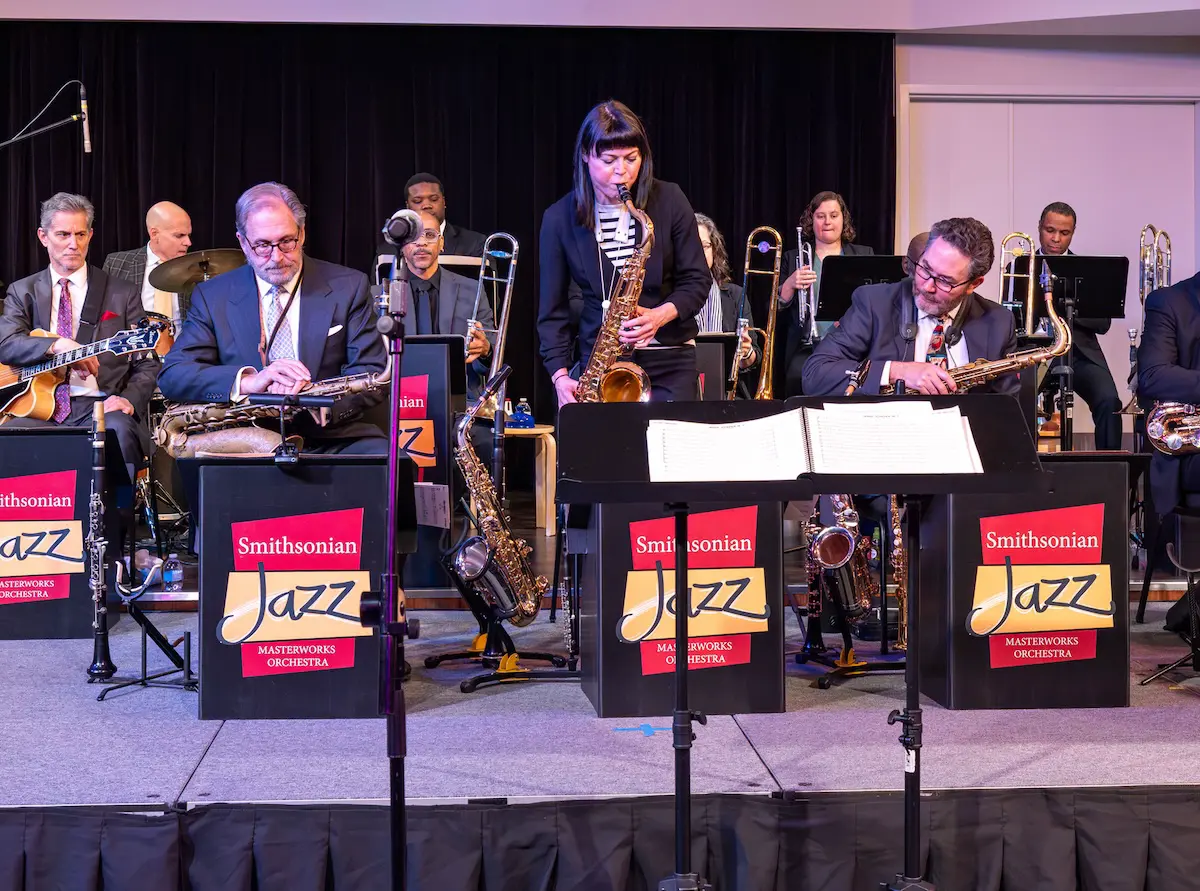
Smithsonian Jazz Masterworks Orchestra: Ellington Masterworks
In February 1975, getting on for a year after Ellington’s death, Kenny Burrell recorded the album Ellington Is Forever, a series of items interpreted by a 10- to 12-piece ensemble which included Jimmy Smith (org), Jimmy Jones (p), Thad Jones (c, flh), Jon Faddis (t, picc t), Joe Henderson (ts), Jerome Richardson (ts, ss) and Jimmie Smith (d).
Burrell was Ellington’s favourite guitarist and loved Ellington madly. So I was a touch shocked with myself when I found the Fantasy CD reissue of this material less than compelling – until, that is, I came to the final three tracks, which included a wonderful 10-minute blues medley (Carnegie Blues, Rocks In My Bed, Jeep’ s Blues, The Creole Love Call) and a superb, reflective reworking of Take The A Train. So I kept the CD and have often played the aforementioned tracks.
This may seem an unduly lengthy prelude to a consideration of the present release from the portentously titled Smithsonian Jazz Masterworks Orchestra and their concert take on what they call Ellington Masterworks. But it serves to indicate the problem I have with all tribute albums: namely, what is the point? Furthermore, how does one decide what are the masterworks from an oeuvre as rich in jewels and gems as that given to us by Ellington? If Jack The Bear is (rightly) here, why not Ko Ko?
Throughout, the arrangements and playing are fine but needed more diversified zest, more sheer “zing”, grease and grit to intimate the essence of Ellington (compare the original version of Ad Lib On Nippon from the 1966 The Far East Suite with what is on offer here). There are undoubtedly some fine, burning and building moments to enjoy, especially in the development of Tattoed Bride, Oclupaca and The Shepherd, But the overall impression is one of a studied devotion to a magic that remains magnetic and life-transforming in its own historical right. So as I said, exactly what is the point of any such devotion? I’ll keep the CD, but I’m not sure how often I will play it. Sorry, guys!
Discography
The Flaming Sword; Tattoed Bride; Race; Madness In Great Ones; Ad Lib on Nippon; Oclupaca; Shepherd; Jack The Bear (55.57)
Charlie Young (conductor & artistic director); Steve Wilson, Bill Mulligan, Scott Silbert, Luis Hernandez, Leigh Pilzer (saxes); Josh Kauffnan, Barbara Laronga, All Harry Albrecht; Kenny Rittenhouse (t); Jennifer Krupa, Matt Niess, Bill Holmes (tb); Tony Nalker (p); Amy Shook (b); Ken Kimmery (d & executive producer). MCG Jazz, Pittsburgh, 6 April 2024.
A-Train / MCG Jazz MCGJ1062
Editor’s note: Somehow, two review copies of this record slipped through, the other reviewed here in July by John White. But both opinions are valuable.
Sonny Rollins: Tenor Madness
It’s said that when Rollins and Coltrane had finished their 12-minute exchange of romping post-bop blues figures on the title track, Coltrane suggested to Rollins that his compatriot had been “playing” with him. Allegedly, Rollins assured Coltrane that this had very much not been the case. Whatever, (the misleadingly titled) Tenor Madness is a most enjoyable medium-up swinger, with exemplary contributions from what was the Miles Davis rhythm section of the period: Red Garland (p), Paul Chambers (b) and Philly Joe Jones (d).
The rest of the recital is all Rollins with that superb, nudging and ultra-supportive rhythm section. The perky Paul’s Paul is a finger-snapping delight, the measured meditative depths of When Your Lover Has Gone, (the in-part Debussy) My Reverie and The Most Beautiful Girl In The World a composite poetic picture. And the two-and-a-half minute bonus that is the concluding Count Your Blessings offers a welcome soupçon of that fine combination of Richie Powell (p), George Morrow (b) and Max Roach (d).
Exploratory gems like the Blue Note Live At The Village Vanguard lay just ahead for Rollins, prelude to the later wonders of the RCA The Bridge, the cascading exploratory work with Don Cherry and the many marvels of such mid-1960s Impulse! recordings as Alfie, On Impulse! and East Broadway Rundown. But this Tenor Madness session will always retain and project a most particular and pleasing mellow magic of its own.
Discography
(1) Tenor Madness; (2) When Your Lover Has Gone (18.22) – Paul’s Pal; My Reverie; The Most Beautiful Girl In The World; (3) Count Your Blessings (19.16)
Rollins (ts) with (1) John Coltrane (ts); Red Garland (p); Paul Chambers (b); Philly Joe Jones (d). (2) as (1) but Coltrane out. (3) Richie Powell (p); George Morrow (b); Max Roach (d). Hackensack, New Jersey, 24 May 1956 (1 & 2) & 22 March 1956 (3).
Jazz Wax JWR4532LP