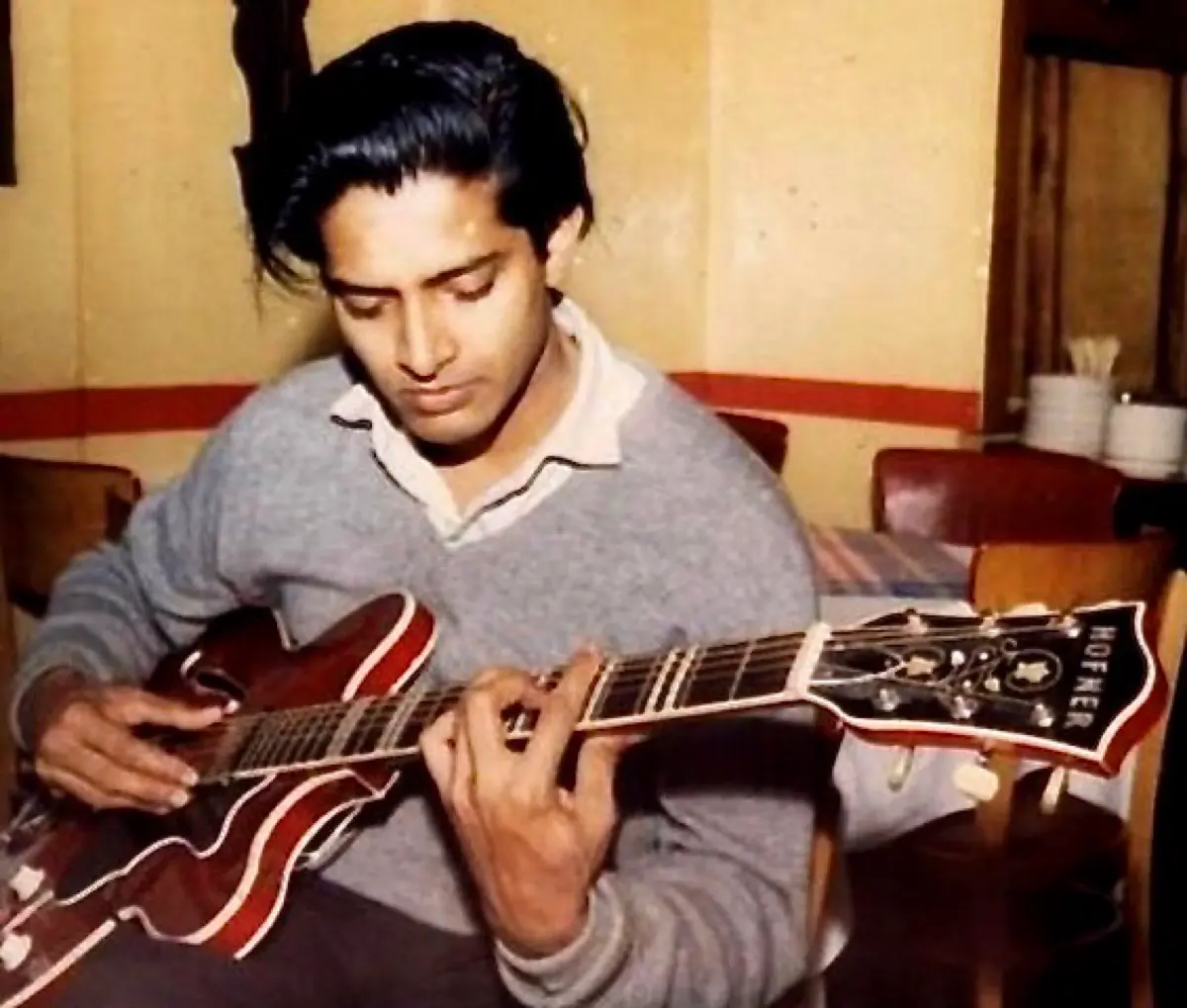
Amancio D’Silva is a virtuoso jazz guitarist of the late sixties and a pioneer of what some would call ‘Indo-Jazz’. For others, there is only jazz with an infinite variety of expressions, of which Amancio’s is a particularly distinctive brand. Amancio is an old friend, thinner than when we last met, but looking well and, as always, younger than his age. His red Fender Stratocaster stands in the corner by the CD player. He hasn’t played it for several years, due to a near fatal stroke in 1991, but he is making a steady and courageous recovery.
The new jazz has, for him, an emphasis on the technical approaching that of classical music. ‘Technically today we are miles ahead, but . . . no feeling. Why do they have to go play jazz? These people are playing classical music’
Joyce, Amancio’s wife of over 30 years, left Amancio’s albums out on the settee. As I looked them over, my excitement was that of someone rediscovering lost treasures of jazz history. None of these albums is in print, which makes them a very rare collection of records indeed. On the cover of Amancio’s debut album, Integration, recorded in 1969, Don Locke of Jazz Monthly had this to say about the young guitarist who had caught his ear: ‘Just as Reinhardt was a gypsy playing his special brand of jazz, so Amancio D’Silva is an Indian playing his special brand of jazz, and in each case the music is distinctive and successful to the same degree…’
After his first album, Amancio made important recordings with some of the most influential players in the development of modern jazz in Britain – the legendary Joe Harriott, Stan Tracey and John Mayer. The distinctiveness in Amancio’s style of jazz which Don Locke has spoken of is not only in D’Silva as a player, but also as a composer. It is noteworthy that the above recordings consisted mainly of his own compositions.
Sadly, his promising performance career was cut short by illness. But Amancio went on to continue his contribution to the development of jazz through tuition of up and coming young musicians. This took place mainly at Jenako Arts, a cultural centre in East London which was an important nexus for jazz and traditional artists from Africa, Asia and South America in the eighties. He continued passing on his skills to young people at the Krishnamurti International School at Brockwood Park, near his home in Hampshire.
Amancio’s relationship with the guitar goes back to his childhood days in India, where there was a vibrant jazz scene in the fifties and sixties. In Bombay every two to three months there was a jazz week and Amancio recalls the visit of Duke Ellington as a jazz ambassador to the annual festival in Bombay known as the Jazz Yatra (Jazz Pilgrimage). Other notable visitors to the festival included the late Paul Desmond and Dave Brubeck. At the age of 25 Amancio had established such a reputation as a musician that the Maharani of Jaipur, a lover of jazz, offered to be his benefactor. ‘I wrote a song on my first record. I called it Jaipur. . . She was a very good benefactor. She bought me a good guitar and she bought a lot of jazz records so I could hear the music.’ Amancio’s greatest early influence was Charlie Christian. Amancio recollects that ‘He was the first person to play on the electric guitar. Benny Goodman’s brother-in-law discovered him and Benny Goodman had him in his band playing hits like Flying Home and Seven Come Eleven. He was only in the limelight for two years then he got TB and died.’ Amancio’s other influences include Wes Montgomery, Johnny Smith, Barney Kessel, Jim Hall and Kenny Burrell – most of whom, like Amancio, are melodic improvisers.
A nearly tragic twist of fate led Amancio to his jazz career in England. He and Joyce married in India whilst Joyce was working there as a teacher. They had a son, Stephano, who became gravely ill soon after birth and the family had to fly him to Britain for specialist treatment. Fortunately, Stephano soon made a full recovery and is now an excellent guitarist himself.
Amancio and his family stayed on in England. Through a friend, he was put in touch with Jonathan Miller, who introduced Amancio to the British jazz scene. It was through Miller that Amancio first became acquainted with the late Denis Preston, a producer who brought about the collaborations with Joe Harriott, Stan Tracey and others like violinist John Mayer, who later gained a reputation for Indo-Jazz fusion.
Speaking of the musicians he has had pleasure in working with, one senses Amancio’s deep respect for the late Joe Harriott. His face is serious when he says ‘Joe was not from this planet.’ Amancio recalls that the band would spend a whole week in rehearsals before a gig. Joe would turn up 15 minutes before the gig and lock himself away to focus on the music. Then he would play an astonishing set, as if he had rehearsed with them all week. In the studio Joe had the habit of playing everything to perfection in a single take.
However, contrasted with this vision of Harriott as an almost extra-terrestrial genius is the picture of him as a warm and humane personality: ‘He was so good with children . . . with his own and mine. Some people thought he was hostile. No way!’
In 1969, the same year as his debut album was released, Amancio recorded Hum Dono with Harriott. Two years later his collaboration with Stan Tracey, Reflections, marked not only a significant musical partnership but the start of a friendship that has endured for many years. There is nothing like serious illness to reveal one’s true friends, and Stan has been a tremendous support to Amancio through good and bad times, including the period of the stroke. Also, Amancio has had a long association with horn player Ian Carr, who has featured on most of his work, as has bassist Dave Green.
What does Amancio think of the jazz scene in Britain today? He acknowledges that there are some fine young jazz players emerging, but he is not uncritical and perhaps there is something fundamental to be learnt from this. The new jazz has, for him, an emphasis on the technical approaching that of classical music. ‘Technically today we are miles ahead, but . . . no feeling. Why do they have to go play jazz? These people are playing classical music. Jazz is something from the heart.’
Discography
Amancio D’Silva: Integration – Introducing Amancio D’Silva (1969, Columbia/EMI SX6322/SCX6322)
Joe Harriott/Amancio D’Silva Quartet: Hum Dono (1969, Columbia SX6354)
Various: Jazz Explosion (1969, Columbia SLJS1)
Amancio D’Silva/Stan Tracey: Reflections (1971, Columbia SCX6465)
Cosmic Eye: Dream Sequence (1972, Regal Zonophone/EMI SLRZ 1030)