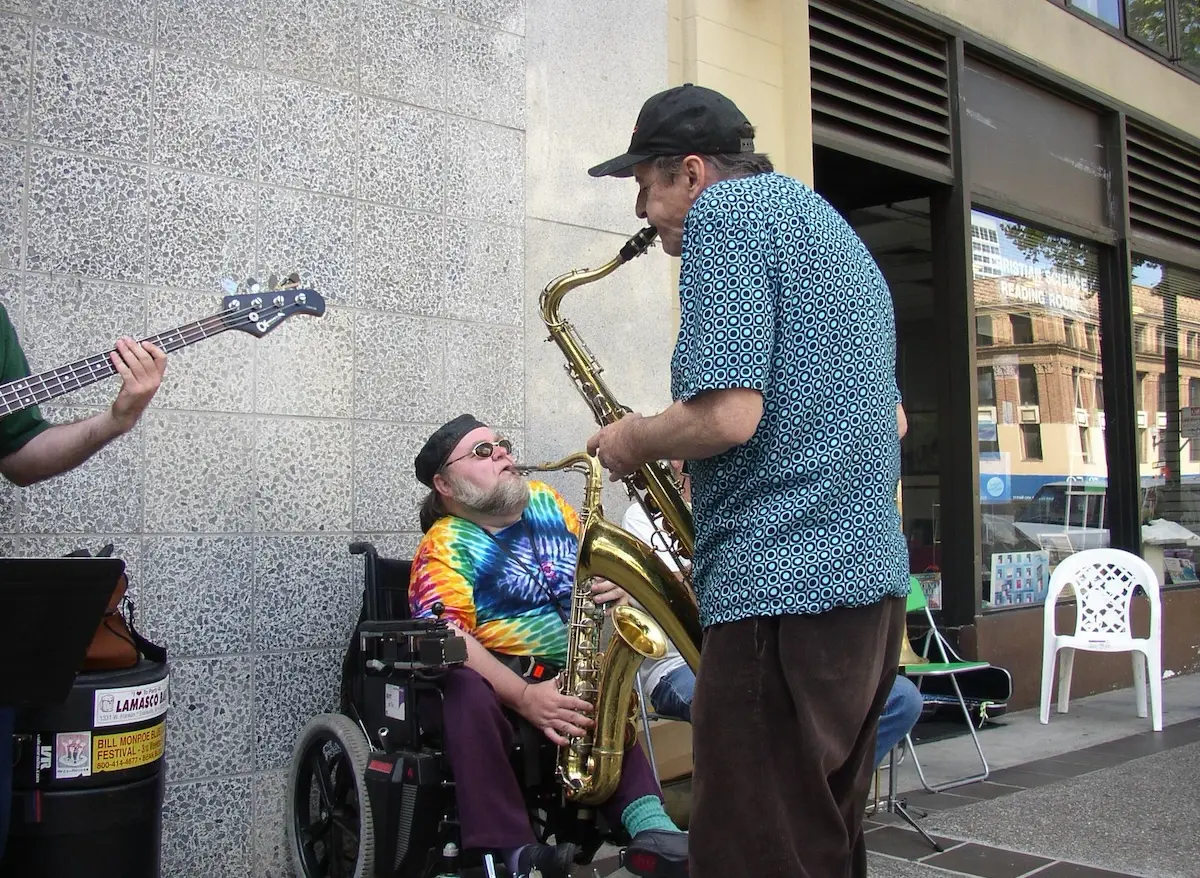
The late reeds man Bill Ramsay told me this story about transplanted Pacific Northwest saxophonist Bert Wilson. Wilson sat in his wheelchair, ready to blow at a wedding reception for his friend, long-time Harry James pianist and arranger, Jack Perciful, in Jack’s backyard in Olympia, Washington. Ramsay continues the story: “So Cathy [Jack’s bride] had Bert play her favourite song . . . and there are a lot of people there, non-musicians . . . Bert starts to play, and I’m getting nervous. I’m looking at my wife and saying, ‘He’s playing the melody straight; this ain’t gonna stay that way for the rest of the tune.’ Bert, about eight bars into the tune, he can’t handle it, he’s just got to take it out [chuckles] . . . and he starts playing it like, crazy, man, and people are looking. ‘God, he’s not very good, is he?’ I said, ‘No, he’s very good. He just likes to play things his own way.’”
Behold Bert Wilson – survivor of the 60s and underground saxophone legend – lying low in this small city, far from the centres of jazz. Bert had been there, an unlikely traveller through those mean streets, unable to stand on his own two feet and dependent on the kindness and concern of friends. Despite hardships, he had carved out a reputation in the Apple, having appeared on records with the likes of Sonny Simmons, Warren Gale, James Zitro and Barbara Donald,* some of the first generation of fellow travellers to attempt to make sense of innovations set down by Trane and Ornette. Now in far-off Olympia, he had found an island buffeted by calm seas out in the provinces where he need not have to make do in a sixth floor New York City apartment without an elevator, nor worry about having his instruments ripped off in crime-ridden, pre-Giuliani Manhattan. No one else in the area could quite match Bert’s musical outlaw reputation at that time, though others had charted their own courses. In time, most of them would find their way to Bert’s house. That’s where the magic happened.
Indeed, Bert was like a magnet to good musicians, as he expressed it himself in a 2005 Cadence interview: “This is one point I want to make. Wherever I have lived in my life, the greatest musicians have always come to my house to play. I’ve been blessed, man.”
From the same interview, Bert commented on a few of the heavyweights who dropped by to play in the years prior to his move to Olympia.
Joe Lovano. “Yeah, Joe’s a close friend . . . I met Joe back in 1974, and it was an instant connection . . . I played with Joe quite a few times when I lived in a bungalow about 20 miles out of New York (mid-70s) . . .
Jim Pepper. “Another guy who had a very rough life, but he was a beautiful cat, and we were very close and used to sit around my apartment and make far-out noises for each other and then try to take them apart and figure out what notes they had in them and how they fit against the harmonic structure.”
David Liebman & Steve Grossman (in Berkeley). “[David] Liebman also came by when I lived in Berkeley and we played . . . I have a recording of it.” “Steve Grossman came by when he was 16 years old, before he went with Miles. He could play Coltrane’s Spiritual and India in 12 keys!”
John Coltrane Although he did not visit Bert’s house, Bert was proud of having performed with Trane in L.A., in 1966. “He was playin’ the blues,” reported Bert, “We played Blue Train for 45 minutes.” On another occasion, he had performed with Roland Kirk as well.
Bert was also a skilled saxophone teacher. Among his better-known students were Ernie Watts, Lennie Pickett of Tower of Power, and Jeff Coffin of the Dave Matthews band. “He was a very patient teacher,” noted former student Michael Olsen. “But he didn’t let people slide either.”
I met Bert in 2010 when a friend, Olympia saxophonist Chuck Stentz, took me by the modest house Bert shared with his partner, flutist Nancy Curtis, for a regular Tuesday evening jam session. One couldn’t help being inspired by the man. Though the effects of childhood polio had crippled his body and confined him to a wheelchair – leaving him in frequent pain – put a saxophone in his hands and he’d enter something like an out-of-body state. Particularly adept at producing multiple notes at the same time (multiphonics), he had cultivated a robust though musical sound on soprano, alto, and tenor and could navigate chord changes with ease. He had also mastered the bass clarinet. A monster musician, he wrote many challenging pieces of music that were at once innovative, memorable and accessible.
The Tuesday jam-session musicians called themselves Bebop Revisited, jamming mostly on standards and Charlie Parker heads. Every good player in the area made the session at one time or another. Chuck Stentz, born in Olympia in 1926, was a veteran saxophonist who had recorded back in the late 40s with the Ray Borden band out of Boston. After a few years back east, he returned to Olympia where he lived out the remainder of his life. He linked up with Wilson not long after Bert moved to town around 1979. Chuck was a fine musician whose robust, straightahead tenor made a good foil for Bert’s more outside outbursts.
Another who made the Tuesday jam until shortly before he took ill and passed away in 2008 was pianist Jack Perciful. Jack, born in Idaho in 1925, had spent the final 17 years of a long career in music as pianist and arranger with the Harry James orchestra. A thoughtful, sensitive soloist, his classic style exuded charm, warmth and beauty, reflecting his primary influences, Art Tatum, Jimmy Rowles, and especially, Nat Cole. That these more traditional players could jam with Bert redounds to the musicianship of all three. In addition to solid musical skills, they all had big ears and great respect for the others’ talents.
Though sometimes criticised for neglecting standards in favour of his own compositions, Bert loved playing standards with the Bebop Revisited folks. When he did, he might play the head and begin a solo conventionally, but before long, he’d break out, stretching the intervals and spinning lines that prodded and teased the melodic, harmonic and rhythmic contours of the tune. His range was phenomenal. A phrase might begin in a lower register before spiralling upward, culminating in harmonics that flew right off the chart. But no matter how far into the stratosphere he ventured, the notes he chose always fit the underlying harmony of the tune he was playing. Often the notes that came out of his horn were not the ones our ear expected to hear, but they always made musical sense, fitting the contour of his improv. Sometimes he launched into all-out sheets of sound that might end in harmonics or dirty multiphonic smears. His lines and intervals often turned choppy, leaping and loping along, then jutting off at quirky angles, lurching into clipped staccato phrases or wild bursts of speed, Bert honking and shrieking a bit like an old bar-walker, yet never losing his way in the standards he reconstructed whenever he played with the Bebop Revisited cats.
And while his music was highly original, no one would mistake it for anything but jazz. It stayed in the tradition, and it swung. Devastating on ballads, he played with great passion and an obvious concern for beauty. Like many better known jazz players – Ben Webster, Coleman Hawkins, Prez, Bird, Johnny Hodges, etc. – Bert was a confirmed romantic, unafraid to let his tender emotions pour out into his solos.
When asked to name his early influences in the Cadence interview, he answered “Bird, Dolphy, Rollins, Coltrane, Coleman Hawkins, and Art Tatum are my daddies and, of course, Art Blakey.” Any list of influences that contains both Dolphy and Tatum shows a deep appreciation for the evolution of jazz within its traditional framework. He was an extension of that great tradition as was evident to all who heard him.
Little in Bert’s early life portended the path he would take in music. He was born in October 1939 in Evansville, Indiana. His grandfather had been in vaudeville and schooled young Bert in the business. As he remembered it, “I was doing song and dance with my granddad when I was four years old, man . . . And I could do anything Shirley Temple would do.”
The encounter with polio at age four put an abrupt end to any pretensions Bert might have harboured about a career as a dancer. He was unable to walk and paralysis prevented him from moving his arms for years. Instead, he became fascinated by jazz while attending a hospital school in Chicago where another boy introduced him to Charlie Parker’s music. Once recovered, he studied piano and took up clarinet at 13. In the latter half of the 50s he relocated to L.A. There he picked up the saxophone at 18 and never looked back.
During the 60s, he began to connect with musicians who would be important to his career. He met Barbara Donald* in 1962, when she was 17. They would go on to work together frequently and make records. A key event in the mid-60s was his meeting with percussionist James Zitro. The drummer had been invited to sit in with none other than John Coltrane in L.A. Apparently, Trane liked what he heard and told Zitro he could join his band when he returned to New York. Sadly, Trane passed away before this could happen. In a Cadence interview from 2006, Zitro described his meeting with Bert, shedding light on Wilson’s mania for non-stop jamming at that time. Said Zitro “One day, this guy [Bert] comes around and invites me to this jam session . . . We started playing and played for 13 hours! . . . I had blisters on my fingers, Bert’s lip was split, but everything clicked . . .”
Possibly through his association with Barbara Donald – at that time married to alto saxophonist Sonny Simmons – Bert was invited to participate in a recording session with Simmons in New York. Bert managed to get his friend Zitro onto the record date. In the fall of 1966, Zitro packed his wife and one-year-old child, along with Bert and his wheelchair, into his car and drove to New York to record Music From The Spheres for ESP, an avant-garde classic under the leadership of Simmons. Raised in Oakland, California, Simmons had spent time in the band of Charles Mingus and had made a name for himself as one of the leading avant-garde and free jazz advocates on the West Coast. His records on Contemporary with Prince Lasha are acknowledged as classics. Despite his early success, Simmons battled personal demons and fell into hard times throughout most of the 70s and 80s before reemerging for a surprising second act in the 90s that continued until his passing in 2021.
As for Bert and Zitro, a second disc for ESP followed. More than anything else up to that point, the ESP records put Wilson and Zitro onto the jazz map and seemed a portent of good things to come. However, life in the big city held challenges for Bert. For starters, living on an upper-floor apartment with no elevator presented obvious problems for Wheelz, as Bert was known to his friends. And on more than one occasion, he lost instruments to theft. In one incident Bert was sitting in a car when someone reached in and snatched one of his saxes.
After surviving a couple years in the Apple, Bert returned to California where he settled in Berkeley. Except for a short sojourn in upstate New York, Bert would stay in California until his move to Olympia at the close of the 70s. Gigs were sporadic, and as ever, issues of mobility dogged him. However, there were more recordings during those years, including a couple with drummer Smiley Winters: Smiley Etc. (1969) featured Smiley, Donald Garret, Barbara Donald and Michael White; then there was the Now Creative Arts Jazz Ensemble on Arhoolie. Additional recordings appeared on 9 Winds.He also began releasing private recordings from his stockpile on his own label called Dr. Wheelz’ Archives.
The move to Olympia came when musician friends living there learned he was alone and “miserable” in Woodstock, New York. These friends organized a benefit to bring Bert to Olympia where he would at least not be alone. In Olympia, he met Nancy Curtis, his future wife and a fine flute player who would become a regular participant at the Tuesday jams, as well as an important solo voice in his working band, Rebirth. A highlight of the Rebirth years was a fine album for Arabesque called Endless Fingers (1997) which featured Chuck Stentz on two tracks. For these tracks, Chuck and Bert really dust off their tenors for some spirited blowing, Bert tempering his outside impulses somewhat while Stentz plays with a bit more fire than usual for him. The result is an exciting tenor duel in the spirit of Ammons and Stitt, Dexter and Wardell, or Griff and Lockjaw. The Arabesque CD is excellent both for Bert’s playing and his memorable compositions. The rest of the musicians are first rate, including Craig Hoyer on piano, Nancy Curtis on flute, Dan Schutte or Peter Vinikow on bass and drummer Bob Meyer. Endless Fingers earned a well-deserved rating of five stars in the All Music Guide and is easily recommended. A follow-up disc with almost the same personnel reunited Bert with his old friend James Zitro. Called Dedicated to Friends and Mothers, it was released on the Seattle-based label Pony Boy and contains some very nice music indeed.
Those who knew Bert remember him as a talent deserving of wider recognition. Considering what he had to contend with, it’s a miracle he lived long enough to accomplish what he did. When he died in 2013, he was 73, remarkable given that doctors had informed his family years before he would likely not see his fifth birthday. Though he lived, many hardships awaited him. Lack of mobility was always an issue. Another was the frequent pain that took him off his horns for extended periods. He had little control over these physical factors, though artistic decisions he made were not always conducive to financial gain. No way was he ever going to play music aimed at mass appeal or even produce quiet background sounds for dining or for wedding receptions. It just wasn’t in him to do that. He had to play it the way he heard it. As he told his Cadence interviewer, “I got into music to play music, not to get rich and famous, though I wish I could bring my music to more people . . . as I always say, ‘I’m not depressed, I’m oppressed.’ Ha!” No doubt Bert Wilson suffered dark days and long painful nights during his life. But that he could turn his oppression into a joke speaks volumes about the man’s spirit and inner strength.The recorded legacy** he left us resonates with that spirit and inner strength. He may not have reached as many as he would have liked, but those he did will not forget him.
Notes
*An underground legend in her own right, trumpeter Barbara Donald had played with Trane, Dexter Gordon, Roland Kirk, Prince Lasha and others. She had also relocated to Olympia where she worked with Bert.
**Throughout his career, Bert made many private recordings of jam sessions and performances of his bands. Perhaps some of these will be released in the future.