Arthur King: UMN (Fantastic Planet)
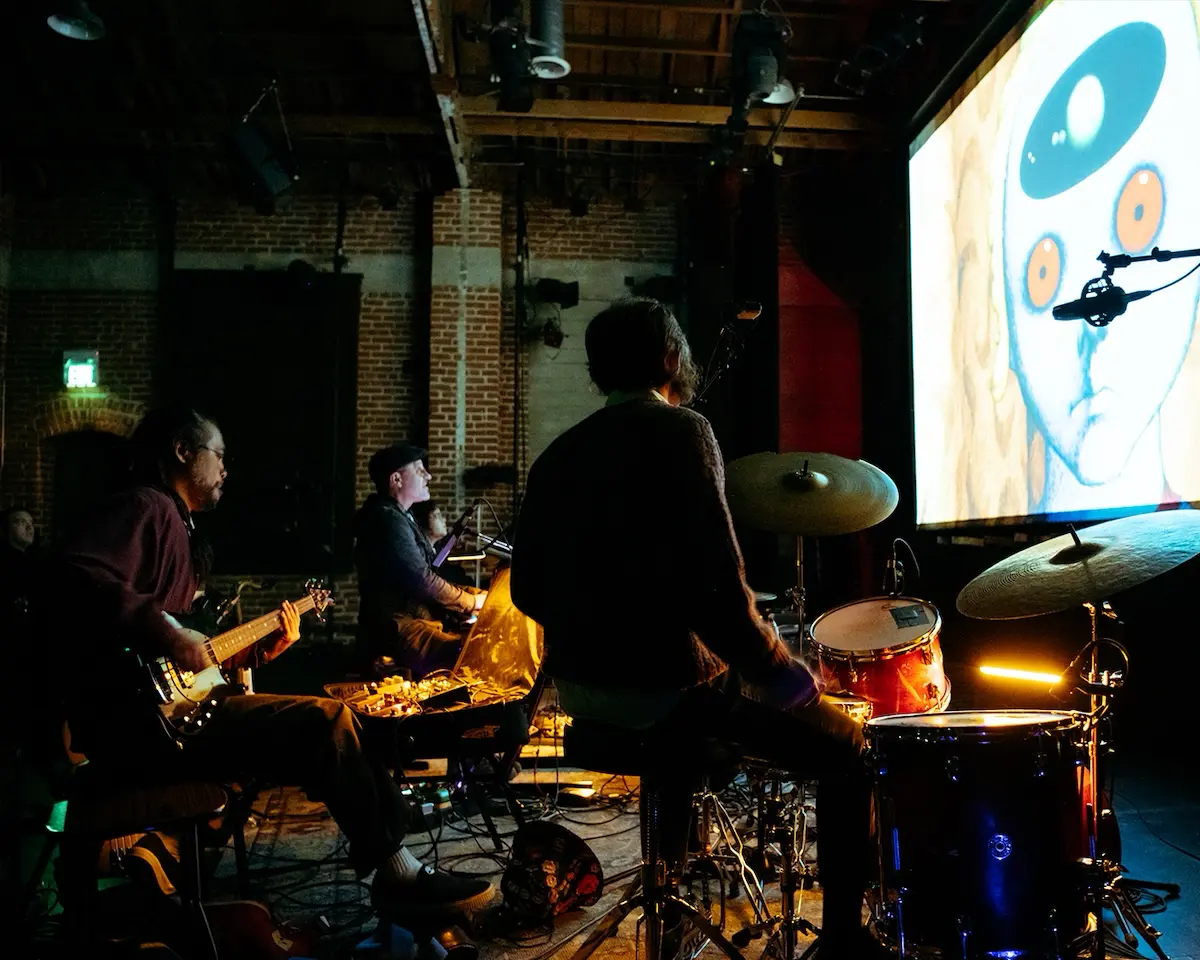
The spoken introduction by renowned Canadian filmmaker Floria Sigismondi sets the scene nicely for the performance which follows. As many readers will already be aware, the premise of LA-based experimental music ensemble Arthur King’s long-running Unknown Movie Night (UMN) series is that they will improvise an impromptu movie score in real-time, often without prior sight of the film. They’re guided largely by their wits and some visual cues from the silver screen, and the music invariably stands up in its own right, even without the imagery.
Sigismondi’s choice of movie for this evening in February of 2025 was René Laloux’s 1973 film Fantastic Planet. Whilst it’s not a film I would claim to know, Sigismondi describes an imaginary world rendered in exquisite hand-painted imagery. Based on Stefan Wul’s novel Oms En Série, the storyline charts an uprising on the planet Ygam by the Oms against their blue-skinned oppressors, the Draags. The stop-motion animation is based on imagery conceptualised by French surrealist Roland Topor, and several reviewers have described it as an hallucinogenic experience. The precise relationship between the imagery and the improvisation may be missing from the recording, but listeners can still create an imaginary screenplay simply by closing their eyes.
King stalwarts Peter Walker and David Ralicke were joined by fellow angelenos JP Maramba and Kern Haug, who met for the first time just before the show, and Pauline Lay, whose electronically processed violin spans a wide timbral spectrum. To say they quickly developed an understanding would be a gross understatement, each player melting plasticine-like into a fully unified sound world. Individuals are rarely foregrounded for long, though Ralicke’s lyrical tenor makes a strong early impression on It Doesn’t Move. Many pieces seem to float on the merest hint of a pulse, but just occasionally, as with Ancestral Planet, bass and drums lock together and the ensemble settles into a kosmische space-rock groove. One of the strongest UMN releases I’ve heard to date, Fantastic Planet is a work of strange beauty and great imagination.
Discography
Introduction by Floria Sigismondi; It Doesn’t Move; Tiwa; Intimacy; Playthings; Shame; Lessons; Run Away; The Oms; Deprived; Natural Satellite; Meditation Of The Draag; Terr; Ancestral Planet (74.24)
David Ralicke (ts, elec); Peter Walker (elg, elec); Pauline Lay (vn, elec); JP Maramba (elb); Kern Haug (d). 2220 Arts + Archives, Los Angeles, 13 February 2025.
AKP Recordings AKP054
Finn Loxbo: Lummernikt
My most recent encounter with Swedish guitarist Finn Loxbo was on last year’s bruising Ensamseglaren by the Anna Högberg Attack. Loxbo played electric guitar and was part of a thrilling but scarcely yielding wall of noise. It’s a side of his musical persona that you can also hear in his relentless trio power Kyosaku, but his collaborations with composer Magnus Granberg and the justly intoned chamber-jazz group Kommun reveal a quieter and more introspective side, and this collection of pieces for solo acoustic guitar sits firmly within that latter camp.
The album’s title provides some clues as to how Loxbo approaches the material – the word describes the spores of a protected species of clubmoss of the Lycopodiaceae family which, when ground into powder, becomes highly flammable and was once used as a form of gunpowder. Precariously balanced and occasionally volatile, the music isn’t easy to place within any kind of broader lineage, but if pressed I’d mention the names of David Grubbs, John Fahey and Derek Bailey. Precise finger-picking often sits in curious juxtaposition to Loxbo’s open and extremely malleable compositional forms. As the pieces unfold the intensity will often build to unbearable levels, though Loxbo seems to instinctively know when to release the pressure valve.
Recorded by label boss and producer John Chandler, the tracks have a very raw and immediate sound that matches Loxbo’s sense of nervous urgency. Opener Tumlare spins on a sinuous flamenco-style arpeggio, its rapid movements finally halted by a matte of static chords. Återfalln recalls the deconstructed folk of Grubbs’ work with Jim O’Rourke in Gastr Del Sol, while Loxbo’s kora-like timbres on Das Lebende Tonkino brush with minimalism. On the title track, Nattlodn and Skuggmätar the ringing harmonics and atonal harmonies nod to Bailey, and the closing Bolles Sista Resa finds Loxbo interacting with a piercing feedback drone. Lummernikt may initially a tough nut to crack, but if you’re willing to dive in and surrender to its peculiar charms your efforts will be handsomely rewarded.
Discography
Tumlare; Återfalln; Das Lebende Tonkino; Lummernikt; Nattlodn; Ametistskimmerspindeln; Skuggmätar; Bolles Sista Resa (40.24)
Loxbo (g). Stockholm, 16 June and 14 December 2025.
Fönstret-17
Roberto Ottaviano: Dark Sides
I was both surprised and delighted to find Dark Sides in the most recent JJ reviews list – surprised because it was initially released in October 2025, but delighted because it’s one of the Italian soprano saxophonist’s strongest releases for some time. One of the world’s leading voices on his instrument, Ottaviano has a distinguished CV that includes spells with the Italian Instabile Orchestra and Louis Moholo-Moholo’s Canto General, a mentorship under Steve Lacy throughout the 1980s, studies in composition with Ran Blake, Bill Russo and George Russell, and more recently a collaboration with British pianist Alexander Hawkins.
Dark Sides is both the title of album and the name of this multi-cultural group, but more than that it is Ottaviano’s response to some of the worst impulses of humankind, currently all too prevalent as nations on every continent are returning to a war footing. Offering a sense of hope in the longer historical perspective, Ottaviano’s seductive blend of ancient folk-songs, European chamber jazz and sounds of the East are, if you like, his antidote to the modern malaise and a paean to global unity.
A Long Deception quickly establishes the mood, brooding gongs and sampled voices woven within atmospheric layers of electronics. Preachers And Merchants is a modal Coltranesque burner, Ottaviano’s smouldering solo brimming with latent power. Frana’s oud takes the lead on Gabriel’s Message, a baleful folk-ballad, which, like Jocelyn Pook’s Bridal Ballad evokes medieval times. The title track has a surprisingly slinky groove, arco bass and woody reeds locked in unison as the theme unspools, while the malign inspiration for Musk Aroma, a free flowing sax-drums duet coloured with dystopian electronics, should be clear from the title. The more playful Syte has a similar energy, and the East-West grooves of Spinosa Lacrimae remind me of Louis Sclavis’s early quintets. An imaginative reading of Dvorak’s Going Home skirts ambient jazz terrain without sacrificing the piece’s essential gravity, lingering in the mind long after the final notes have rung out. Ranking amongst Ottaviano’s very best work, Dark Sides is highly recommended.
Discography
A Long Deception; Preachers And Merchants; Gabriel’s Message; Dark Sides; Musk Aroma Therapy For Trumpeters; Syte; Waiting The Flood; Bridal Ballad; Spinosa Lacrimae; If You Want To Tell Me Something (Shout Up); Goin’ Home (49.53)
Ottaviano (ss, cl, elec); Peppe Frana (oud); Luca ‘DJ Rocca’ Roccatagliati (elec); Giorgio Vendola (b, elec); Ermanno Baron (d, pc). Bari, Italy, 15-16 January 2025.
Dodicilune ED589-9