
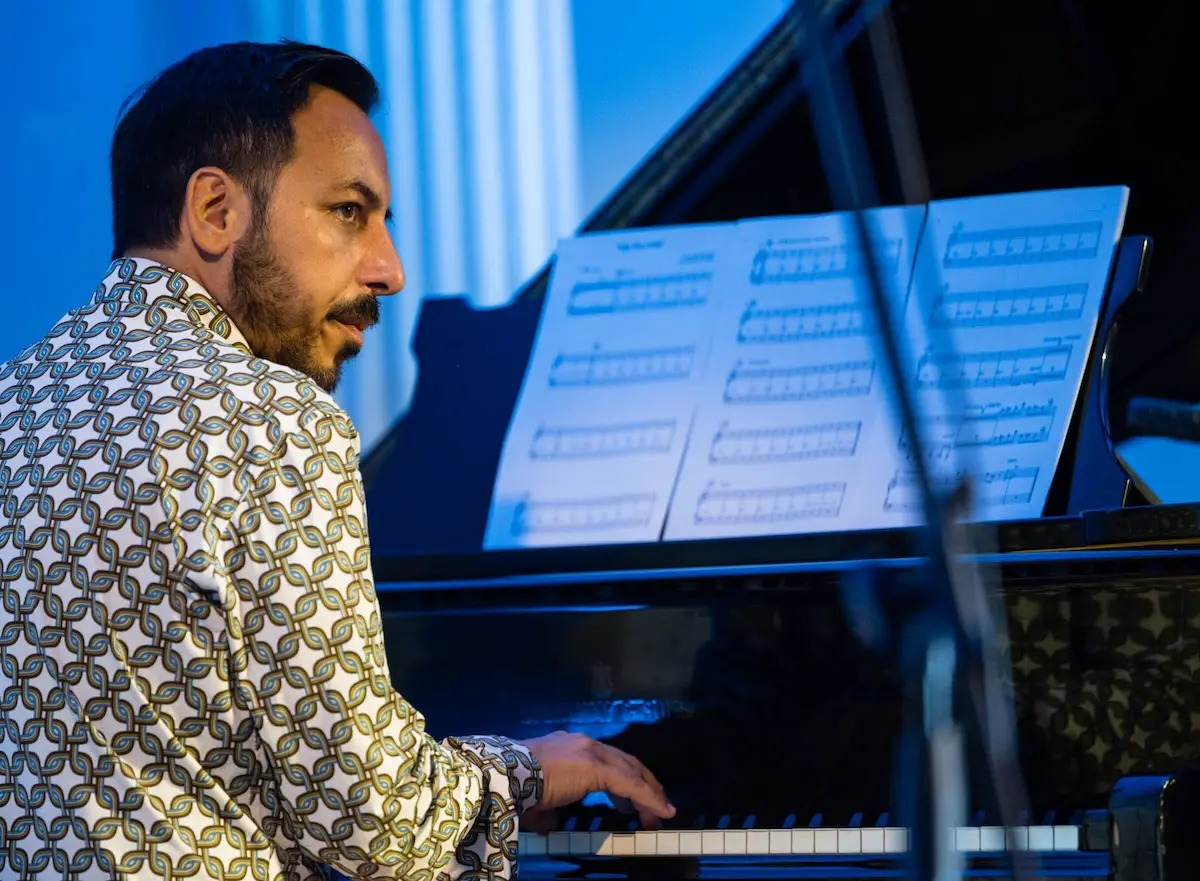
Sergio Di Gennaro: Blind Spots, Still Looking
With Blind Spots, Still Looking, his second album as a leader, Italian pianist Sergio Di Gennaro unveils a universe where Mediterranean lyricism intertwines with a profound inner quest. Joined by double bassist Ares Tavolazzi and drummer Enzo Zirilli, he shapes a trio of remarkable subtlety, while saxophonist Emanuele Cisi, featured on two compositions, broadens the sonic horizons of this deeply refined work.
From the very first notes, it is the quality of the writing that immediately stands out. Di Gennaro belongs to that rare group of musicians for whom melody remains an essential language, almost a form of breathing. In a jazz landscape often drawn toward display and technical bravura, he chooses the path of suggestion: his compositions never pursue complexity for its own sake, but instead unfold naturally, carried by deeply memorable themes, delicately crafted harmonic movements, and an exceptional sense of narrative. Each piece seems to open a door onto an intimate story, inviting the listener to be guided by emotion rather than simply by the notes themselves.
The album opens with Just Breathe!, a true invitation to contemplation. The piece emerges from a delicate dialogue between piano and bass, like a conversation suspended in silence, before Zirilli’s brushes gently introduce movement through subtle Latin colors and pop-inflected nuances. It immediately reveals the trio’s aesthetic: an airy, lyrical form of jazz, shaped by understated elegance.
On Night Sorrow the slow Latin pulse creates a meditative, almost nocturnal atmosphere, where each phrase seems to search for light within melancholy. By contrast, Tilo’s Walk brings a more luminous energy, driven by instantly captivating melodic lines and Zirilli’s supple, inventive drumming.
The journey concludes with Wound Up To Fly, a piece in which the trio’s chemistry reaches a new depth. Ares Tavolazzi’s warm bass lines intertwine naturally with the piano, while Enzo Zirilli’s creativity acts as a discreet breath, adding movement and dimension without ever disturbing the balance of the ensemble.
The presence of Emanuele Cisi adds another layer to this musical architecture. His saxophone emerges like an inner voice, an external gaze revealing new emotional perspectives. Featured on Modern Blindness and Rainy Lake, he also illuminates She Danced Alone, a superb ballad that seems to carry the poetic legacy of Bill Evans, elevated by Ares Tavolazzi’s lyrical and deeply expressive solo.
Blind Spots, Still Looking explores the invisible territories of human experience: silences, buried memories, and emotions that are often sensed rather than spoken. The album’s title evokes those blind spots that escape our perception but that music has the power to reveal.
The true strength of this recording lies in its restraint. Nothing feels overstated, nothing artificially amplified. The performances display undeniable technical mastery without ever falling into ostentatious virtuosity; the compositions reveal remarkable harmonic richness without becoming mere intellectual exercises. Every note, every silence, and every interaction seems to serve a larger purpose: expressing the inner poetry of the music.
Discography
Just Breathe;Night Sorrow; Tilo’s Walk; Modern Blindness; Smoothly Gliding; She Danced Alone; Rainy Lake; Wound Up To Fly (40.34)
Di Gennaro (p); Ares Tavolazzi (b); Enzo Zirilli (d); Emanuele Cisi (ts). Turin, 2 October 2025.
GleAM Records AM7045, reviewed by Emma Forestier
Kristaps Vanadziņš: Piano Is My Temple!, Vol. 1
The artistic journey of 39-year-old Latvian pianist Kristaps Vanadziņš’s is one that transcends stylistic boundaries. Drawing from both European jazz and Baltic musical traditions, he has developed a deeply personal voice in which improvisation, classical influences and cinematic lyricism coexist naturally.
With Piano Is My Temple!, Vol. 1, his first solo piano album, Vanadziņš returns to the essence of his instrument. After years exploring the expressive possibilities of the piano trio, he embraces a more intimate format, creating a direct dialogue between pianist, piano and listener.
The album’s title is almost a manifesto: the piano becomes a sanctuary, an inner space where music unfolds through silence, reflection and emotional honesty. Rather than seeking to impress through virtuosity, Vanadziņš invites deep listening. Each piece flows organically into the next, shaping a cohesive and deeply personal journey.
His understated approach occasionally recalls the spirit of Bill Evans in its attention to silence, harmonic colour and lyrical phrasing, while also echoing certain contemporary neo-classical aesthetics. Yet these are affinities of spirit rather than style. Vanadziņš possesses a distinctive musical voice, rooted in jazz but drawn toward contemplation. Recorded with remarkable attention to nuance, every touch of the keyboard carries emotional weight. This is not background music but an intimate conversation between artist and listener.
The album also reflects Vanadziņš’s Latvian heritage, blending Nordic restraint with warmth and melodic sensitivity. His interpretation of Dāvāja Māriņa, the celebrated song by Raimonds Pauls, beautifully illustrates this dialogue between cultural tradition and personal expression. While firmly rooted in jazz, Piano Is My Temple!, Vol. 1 moves beyond the conventions of solo jazz piano. Here, emotion always takes precedence over virtuosity, resulting in a recording of rare sincerity and quiet beauty.
Discography
Piano Is My Temple; Vienmēr Jūnijs; Love Me Tender; 3 Coins In The Fountain; Dāvāja Māriņa; Revolucionārais; Riva Del Garda; Liedagā; Lielais Alberts; Tu Sajutīsi (49.00)
Kristaps Vanadziņš (p). Place and date unknown, c. 2026.
Independent, reviewed by Emma Forestier
Giorgio Albanese: When Time Slipped Away
When Time Slipped Away is the new album by Giorgio Albanese – accordionist, composer and educator based in the United States. Through this project, he weaves a subtle dialogue between his Mediterranean roots and the many languages of contemporary jazz, creating music where memory, improvisation and composition meet.
Surrounded by an international ensemble featuring winds, voice and rhythm section, Albanese develops a rich and nuanced sonic palette. The saxophones of Ethan Klotz and Juanito Saus create elegant contrapuntal lines, while Tino Erdos’s trombone brings depth and harmonic dimension. The voice of Mahya Hamedi enriches the ensemble with a presence that is both melodic and textural, while the piano of Domas Zeromskas, the double bass of Stefano Battaglia and the drums of Nitzan Birnbaum shape a remarkably fluid rhythmic and harmonic dialogue.
At the heart of this sonic architecture, Albanese’s accordion moves beyond the traditional associations of the instrument. It becomes a true narrative force, guiding themes, harmonic colours, and interactions between the musicians. Every element finds its place within an approach where composition and improvisation exist in constant dialogue.
On Meta Blues, Albanese revisits one of jazz’s fundamental forms, transforming it through metric variations and modal explorations that renew its language while preserving its essence. With Get There, melody remains at the centre of the musical discourse, unfolding through a shifting harmonic landscape where tension and freedom continuously interact.
When Time Slipped Away presents a vision of jazz as a living space, open to crossings, transformations and reinvention. The album offers a sensitive reflection on time itself: time that slips away, breathes and becomes musical material. Blending Mediterranean warmth, harmonic sophistication and contemporary expressiveness, Giorgio Albanese delivers a deeply personal work in which every moment seems to discover its own rhythm.
Discography
Chi-Chi; Synthetic Happiness; Thinking About You; Meta Blues; Schizofrenie; Get There; Unconditionally (40.00)
Albanese (acc); Ethan Klotz (s); Juanito Saus (as); Tino Erdos (t); Mahya Hamedi (v); Domas Zeromskas (v); Stefano Battaglia (b); Nitzan Birnbaum (d); Rafael Heredia Horimoto (p); Queralt Giralt (c); Yuval Agam (f). Place and date unknown, c. 2026.
Dodicilune ED600-1, reviewed by Emma Forestier