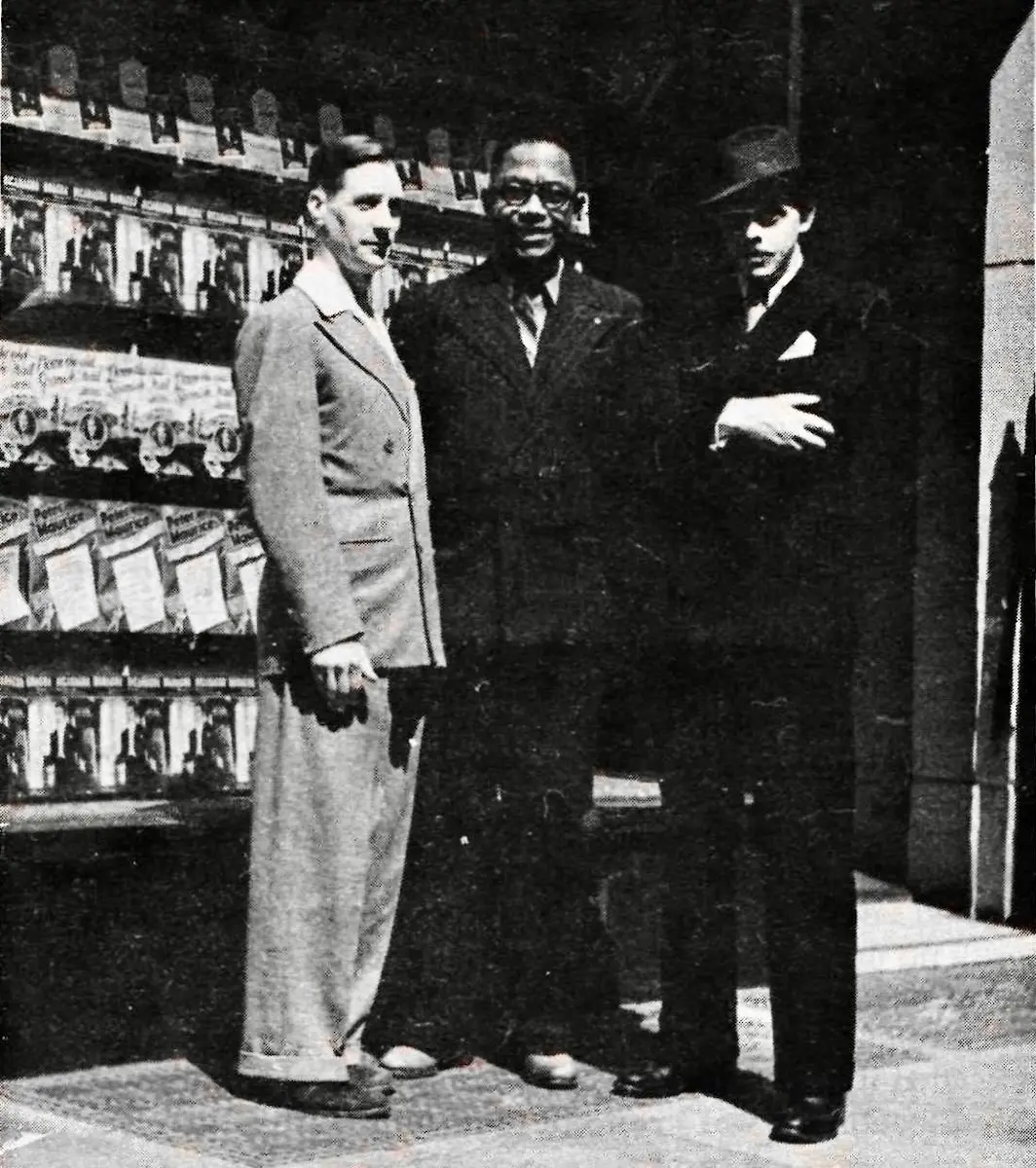
British jazz lost one of its most ardent and active supporters on April 20, 1976 when Carlo Krahmer died at his London home. He was 62 and although the end was not unexpected it was still a shock, especially for those of us who had known that familiar, dapper little man whose life seemed to revolve around an area bounded by Bedford Square to the north and Dobell’s Record Shop to the south. Carlo was, first and foremost, a musician but he was probably better known in the second half of his life as the man behind Esquire Records, the label which brought us so much wonderful British, Scandinavian and American jazz. As a musician he played drums with Claude Bampton’s seventeen-piece band made up of blind musicians. George Shearing was Bampton’s pianist and the Shearing-Krahmer friendship was to last for years. Carlo once told me of the time he sat in at an after-hours session with Fats Waller during the pianist’s second visit to Britain, in 1939. (I think this must have been at The Nest Club, probably the occasion when George Chisholm was also sitting in; see page 67 of Charles Fox’s book Fats Waller in Cassell’s Kings Of Jazz series). Carlo was also with trumpeter Johnny Claes And His Clay Pigeons in the early ’forties, a band which contained a youthful Tommy Pollard on piano (later replaced by Norman Stenfalt) and saxophonists Harry Hayes and Aubrey Franks. He was often to be found on Decca record sessions with George Shearing towards the end of World War Two, usually with the late Tommy Bromley on bass. There are four excellent sextet titles which Decca should reissue from early 1944 under George’s name with Carlo and Tommy Bromley plus Kenny Baker, Harry Hayes and Aubrey Franks. And in 1945 Krahmer made some sides under his own name for Parlophone with an octet including Ronnie Chamberlain and pianist Gerry Moore.
In the years immediately after the war Carlo’s flat at 76 Bedford Court Mansions became a focal point for musicians, particularly those young men working ‘on the boats’ for Geraldo’s Navy, playing waltzes and polkas for the Cunard passengers in exchange for a few hours of bebop heard in the 52nd Street Clubs when the liners were berthed. Records were brought over on return trips, played and replayed at the flat and names such as Charlie Parker and Dizzy Gillespie were bandied about. Carlo was still active as a drummer and was leading a band which often contained Humphrey Lyttelton and Dill Jones, both recently demobbed from the services. In 1948 Carlo decided to form his own independent record company to issue jazz; the major labels were doing precious little to document the course of British jazz at the time. In retrospect the launching of Esquire was a hazardous occupation with shortages of paper, shellac, recording equipment etc. but Carlo’s innate enthusiasm and the business expertise of his wife Greta won through. Carlo played drums on one of the first studio-made Esquire sessions with Ronnie Scott on tenor and Ralph Sharon at the keyboard. He also made use of recordings done at concerts in Birmingham Town Hall on November 21, 1947 (with Humph, Dill Jones, Wally Fawkes and Ernie Mansfield) and March 30, 1948 (with Dennie Rose, the late Reg Arnold, Johnny Dankworth, Ronnie Scott, Jimmy Skidmore and Cab Kaye) and a session which took place at the old Number One Rhythm Club in London on January 11, 1948. On February 17, 1948 he set up a session in the Bedford Court Mansions basement studio with Dankworth on clarinet, Eddie Thompson on piano, Bert Howard on bass and the then 13-year-old Victor Feldman on drums. These were the first records ever issued under Feldman’s name and over the years Carlo did a great deal to encourage Vic, including helping him to switch to vibraphone. Through contracts with European labels, such as Blue Star, Esquire started to issue material made outside Britain and some of my earliest brushes with bebop came via Carlo’s issues of the Howard McGhee Sextet recorded in Paris during 1948.
In May, 1949 Krahmer took a band to France to play at the Jazz Fair, a band which comprised Cy Ellis on trumpet, Harry Brown on trombone, Pip Gaskill (one of the founder members of Humph’s first band) on clarinet, Gerry Moore on piano, Ernie Mansfield, tenor, Alan Hodgkiss on guitar, bass player Eddie King and Carlo on drums. At one of the rehearsals in the flat the McPartlands, then visiting Britain, sat in and there is a version of Sugar in existence, as a battered acetate, with Jimmy and Marion replacing Cy Ellis and Gerry Moore. The band was hardly a huge success at the Salle Pleyel (Britain’s other contribution was the big Vic Lewis band) but I suppose the French fans had come along principally to hear the Charlie Parker Quintet, the Miles Davis-Tadd Dameron Band and, of course, Sidney Bechet. (In fact the fans presented Bechet with a new soprano as a birthday gift; he was 52 on May 14, 1949). Back home again, Carlo continued to issue material on Esquire including the Parker Dials (via one of his European tie-ups) and it was about this time that I first came into contact with him. I was then living in Pontypridd and while my home town has many admirable qualities a thriving jazz scene was not one of them, so I ordered my treasured Esquire 78s direct from source. Carlo invariably found time to answer my letters which went with the orders and gradually a fairly regular correspondence grew up. He would tell me of new sessions he had put in hand and I would put forward a flood of ideas. He was my first contact with the record industry and I bombarded him with letters suggesting that he recorded Kenny Graham’s Afro-Cubists or the Melody Maker Poll Winners. Invariably my suggestions seemed to coincide with his own actions; I remember he told me that my letter about the Poll Winners arrived on the very day that the session took place (February 3, 1951). Six days afterwards the record coupling Brand’s Essence and Marshall’s Plan was actually in the shops. Even by today’s supersonic standards this was quick work.
In retrospect there were few important British jazz musicians who eluded the Krahmer net; he was the first to record Cleo Laine and all the best Johnny Dankworth Seven records were on Esquire. Other artists included Ronnie Scott, Kenny Graham, Tommy Whittle, the Ronnie Ball Trio, Tony Kinsey, Joe Harriott, Vic Feldman, Dizzy Reece, Tommy Pollard, Harry Klein, Jimmy Deuchar plus bands led by Cy Laurie, Chris Barber, Bobby Mickleburgh, Sandy Brown and Vic Lewis. This is by no means a complete list and I must mention the elusive Spike Robinson, an American merchant seaman who played down at the Studio 51 Club whenever his ship was in the Pool of London. Spike was just about the nearest thing to Bird we heard in the flesh and the three sessions which Carlo set up for him (one with the Ronnie Ball Trio, one with Tommy Pollard and one with the Ronnie Scott Boptet) would make a marvellous LP.
But apart from documenting the growth of home-grown jazz in the early ’fifties, Carlo was also the man who introduced us to the names (and the beautiful music) of Scandinavian jazzmen such as Arne Domnerus, Lars Gullin, Bengt Hallberg, Putte Wickman etc. via his deal with Swedish Metronome. This also led to the release here of the Clifford Brown and Art Farmer tracks made in Stockholm and the earliest Esquire issues from the Prestige catalogue came to us through Metronome. Then Carlo signed direct with Prestige and after that we had virtually every Prestige LP on Esquire. In fact we jazz collectors never again enjoyed so much from this important catalogue, for after the Esquire term ran out and the Prestige material passed to the majors (EMI on Stateside, the Philips group and now RCA) no one has even approached the quantity of Prestige issues here which the independent Esquire concern succeeded in releasing. And Carlo loved it all – musically, I mean. He issued James Moody albums because he liked the way Moody played and the fact that Moody reminded him of the British saxophonist Derek Neville. ‘Derek was playing that kind of tenor years ago,’ he told me, ‘and what’s he doing now? Driving a taxi in New Zealand.’ Some of the British artists he recorded were either for old time’s sake or because he genuinely loved the music they played. ‘I think Alan Clare plays fantastic piano,’ he would say, ‘so I record him. The records don’t sell of course.’ Discographically Esquire was a boon to collectors. From the very earliest days Carlo printed the recording dates and personnels on the labels (or sleeves, when he switched to EPs and LPs) and at regular intervals he would send along complete session details to Derek Coller for publication in the Discophile magazine. He also liked to use alternative takes on microgroove where possible.
I saw a great deal of him all the time I wrote for this magazine in the early ’fifties and also when I was with Jazz Monthly. I would call at the flat regularly to collect advance review copies or to hear pressings of new things he wanted to play me. I helped with some of the Prestige recording dates (he was quite aggrieved if he could not fulfil his usual obligation to the customer by including the necessary information on labels) and there were often plenty of interesting people to meet at the flat, for it was still a focal point for jazz. Apart from musicians such as Tommy Whittle or Gerry Moore one was likely to meet executives from Swedish Metronome (with plenty of stories to tell) and on one occasion I came across the American pianist Sanford Gold. Carlo’s assistants included Kitty Grime, Ronald Atkins and Hugh Ledigo, all of whom served an apprenticeship there, parcelling up orders and writing the occasional sleeve note.
Throughout the years that I knew him I was never quite sure just how limited was Carlo’s sight. I believe the sensitive retina of the eye was displaced so that the image coming through the lens did not fall on the correct surface of the inner eye. All I know is that he knew the inside of 76 Bedford Court Mansions like the back of his hand and could jink his way through the stock room, down the stairs and into the studio without brushing against any racks, shelves or other obstructions. I invariably rang him before calling on him so that he had ready the records or catalogue material that he wanted to discuss with me. On only one occasion did his careful preparation fail him. He had asked me to do a record recital in, I think, Luton; it was an Esquire sales promotion exercise and I would be using items from the current catalogue. He asked me to call a few days before the recital to discuss final details. Standing in the stock room together he handed over a pile of records then said ‘I’ve made a list of some of the LPs that I’d particularly like you to feature.’ He put his hand in his jacket pocket, pulled out a sheet of paper, unfolded it, appeared to read it through then said ‘Yes, that’s it,’ and handed it to me. I took it; both sides of the paper were blank. Slightly embarrassed, I said ‘I think you’ve given me the wrong sheet, Carlo.’ He took it back without a word and extracted another sheet from another pocket and handed it to me. This one contained the list of records.
On another occasion he and I left the flat together. ‘Are you going down Charing Cross Road? Good. I’ll come with you because I want to see Doug.’ We walked to Tottenham Court Road together (I invariably had to run to keep up with him), Carlo was talking all the time. When we came to cross the busy main road he simply stepped off the curb and kept on walking and talking. I had no option but to follow and I still have a vivid image of the bus radiators and car wings which brushed us on the way.
Carlo never stopped talking. He had a phenomenal memory for facts, an infallible ear and a consuming interest in jazz which lasted until cancer of the liver finally took him. Doug Dobell told me of his failing health a few weeks before he died and I hope most sincerely that his death was painless. He contributed enormously to jazz in Britain and a reissue of some of the material he recorded would be a fitting tribute to a man I consider myself fortunate to have known and liked enormously for more than a quarter of a century. And my genuine condolences go out to Greta Krahmer who guided and helped Carlo and Esquire for so many years.