
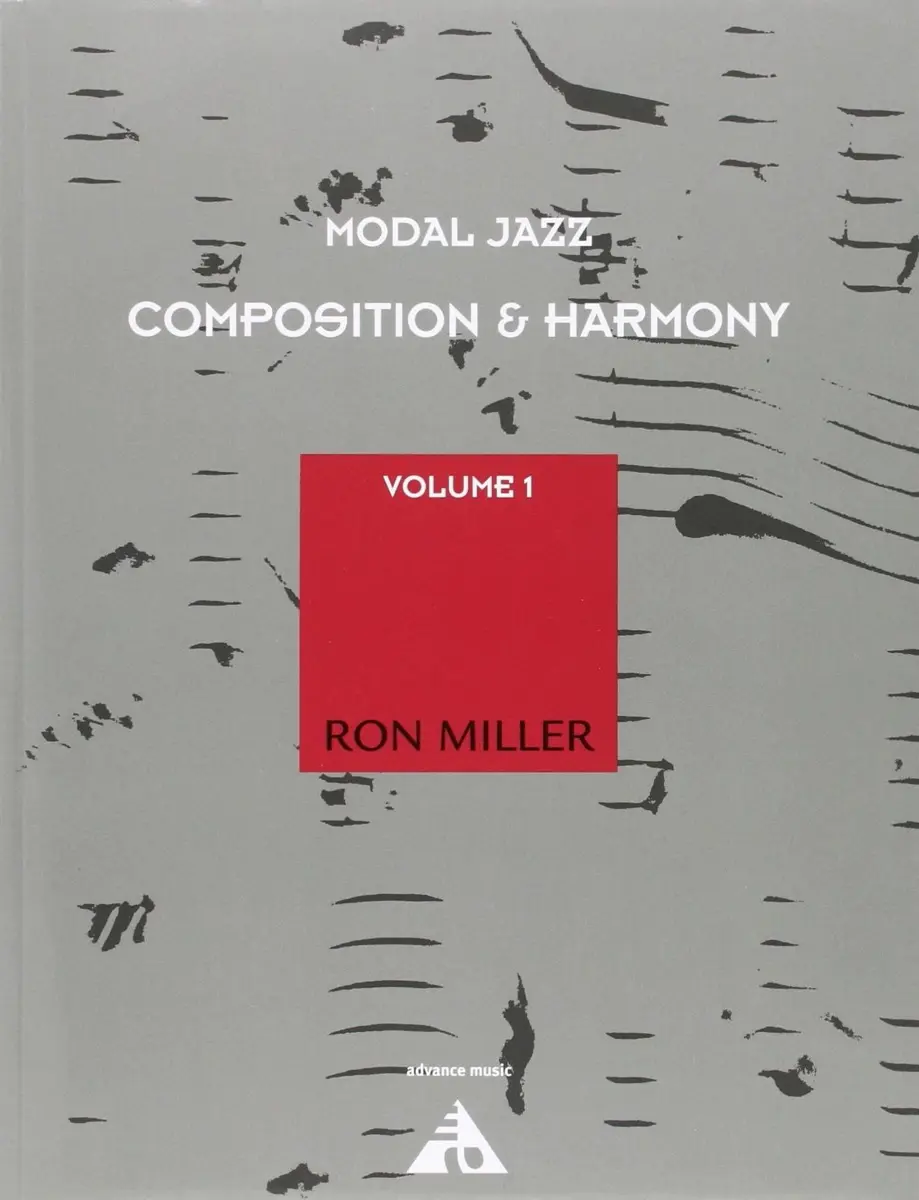
Anybody intrigued by the sixties compositions of Wayne Shorter, Herbie Hancock and Horace Silver or the ECM work of Eberhard Weber and Ralph Towner will be interested in Ron Miller’s thorough investigation of what he calls ‘the chromatic-modal harmonic system and free asymmetric form’. Miller, professor of jazz studies at the University of Miami, traces the origin of this post-bebop style of composition to the sixties generation of university-educated composers (among them Hancock and Shorter) who brought their experience of Bartok, Stravinsky, Ravel and the like to bear on their jazz writing. Exposure to such composers brought an escape from the routines of functional, tonal harmony and the fixed Broadway-type song form, as well as a greater diversity of expression.
Miller goes into great depth, but the essence of the method is to derive from each diatonic and altered mode a chord which fully reflects the character of each mode, dissonances and all. Thus the perfect fourth, traditionally proscribed as an element of the major seventh chord on the first degree of the Ionian mode, is now welcomed as a crucial defining tone. Along with conventional tertiary harmony, the method also jettisons the principle of hierarchical chord progression, treating each chord as a distinct entity with a unique emotional quality. Equipped with an array of such chord colours, the composer is then able to create chord sequences by using such techniques as common-tone connection, pedal point, darkness contour, parody cadence and common upper structure.
Miller’s style is lucid and efficient, the way smoothed with copious examples and illustrations. Applause is also due once again to Advance for their enterprising publishing policy and excellent content and design. Their professionalism is marred only be scant attention to proofreading.
The Christian Escoudé book is an early number in a projected series of profiles of individual musicians. Most of the space in this high quality production (spiral binding, stout paper, excellent printing, sharp calligraphy) is taken up by Escoudé’s approachable-looking guitar music, but there’s also a discography and a brief, generously illustrated biography (in French and English) which includes an account of Escoudé’s 1980 world tour with John McLaughlin, an experience he views with mixed feelings.
Daniel Kazez’s Rhythm Book is a spiral-bound volume of graded exercises in rhythm reading and performance. It focuses on the rhythm encountered in band, orchestral, choral, solo and chamber music, but the material will improve players of any persuasion.
Modal Jazz – Composition & Harmony Volume 1, by Ron Miller. Advance Music, softback, 305mm x 227mm, 142pp
Christian Escoudé – My Book. Published by Jean-Marie Salhani, softback, 310 x 239mm, 76pp, illus, price 145FF. ISBN 2-911567-00-5
The Rhythm Book, by Daniel Kazez. Accura Music, softback, 280 x 218mm, 53pp.