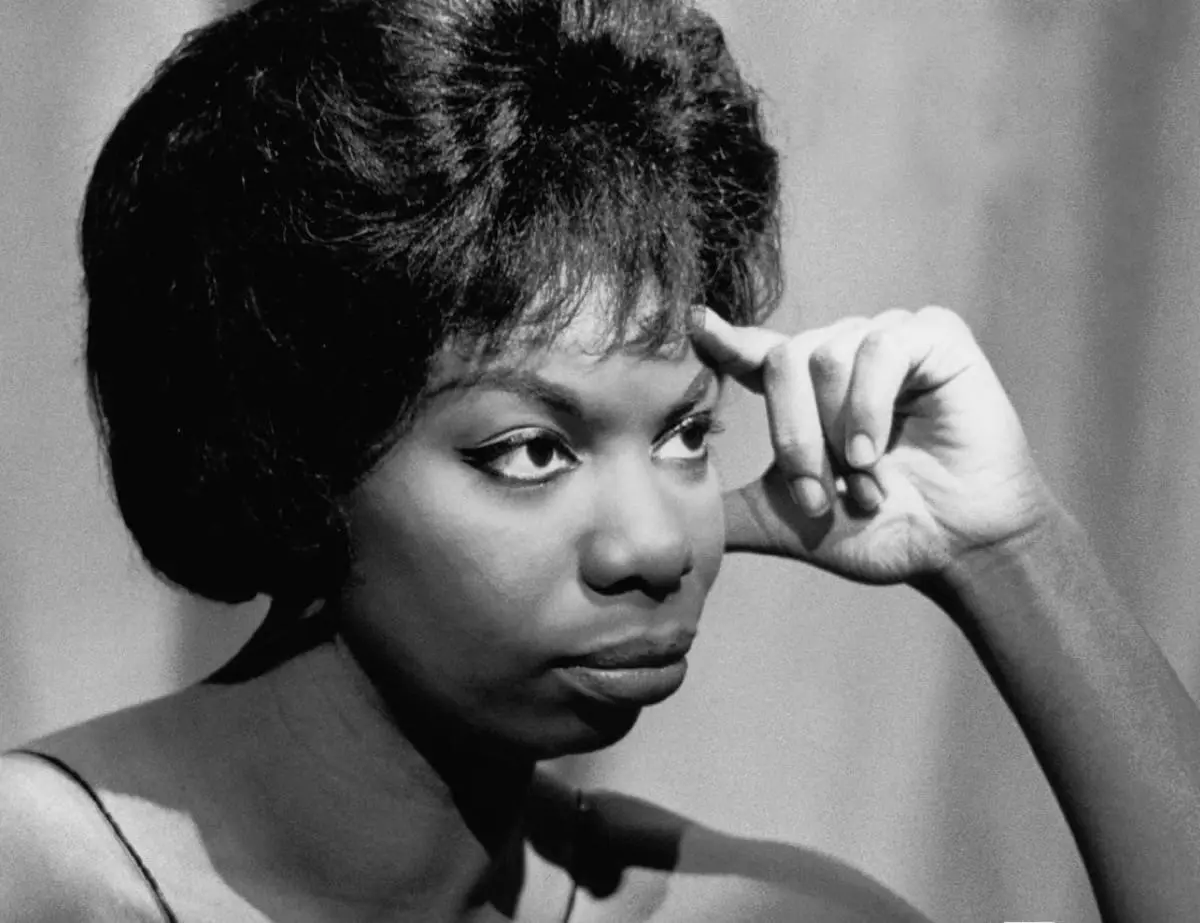
Nina Simone: At The Village Gate
If anyone could convincingly merge jazz and soul (not to mention gospel and the blues and even a bit of baroque) it was Simone. Her range is well-demonstrated on this selection from a live session. A rumbustious reading of Just In Time is followed by an extremely affecting interpretation of Rodgers and Hart’s He Was Too Good To Me, a dignified reading of House Of The Rising Sun, and a superb and (after an fine solo by Shackman) surprisingly classical version of Bye Bye Blackbird in which Simone’s hands engage in a lively cutting contest with each other for an exhilarating contrapuntal solo. The folky Vaynikehu closes the first side in 5/4 time.
Side two brings Simone’s hopes for reform and freedom to the fore. It opens with her lovely composition, Brown Baby, which says optimistically “I’m glad you gonna have things that I never had/When out of men’s heart all hate is hurled/Sweetie you gonna live in a better world.” Seems to me we’re still waiting for that world.
The beautiful but tear-jerking If He Changed My Name (sometimes known as I Told Jesus, as on the superb, heart-rending Roberta Flack on her First Take album) continues the theme before a rumbustious version of the venerable gospel song Children Go Where I Send You. The album closes with another gospel standard, Sinnerman, a spirited vision of the Apocalypse. Sinnerman, like Vaynikehu, may well be from the same concert as the other tracks but the tapes have been lost so this has not been confirmed.
This limited edition LP is printed on 180-gram virgin see-through vinyl, if that floats your boat. The sound is a little woolly in places but nothing can dampen the power of Simone’s performance.
Discography
Just In Time; He Was Too Good To Me; House Of The Rising Sun; Bye Bye Blackbird; Vaynikehu* (26.37) – Brown Baby; Zungo; If He Changed My Name; Children Go Where I Send You; Sinnerman* (28.26)
Simone (v, p); Al Shackman (g); Chris White (b); Bobby Hamilton (d). New York, April 1961, except * unknown location and date.
Waxtime 526026
Mark Adams & The Neo Soul Allstars: This Is Neo Soul
The first time I played this album I found it overly busy, somewhat too relentless, convincingly funky but lacking in any substantial jazz content, though the high quality of the musicianship and production was evident, as were some subtleties in the details. It began to grow on me during the second hearing and by the third I had identified tracks that I would expect to listen to again, although probably not the whole album in one lump. I’m an old school soul fan – Wilson Pickett, Otis Redding, Etta James and suchlike, though I can see the roots of this more contemporary soul in some of the music of James Brown and Stevie Wonder, for example. The Allstars’ music is rooted in the 70s but incorporates subsequent developments skilfully, effectively and (yes) funkily.
Alongside the originals the programme includes three Roy Ayers covers, one Lonnie Liston Smith cover and a tribute to Smith. Adams has an impressive CV, having worked as MD with Ayers for a quarter century or more, as well as Ron Carter, Ronnie Laws, Erykah Badu, Hugh Masekela, Bobbi Humphrey and Jocelyn Brown amongst many others, whilst various members of the Allstars have a similarly impressive roster of collaborators and leaders including Ayers, Smith and Aretha Franklin, Roberta Flack, Ayers, Smith, Chaka Khan, Gloria Gaynor, Luther Vandross and Chic. If this is your bag this album can certainly be recommended.
Discography
Expansions; Don’t Stop; Don’t Look Back; Daydream; Vibrations; Sweet Tears; Open Letter; Dre’s World; Talking Walls; Groove (59.52)
Selected personnel: Kenyatta Beasley (t); Dave Mullins (s); Mark Adams (kyb); John Smith, Bill White, William “Spaceman” Patterson (g); Monte Croft (vib); Emanuel “Chulo” Gatewood, Roy Bennett, Donald Nicks (b); Chris DeCarmine (d); Steven Kroon (pc); Jonathan Quash, Kimberly Davis, John Pressley, Miya Bass (v). Place and date unknown, but c. 2022-2025.
Down Jazz