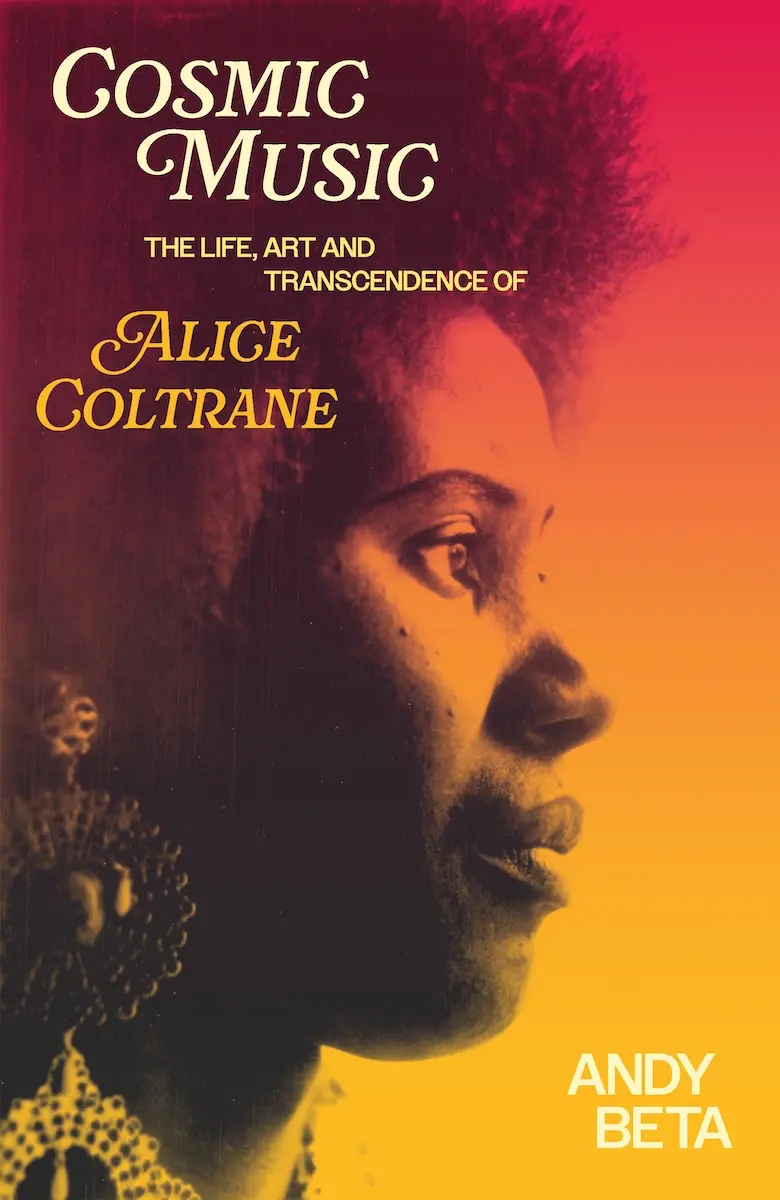
I first heard Alice Coltrane on the album after which this book is named. It had been the first time she had recorded with husband John, although the LP was not released until after his death. Like many Trane fans I regretted the demise of the classic quartet of McCoy Tyner, Jimmy Garrison and Elvin Jones when Tyner and Jones left the band, displeased with Trane’s inclusion of additional drummers. It took me a while to adjust, but I did buy Alice’s Impulse albums, A Monastic Trio and Universal Consciousness (where she played harp and organ) as I was intrigued by how she was applying her interest in Eastern music, religion and philosophies, which she had shared with John.
She had in fact already had a solid career before joining Trane. As Alice McLeod (her maiden name) she had spent time in Terry Gibbs’s group, playing piano and occasionally second vibes. She also worked with singer Kenny Hagood and was married to him briefly. Earlier, whilst still in her home town of Detroit, she featured as the arranger and pianist (playing a Wurlitzer) with The Premiers, a vocal trio that included George Bohannon. After leaving The Premiers she took gigs wherever she could, often playing piano for visiting musicians such as Sonny Stitt and Cannonball Adderley.
Andy Beta provides a lot of information about Alice’s early years in Detroit. The city is perhaps best known as the birthplace of Tamla Motown, but it has had its share of influential jazz musicians as well, including Donald Byrd, Yusef Lateef, Wardell Gray and, way back, McKinney’s Cotton Pickers. When Alice was growing up there the schools had been effectively desegregated but out in the city racism was active, with much gang violence, white on black and black on white. Beta also examines the often negative effects of urban renewal, with new and expensive residential and commercial developments and highways sweeping away poor, working class (and mostly black) neighbourhoods.
Whilst she had been with Gibbs’s group in Paris she met John Coltrane and in 1965 they got married in Mexico. This too was a short marriage as Trane died in July 1967 but inevitably he looms large in Beta’s narrative and I’m sure Alice would have wanted that. Nonetheless, this is her story, and Beta provides a rounded portrait of her and of her work in its own right.
Alice is credited with (or blamed for, depending on your taste) being a major player in the development of “spiritual jazz” and her work has extended well beyond jazz, with such projects as The Vedantic Centre and a spiritual community in the Santa Monica Mountains of California, adopting the name Turiyasangitananda and recording with the ashram’s choir, leading it from the organ. Like Trane, she had grown up in a Christian tradition (both of them had church ministers amongst their families) but were increasingly attracted to Hinduism. Beta gives a rounded picture of their spiritual journey and how it affected their artistic and personal evolution, taking us on Alice’s long evolution from Bud Powell disciple to spiritual leader.
Cosmic Music: The Life, Art And Transcendence Of Alice Coltrane, by Andy Beta. White Rabbit Books, 392 pp plus 13 pp author’s preface and prologue and 36 pp notes. Hb £30; also available in e-book and audio formats