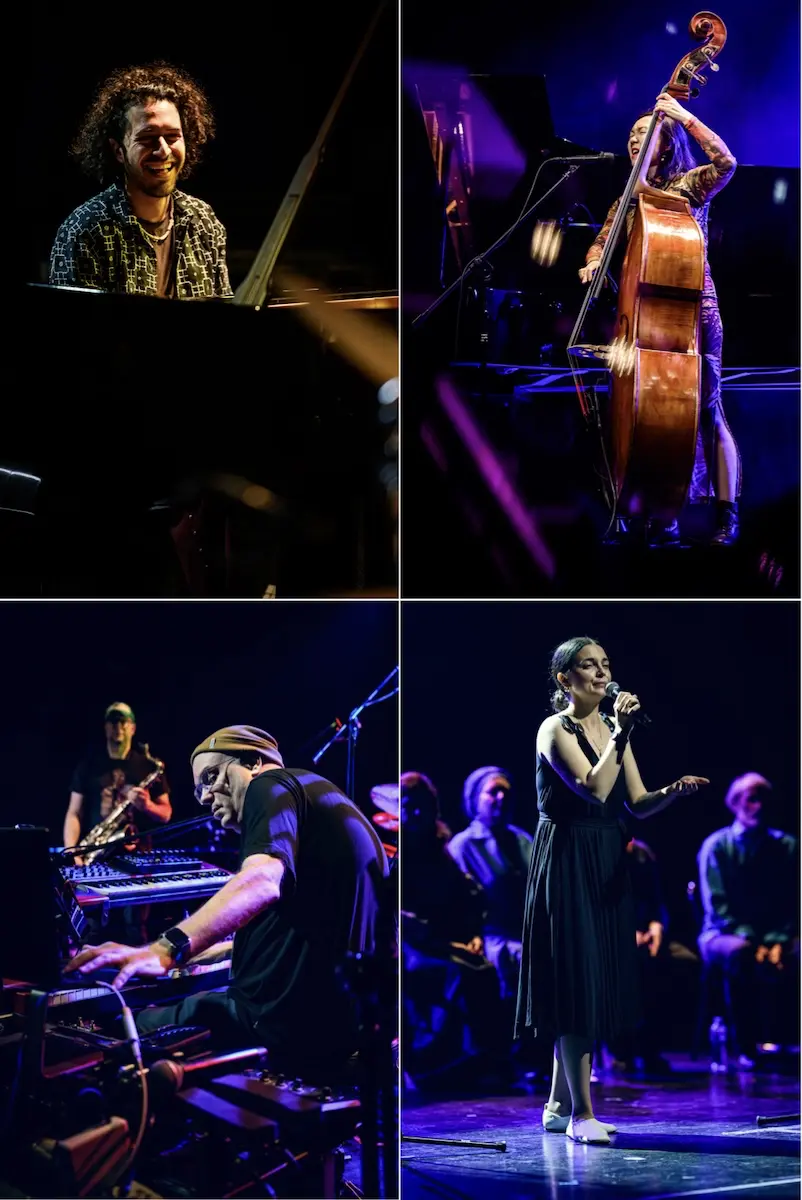
The 52nd International Jazz Piano Festival in Kalisz, Poland (20-23 November 2025) was the first edition prepared by Krzysztof Herdzin, who assumed the role of artistic director after Paweł Brodowski. This change, inevitably accompanied by a degree of uncertainty among the Kalisz audience, proved to be an impulse for a creative expansion of the festival’s long-established formula. The programme preserved its aesthetic continuity while clearly broadening its stylistic spectrum, foregrounding the diversity of contemporary jazz.
Thursday’s opening had a reflective character. Instead of a traditional recital, audiences were presented with a cinematic diptych – Forever Melomani (Na zawsze Melomani) and Komeda: A Personal Portrait (Komeda osobisty) – both scripted by Igor Mertyn. The screenings were followed by a discussion with Mertyn and Tomasz Lach, son of Zofia Komedowa and raised by Krzysztof Komeda-Trzciński. It was a conscious gesture of anchoring the festival in the history of Polish jazz and paying homage to its most significant figures.
Friday evening began with a solo recital by Dominik Kisiel, who offered music of focus and intimacy, free of ostentatious gestures. His playing was shaped by subtle dynamics, attentive phrasing and a natural unfolding of form. Echoes of the Tri-City jazz tradition could be heard – not as an aesthetic manifesto, but rather as a way of thinking about structure and narrative.
The same evening continued the Kalisz tradition of presenting Austrian musicians. The audience was immersed in the world of OWLS – the trio of Simon Oberleitner (piano), Konstantin Kräutler-Horváth (drums) and Oliver Steger (double bass). Drawing on material from Wendolins Monocle, Crumbling Light and Light Works, the group combined a European jazz idiom with classical refinement, ambient colours and a distinctive melodic sensibility. Lyrical themes emerged against a backdrop of subtle piano preparations, field recordings, loops and electronic textures, forming a coherent, pulsating narrative. OWLS in Kalisz revealed the full scope of their artistry: concentration, precision and openness to dialogue, worthily continuing the festival’s longstanding “Austrian line”.
The climax of Friday night was the performance by the Emmet Cohen Trio: Emmet Cohen (piano), Joey Ranieri (double bass) and Joe Farnsworth (drums). The group drew a full house not only because of Cohen’s prestige – he was recently voted the world’s top jazz pianist in the Downbeat readers’ poll – but also due to its growing reputation as one of today’s leading straight-ahead trios. Cohen’s style unites dazzling technique, deep sensitivity and elegance, engaging in a genuine dialogue with an equal partner in the rhythm section. Farnsworth impressed with his ease, dynamic range and impeccable time; his drum solo, crowned by a flamboyant toss of the sticks, was among the evening’s highlights. Ranieri brought freshness and maturity, underscoring the leader’s harmonic ideas. Cohen avoided overt virtuoso display, opting instead for clarity of phrase, sincerity and the sheer joy of playing. On stage, the trio functioned as a single organism – light, elastic and mutually inspiring – closing Friday with one of the festival’s strongest moments: no fireworks, just pure, pulsating musical energy.
The Festival Night Club, set within the restored walls of the former Calisia piano factory, belonged to the Wrocław-based Kratisa Q: Maja Babyszka (piano), Dimitrios Hartwich-Vrazas (tenor saxophone), Jan Jerzy Kołacki (double bass) and Jakub Jugo (drums). Their music combined transparent composition with open improvisation, creating a narrative that was cohesive, fresh and free from stylistic randomness.
Saturday afternoon brought an author’s meeting with Paweł Brodowski (hosted by Jan Cegiełka), which – like the anniversary exhibition Jazz Forum: 60 Covers For 60 Years – introduced a strong historical dimension. Curated by Kasia Stańczyk, the exhibition featured works by, among others, Rafał Olbiński, Rosław Szaybo, Andrzej Pągowski and Rafał Krajewski, recalling the crucial role of Jazz Forum in shaping the visual and cultural identity of jazz in Poland.
Saturday’s concert programme opened with The Wandering Bird (Wędrujący ptak). Taking up the challenge of reconciling tradition and improvisation, it was a project by pianist and synthesist Łukasz Ojdana and his wife, vocalist Maria Ojdana, with the Ukrainian vocal group Drevo (Tatiana Sopiłka, Anna Ohrimchuk, Serhij Ohrimchuk and Jurij Pastushenko). The music fused three elements: archaic Polish and Ukrainian songs, expansive jazz improvisation and contemporary synthesiser colours. These layers intertwined to form a narrative rich in tension and contrast, centered around the titular bird – a symbol of the soul and a guide between worlds. Drevo sang with the characteristic timbre of Ukrainian folk tradition, while Ojdana wove his own counterpoint, extending the synthesiser’s palette from shimmering, ethereal hues to dense electroacoustic landscapes. The Wandering Bird proved to be one of the most atmospheric and moving moments of the day.
After the interval, the stage was taken over by the Joey Alexander Trio – Indonesian pianist Alexander, bassist Alon Near (Tel Aviv) and drummer Matheus Jardim (Brazil). Despite his young age, Alexander demonstrated mature, emotionally saturated playing. The trio seamlessly blended lyrical passages with dynamic improvisations, forming an expressive collective in which each instrument retained its individuality while contributing to a natural, ongoing dialogue.
The late-evening highlight on the main stage was the duo of double bassist Linda May Han Oh and pianist Fabian Almazan. Beyond the musicians’ renown, the performance captivated through its exceptional sensitivity. Linda, born in Malaysia and long based in the United States, enriched her bass lines with subtle vocalisations, lending the concert an intimate aura. Fabian, born in Havana and raised in Miami, combined classical training with jazz imagination, enchanting with elegance, spatial awareness and precision in his dialogue with the bass. The duo moved freely between lyrical statements and rhythmically pulsating lines, radiating intimacy, joy of shared music-making and a striking emotional closeness.
The Festival Night Club concluded Saturday with the Jarecki Jazz Octet, a new Polish formation featuring Agata Ławicka (trumpet, flugelhorn), Dawid Tokłowicz (alto and soprano saxophones), Szymon Kowalik (tenor saxophone), Tomasz Klepczyński (bass clarinet), Dominik Łukaszczyk (trombone), Jan Jarecki (acoustic and electric piano), Piotr Lemańczyk (double bass) and Marcin Sojka (drums). Jarecki’s compositions, written specifically for this ensemble, combined swing, groove, ballad forms, Afro-Cuban elements and modern improvisation, yielding a coherent and dynamic musical statement.
Sunday, the final day, opened with the Filip Wojciechowski Quartet – Filip Wojciechowski (piano), Marcin Kajper (tenor saxophone), Paweł Pańta (double bass) and Patryk Dobosz (drums) – presenting material from their latest album View. From the first bars, the group built a carefully shaped narrative, blending clear, almost contemplative phrases with rhythmically expansive forms. Wojciechowski’s warm, deep piano-tone bridged jazz language and classical heritage, most strikingly in a jazz contextualisation of Chopin’s Mazurka in D major, offered as a homage to the pianist’s classical roots. The concert opened the festival’s finale with calm maturity and a strong sense of form and sound.
The second group featured the international Antonio Faraò Trio – Faraò (piano, Italy), Yuri Goloubev (double bass, Russia) and Jeff Ballard (drums, USA). The very lineup promised a meeting of top-tier musicians, and the Kalisz performance fully delivered. Faraò impressed with technical mastery and a deep sense of swing, Goloubev added depth and precision, and Ballard supplied energy, finesse and his distinctive drive. The trio offered an intense, elegant and perfectly communicated display of contemporary jazz.
The festival’s final word belonged to the Scott Kinsey Group, led by the charismatic “keyboard wizard” Scott Kinsey. Rooted in the jazz-fusion tradition, with clear references to the aesthetic of Joe Zawinul – Kinsey’s close artistic mentor – the music pulsed with energy, syncopated grooves and expansive forms, balancing precision with exuberant improvisation. Itai Weissman (saxophone, flute, EWI) added a futuristic edge, Federico Malaman (double bass) anchored the groove with authority, and Gergő Borlai (drums) propelled the band with a powerful drive, oscillating between finesse and near-rock intensity. It was an uncompromising, high-energy finale, reminding us that fusion, at its best, still sounds fresh and compelling.
The 52nd edition of the International Jazz Piano Festival in Kalisz proved to be a mature opening of a new chapter. Krzysztof Herdzin’s programme did not break with Paweł Brodowski’s legacy, but rather developed it creatively, underscoring the multiplicity of today’s jazz. From intimate recitals and tradition-rooted projects, through European lyricism and the dialogue between folklore and improvisation, to energetic fusion and late-night club sessions – the whole formed a coherent discourse. Once again, Kalisz confirmed its status as a meeting place of generations and styles, a space for attentive listening and the highest musical quality.
Text and photos: Szymon Ratajczyk (ratajczyk.art)
Editor: Damian Kacprzak