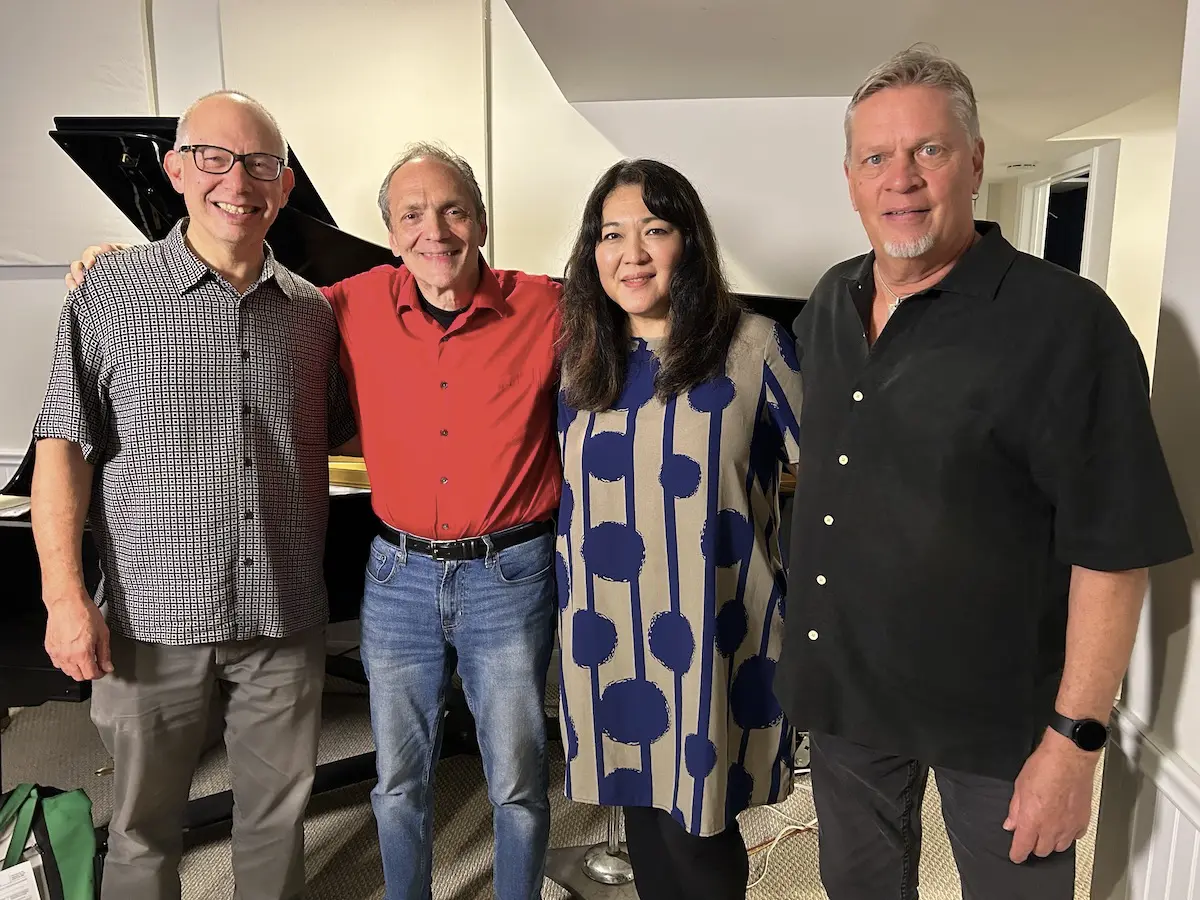
Lizzie & The Triggermen: Live At Joe’s Pub
Lizzie Shapiro is inspired by the likes of Judy Garland, Maria Callas, Sarah Vaughan and Billie Holiday. She has an acting background and trained for several years as an opera singer – a coloratura soprano – before turning to jazz. In 2015 Shapiro put together the Triggermen, the 10-piece band of which she’s lead singer. They built an enthusiastic following on the jazz circuit before issuing their debut recording in 2020. Now, after another five years, they’ve issued their second album, Live At Joe’s Pub.
Joe’s Pub, the well-known music venue at the Public Theatre in New York, is not actually a pub. There was no plan to make a live record there, in fact no one in the band knew the concert was being taped apart from Shapiro, who’d asked the venue to record it for promotional purposes. However, the outcome was so good that she and the band decided to release it as an album.
The music is an eclectic selection of 1930s/40s big-band numbers, jazz standards, Broadway songs, original compositions and some bebop thrown in for good measure. In Shapiro’s words the Triggermen are a modern band inspired by retro sounds rather than a nostalgia act. All the arrangements are by Dan Barrett, Benny Goodman’s former trombone player. When prospective members recruited by Shapiro heard that Barrett, a musician’s musician, was involved, they were keen to jump in.
Shapiro has an unusual voice – it’s partly in the style you’d associate with old musicals like Oklahoma, partly her native Massachusetts drawl and partly operatic. Have a listen to her and the band in Marion Sunshine’s When I Get Low I Get High. Also have a look at her singing the second clarinet’s role in Sidney Bechet’s Waste No Tears at Joe’s Pub last year.
Discography
When I Get Low I Get High; (Welcome); A Lot Of Livin’ To Do; I Know A Man; (Lizzy & The Precarious Safety Pin); Everything’s Coming Up Roses; (band intros); Good Queen Bess; Sweet Marijuana; I’d Rather Be Burned As A Witch; (Lizzy Trash Talks The Next Song); Ding-Dong! The Witch Is Dead; Waste No Tears; Baby One More Time; Struttin’ With Some Barbecue; (Lizzy Gets Sassy); Outta Your League; (Lizzy Gets Sentimental); La Vie En Rose; (Lizzy Gets Serious); When That Man Is Dead And Gone; (Encore); I Love To Singa (73.30)
Lizzy Shapiro (v); Nate Ketner (as/cl); Ricky Alexander (ts, bar, cl); Gordon Au (t); John Allred (tb); Luca Pino (g); Bobby Hawk (v); Chris Dawson (p); Gary Wicks (b; Anthony Ty Johnson (d). Joe’s Pub, New York, 6 April 2024.
lizzyandthetriggermen.com
Louis Stewart with Brian Dunning: Alone Together
Regarded as one of Ireland’s finest jazz guitarists, Louis Stewart was influenced in his playing by Charlie Christian, Tal Farlow, Barney Kessel, Jimmy Raney, Jim Hall and Pat Martino. He performed and recorded with Tubby Hayes, Benny Goodman, J.J. Johnson, George Shearing and Ronnie Scott amongst others and has appeared on over 70 albums, many as leader or co-leader.
Stewart is accompanied on Alone Together by Brian Dunning, who played jazz flute on the Irish jazz scene in the 70s and early 80s. He was a relative latecomer to the flute and was working as an electrician when he began lessons. Dunning moved to the United States in the 80s where he toured for several years blending Irish traditional music, jazz and classical chamber music with the bands Nightnoise and Puck Fair.
Alone Together was recorded live over three lunchtime concerts at the Peacock Theatre in Dublin and released on LP in 1979 and CD in 1999. Initially, there were eight tracks comprising revised versions of a selection of standards together with an improvised piece by the pair entitled Definitely Doctored. The album’s now been remixed, remastered and reissued with the addition of two newly discovered studio tracks – Some Day My Prince Will Come and Wes Montgomery’s West Coast Blues. The latter features an unnamed bass player, believed to be Martin Walsh.
Impressive interplay between Stewart and Dunning shifts effortlessly between bop, bossa nova and modern jazz arrangements. Sound quality is excellent. The fold-out digipak comes with liner notes plus black and white photos in a 12-page booklet.
Discography
There Will Never Be Another You; Windows; Definitely Doctored; Inner Urge; Israel; Alone Together; Triste; Donna Lee; Some Day My Prince Will Come; West Coast Blues (50.48)
Stewart (g); Dunning (f). Peacock Theatre, Dublin, 15-17 August 1979.
Livia Records LRCD2503
Ted Rosenthal Trio: Classics Reimagined: Impromp2
New York pianist Ted Rosenthal won the Thelonious Monk International Competition in 1988. He’s performed solo and with orchestras around the world and played with Gerry Mulligan, Art Farmer, James Moody and Phil Woods amongst many others. To date he’s released 19 albums as a leader in his own right.
Rosenthal has two working trios – in one he’s accompanied by bassist Noriko Ueda and drummer Quincy Davis and in the other by Martin Wind and Tim Horner. It’s the first trio which features in Impromp2 with Horner on two of the numbers. The release is the sequel to Rosenthal’s 2010 album, Impromptu, where he first jazzified pieces from the classical repertoire.
Applying the jazz treatment to the classics isn’t a new phenomenon of course. Many will recall fellow pianist Dave Brubeck’s 1960 album, Classical Brubeck, for instance and who can forget Jacques Loussier’s rendition of Bach’s Air On A G String, advertising Hamlet cigars? Nowadays though, the maestro of the art is arguably Rosenthal whose superb arrangements transfigure often familiar tunes into fresh ways of experiencing them.
Impromp2 has 11 such pieces. The trio is augmented by versatile violinist Sara Caswell on Rachmaninoff’s Vocalise, Elgar’s Salut d’Amour and Erik Satie’s lyrical Je Te Veux, while virtuoso clarinettist Ken Peplowski guests on Chopin’s Waltz in A-Flat and Mussorgsky’s The Old Castle. Other composers subject to similarly inspired jazz transformations are Dvorak, Brahms and Beethoven. For a taste, have a listen to how Rosenthal turns Chopin’s Waltz In C-Sharp Minor into a samba.
Discography
Waltz In C-Sharp Minor; Slavonic Dance; Mazurka In A Minor; The Old Castle; Vocalise; Allegretto From Symphony No. 3; Pathetique Sonata, 2nd Movement; Pathetique Sonata, 3rd Movement; Salut D’Amour; Je Te Veux; Waltz In A-Flat (66.09)
Rosenthal (p); Noriko Ueda (b); Quincy Davis (d). With Ken Peplowski (c); Sara Caswell (v). New Jersey, 5-8 August 2024.
TMR 101725