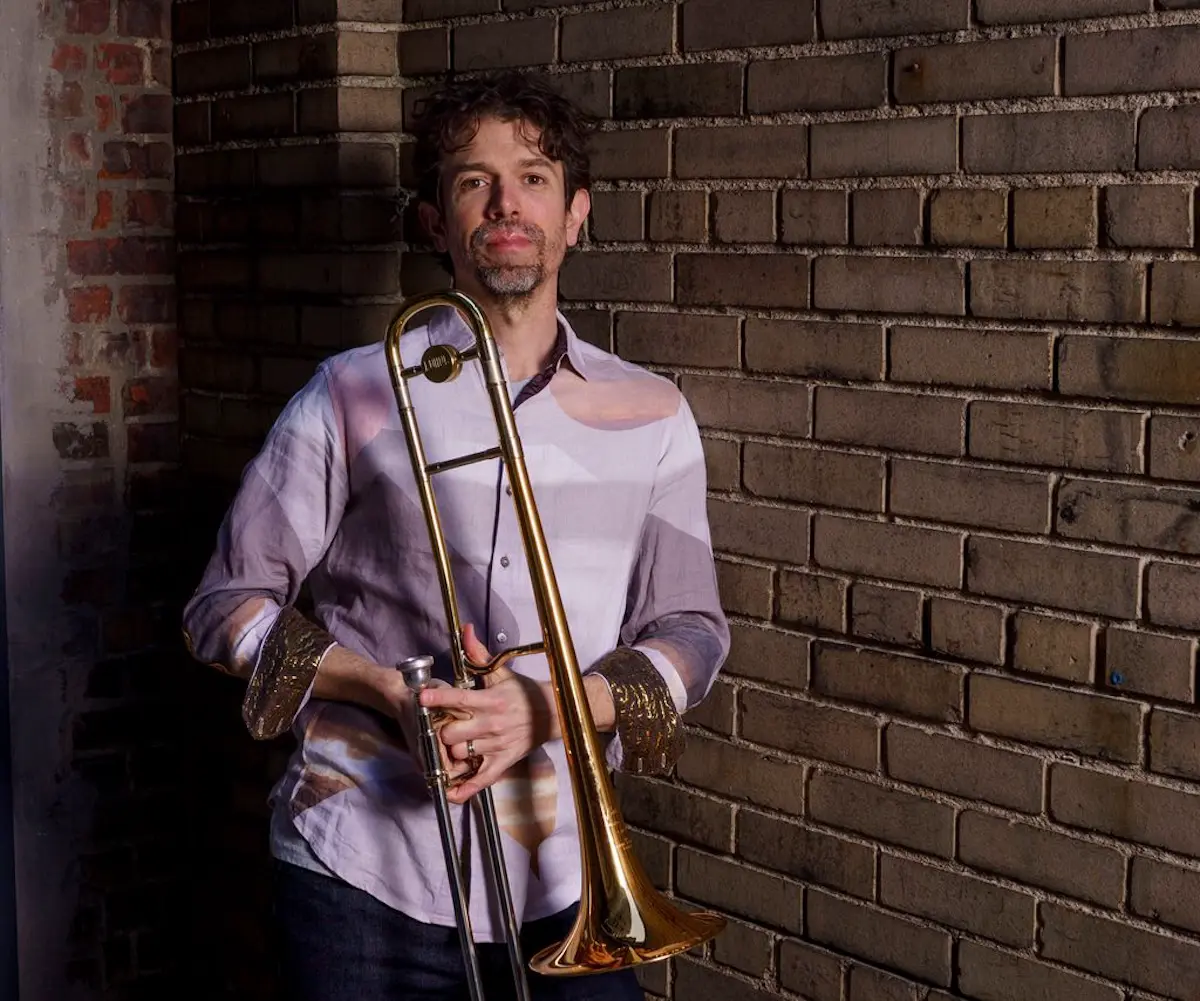
Ryan Keberle’s Collectiv Do Brasil: Here Is Donato!
Master trombonist Ray Keberle has studied at both the Manhattan School of Music, where he was mentored by Steve Turre, and Juilliard, where Wycliffe Gordon was his teacher. He has worked with Maria Schneider, Wynton Marsalis, David Berger, Rufus Reid, David Bowie and Justin Timberlake and has acquired an enviable reputation as “one of the most in-demand trombonist on the scene”. This was acknowledged by DownBeat critics in 2024 when he came joint-top in the trombone section along with Michael Dease. (Turre and Gordon finished third and fourth, respectively). He also enjoys a considerable academic career teaching at Berklee School of Music, New York University and London’s Royal Academy of Music. On this, his 14th album as a leader, he concentrates on the music of Joao Donato, “a massively influential figure in the history and development of bossa nova and Brazilian music”. Coincidentally, Donato is also a trombonist, having played with Eddie Palmieri and Tito Puente.
Keberle’s open sound, uninhibited by the use of mutes, reveals a legato timbre that calls Andy Martin and the great Urbie Green to mind. The cute Tema Teimoso has an extended montuno with creative interplay between the leader and pianist Felipe Silveira. The montuno, of course, is an essential element of the Latin genre. The busy, bustling Afro-Cuban rhythms of E Menina and Celestial Showers find Keberle at his most inspired. Nao Tem Nada Nao is notable for some intriguing bitonality from Silveira along the way. Mentiras and Ate Quem Sabe are two of Donato’s most melodic ballads. Someone should write a lyric to reflect their song-like quality.
Discography
Tema Teimoso; Nana Das Aguas; Nowhere To Go, Nothing To See; E Minina; Mentiras; Nao Tem Nada Nao; Celestial Showers; Ate Quem Sabe; Cade Jodel; Lugar Comum (40.35)
Keberle (tb, v); Felipe Silveira (p, elp); Felipe Brisola (b, elb); Paulinho Vicente (d); Guegue Medeiros (pc). Sao Paulo, Brazil, 17-19 2024.
Alternate Side Records ASR 022
Holland Court Jazz Trio: Inverted Tango
Bassist Frank Wagner, the leader of the Holland Court Jazz Trio, attended the Berklee College of Music, where he studied with Steve Swallow and Ron McClure. He has worked with Buddy Rich, Glenn Miller, Tiny Grimes, Milt Jackson and Eartha Kitt. In 1988, along with drummer Dave Meade, he released his award-winning album Past, Present and Future on Jazzheads Records. Pianist Dave Marck joins them here on the Holland Court Jazz Trio’s debut recording.
Inverted Tango is introduced by Wagner’s resonant bass ostinato leading to a delightful minor-key theme worthy of Erik Satie no less. After this salute to early 20th century minimalism, Inverted Tango develops into a homage to the master of the modern Argentinian tango – the great Astor Piazzolla. The humorously titled Hi-Ya, with its Caribbean rhythms, is actually a contrafact of Thelonius Monk’s Bye-Ya. The 32-bar AABA form is highlighted by two accented quarter-notes a fifth apart throughout the A sections. Phrygian Natural Fix becomes an extended vamp over the impressive Dave Meade’s funky latin grooves. Throughout this CD he reveals a series of imaginative percussive effects worthy of a Shelly Manne. Billy Strayhorn’s lovely A Flower Is Lovesome Thing (written in 1946 as a feature for Duke Ellington’s inimitable Johnny Hodges) is given an inspired reading here by Dave Marck. The trio, along with guest Ben Sutin on violin, pack quite a punch on Manic Depression, creating all the energy and passion you would expect from a Jimi Hendrix original.
Inverted Tango by the Holland Court Jazz Trio with guest Ben Sutin on violin is an intriguing release. It has something quite different to offer and is recommended.
Discography
Inverted Tango; Hi-Ya; Phrygian Natural Fix; A Flower Is A Lovesome Thing ;Invisible Enemy; Domenica Canta; Quiet Room; Manic Depression (56.57)
Dave Marck (p); Frank Wagner (b); Dave Meade (d); Ben Sutin (vn). Brooklyn, NYC, 18 & 19 June 2025.
Composers Concordance Records
Chet Baker: Sextet & Quartet
Chet Baker is aided and abetted here by Glauco Masetti and Gianni Basso, who were part of an exclusive little group known as the who’s who of the Italian jazz scene. They are both multi-instrumentalists who often worked with him. Masetti is limited to the alto here, projecting a fluent Herb Geller-like sound, and Basso on just his tenor is very much a swinging Lestorian. They were so clearly influenced by the prevailing West Coast Jazz school that the album could more accurately be titled Chet Baker In Los Angeles.
As the sleeve-note points out, “Chet Baker had a long and complicated relationship with Italy.” His first visit took place on a successful European tour in 1955. During that tour his pianist Dick Twardzik died from a drug overdose in Paris which devastated Chet. A month after this album was recorded he was arrested and served 18 months imprisonment in Lucca, Tuscany. Over the years, though, he returned to the country many times. He learnt to speak Italian and considered Italy to be his second home.
The programme features staples from Baker’s repertoire except for Sonny Rollins’ Pent-Up House, which is an original composition and not a contrafact, as far as I can tell. This is the first time he recorded it but he was to return to it again on at least five occasions. Another of his personal favourites was Eddie Vinson’s Tune Up, which was appropriated by Miles Davis, of course. Once again my tin ear does not identify a contrafact. The leader is on good-form throughout, particularly on Lady Bird, Look For The Silver Lining and especially on Cheryl, a typically sinuous Charlie Parker blues. The alto and tenor drop out for two of Baker’s lyrical ballad readings – My Old Flame and Indian Summer.
Discography
Lady Bird; Cheryl; Tune Up; Line For Lyons; Pent-Up House; Look For The Silver Lining; Indian Summer; My Old Flame; My Funny Valentine (48.01
Baker (t, v); Glauco Masetti (as); Gianni Basso (ts); Renato Sellani (p); Franco Cerri (b); Gene Victory (d). Milan, Italy, 25 September & 6 October 1959.
WaxTime 771678