
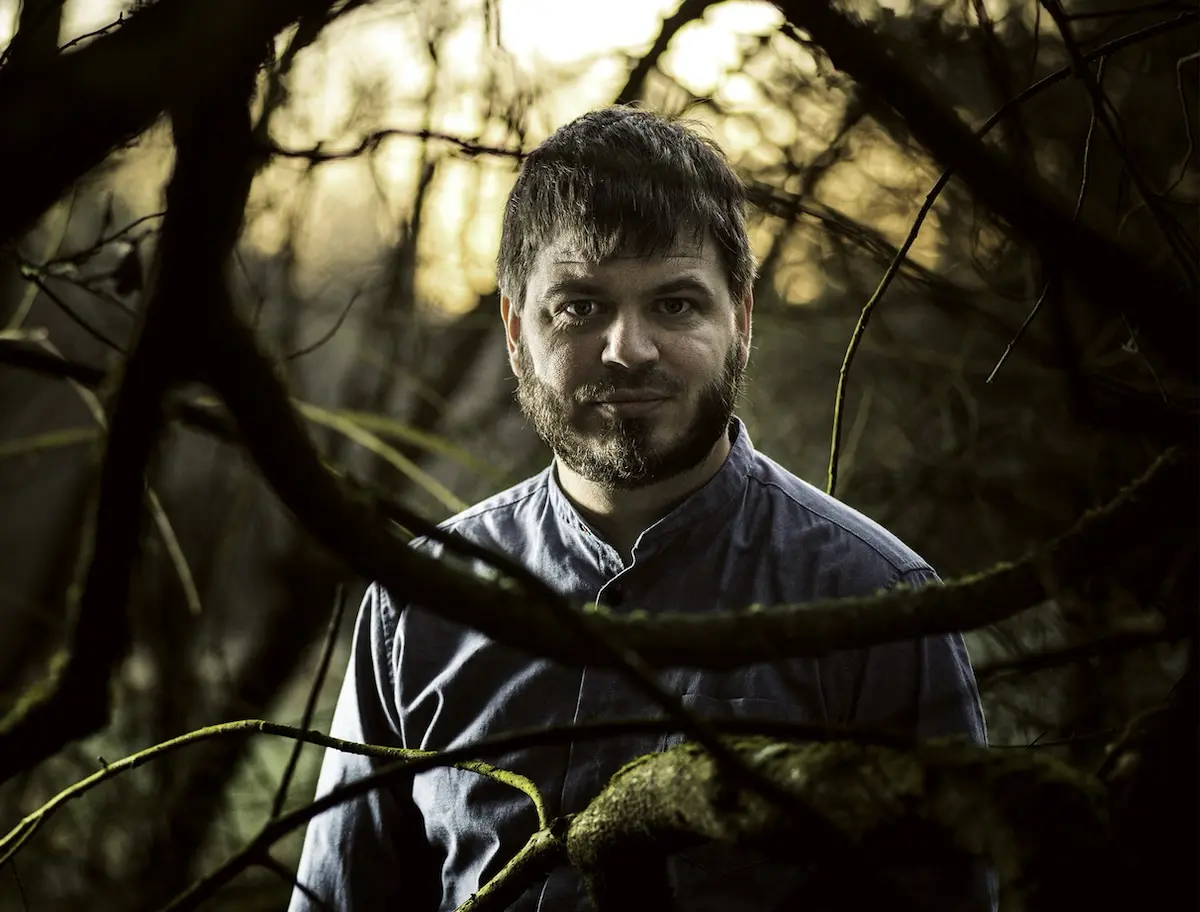
Gorm Askjær Trio+: Microverse I
Announcing their presence with the enjoyable 2020 debut Blodmånen Og Dig (“The Blood Moon And You”), Gorm Askjær’s trio took the sounds of Bill Frisell’s jazz Americana to a freer and frankly altogether more exciting place. That was quickly followed by First Movement by his quirky post-bop quintet Secret Safari but the Aarhus-based guitarist, composer and educator has rather fallen off my radar since then. It turns out he’s been busy with a variety of grass-roots and composition-based projects, but this return to the studio clearly demonstrates that he’s lost none of his sense of adventure in the intervening years.
This is essentially an expanded version of the Blodmånen trio, the core unit augmented by Copenhagen-based clarinetist and saxophonist Francesco Bigoni, whose work with guitarist Mark Solborg also comes highly recommended, and classical cellist Malthe Volfing Højage, who brings textural finesse and an underlying sense of stability to the freer pieces. Flowing smoothly between formal chamber-jazz and collective improvisation, the turnover of ideas within the group is positively kaleidoscopic. With only three of the 12 tracks breaching the five-minute mark, the album’s mosaic-like structure allows Askjær to create a constellation of small musical universes, each with its own distinct atmosphere.
Opener Fatamorgana rises majestically from near silence, the boldly delineated unisons of its Motianesque theme underpinned by Højager’s ghostly cello layers and a rubato pulse. Askjær is first to solo, clean-toned and melodic, and he’s followed by Bigoni’s searching tenor before the piece finally vanishes like the mirage-like phenomena of its title. Bigoni’s Giuffre-esque clarinet holds centre-stage on the improvised Under The Microscope, a short interlude before the more abrasive improvs of It Almost Works and It’s All Getting Fuzzy. Elsewhere, the atonal chamber manoeuvres of Where Do Lost Memories Go are completely spellbinding, Bigoni and Højager impart a sense of delicacy to Echoes, and the pastoral Americana of Spring, which draws proceedings to a close, is the perfectly weighted coda. Another deeply impressive statement from Askjær, and I only hope that a second volume arrives soon.
Discography
Fatamorgana; Under The Microscope; It Almost Works; Grains Of Sand; Where Do Lost Memories Go?; Specks Of Dust In A Beam Of Light; Echoes; It’s All Getting Fuzzy; Hazy Dawn; Strands Of Mycelia; Good Old Times; You Can Never Hold Back Spring (39.02)
Askjær (elg); with Francesco Bigoni (ts, cl); Malthe Volfing Højager (clo); Jens Mikkel Madsen (b); Thomas Eiler (d). Finland Studio, Aarhus, No date.
Jaeger Community Music JCM081
Elin Forkelid: Plays For Trane, Volume 2
Glancing at the title you could be forgiven for anticipating another Coltrane centennial tribute, but the truth of the matter is rather different. Anecdotally, the project very nearly didn’t happen at all, Forkelid (née Larsson) initially declining a 2018 invitation from Stockholm’s Fasching Jazzclub to perform Coltrane’s music as part of a wider celebration of his work. Yet the seeds must have been planted, because less than two years later this stellar ensemble released their debut album on Forkelid’s Sail Cabin imprint. Now very much a working band, they’re back with a well-timed sequel.
In something of a shift of emphasis, most of the repertoire is drawn from Coltrane’s final years, a period that many listeners still find difficult. Yet Forkelid’s group refract the spirit of Coltrane’s ecstatic outpourings in a variety of very personal ways, re-contextualising his music as they go. Without a piano, Stackenäs and Ståhl trace in the music’s textural and harmonic details, while Bromander and Fält are steeped in that quintessentially Scandinavian approach to sound and silence. Often weaving in sounds and devices from other musical genres, their mission is simply to play Coltrane’s music their way.
The opening track is easily the most confrontational passage of the album, a choir of squalling soprano saxes piercing the upper register for close to five minutes. As the solid outlines of a form emerge from the smoke, Ståhl shifts the emphasis with a fast-paced solo before Forkelid then steers the juggernaut towards more meditative ground. The saxophonist gets straight to the heart of the melody on Expression, stretching out against a free pulse as Stackenäs adds some disarmingly Frisellian flourishes. The shimmering textures of Naima suggest a yearning for astral travelling, while the guitarist’s East African figures introduce an unexpected twist to Peace On Earth. The album closes with Reverend King from the posthumously released Cosmic Music, Forkelid’s keening soprano soaring above a minimalist backdrop with a hint of dreamy shoe-gaze rock. It’s far from conventional as musical homages go, but I think it’s all the better for that.
Discography
Dearly Beloved / Sun Star / Venus; Expression; Naima; Peace On Earth; Reverend King (42.24)
Forkelid (as, ts, ss) with Mattias Ståhl (vib, ss); David Stackenäs (elg); Vilhelm Bromander (b, ss); Jon Fält (d). Atlantis Metronome, Stockholm, 9–10 June 2025.
Sail Cabin Records SCRCD006 / SCRLP006
Ensemble neoN & Benedicte Maurseth: Always And Never The Same
Composer and Hardanger fiddle specialist Benedicte Maurseth occupies a niche somewhere between traditional and contemporary music. Her ambient jazz-folk soundscapes for Hubro have garnered five-star reviews and industry awards aplenty, and this ambitious new chamber work continues in a broadly similar same vein. Conceived as a multi-media collaboration with new music collective Ensemble neoN and animator Simone Hooymans, it was given a headline performance at the Ultimafestivalen of contemporary music in Oslo in 2023. Maurseth subsequently reworked the piece with producer and modular synth maestro Jørgen Træen, and it’s this later version, available in digital formats since January, that Aurora is now belatedly releasing on vinyl.
The album’s somewhat oxymoronic title comes from an 1841 essay by Ralph Waldo Emerson on the mutability of nature, an idea mirrored in the music’s constant variations and repetitive minimalist structures. Duos and trios frequently peel away from the main ensemble to impress their personalities onto the music, creating a slow, organic sense of movement. With an instrumentation deliberately designed to complement the timbral qualities of the Hardanger fiddle, the project might also be said to be an eight-part chamber suite, with the composer appearing as principal soloist.
When the album opens, with the longest of three contrasting variations of Contented Pelicans, I am reminded a little of Stephan Micus. The music’s ancient yet somehow ageless sounds lead the imagination to far-flung places. Interspersed between the pelican variations are five evocative tone poems, each taking its title from fragments of early Buddhist sutras. Whilst it’s extremely difficult to pick standout tracks when every piece is so essential to the whole, I particularly enjoyed the evocative melodies and primal drones of Delightful Are Forests and Unmoved, and the juxtaposition of early music and grinding industrial noise on A Bee Among Blooms. The warm, richly detailed studio sound simply invites close attention, making this one of those truly immersive albums that is best experienced by sitting back, turning up the volume, and allowing the music to gently wash over you in waves.
Discography
Contented Pelicans I; Without Path Endless Field; As A Bee Among Blooms Just Walking Through; Contented Pelicans II; Delightful Are Forests Unintended For Delight; Unmoved By Praise Or Blame; Nor Mine, Nor Me, Nor I; Contented Pelicans III (41.29)
Maurseth (hardanger fiddle, p, v) with Inga Grytås Byrkjeland (clo); Ane Marthe Sørlien Holen (vib, pc, d); Yumi Murakami (f, bass flute); Solmund Nystabakk (lute); Jan Martin Smørdal (g, p); Kristine Tjøgersen (cl, bcl, kyb, hca, pc); Jørgen Træen (syn). Oslo, 18-19 June 2025.
Aurora Records ACD5125