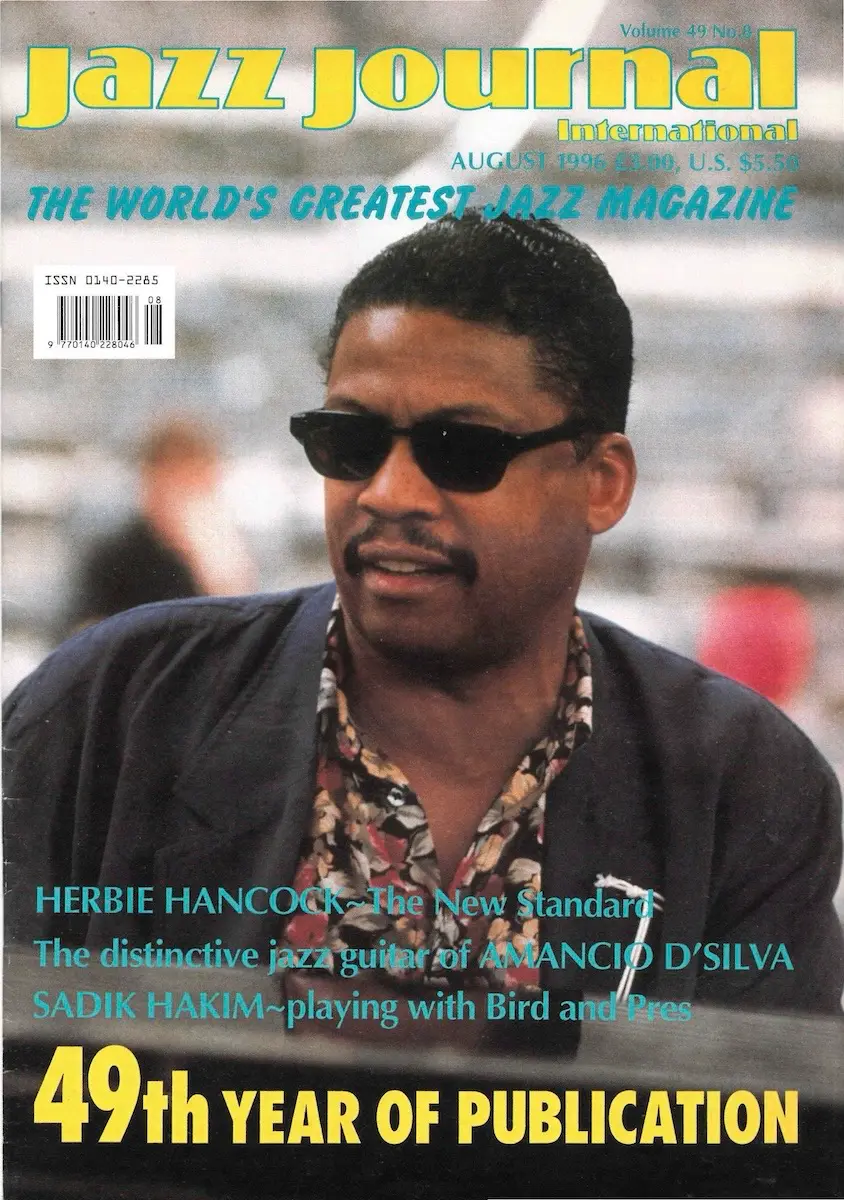
Although he has participated in various jazz sessions in recent years, including the 1985 Round Midnight film soundtrack and a 1993 tribute to Miles Davis with Wallace Roney, Herbie Hancock’s debut for Polygram, The New Standard, is his first straightahead date under his own name since his 1981 quartet recording with Wynton Marsalis.
‘The New Standard was the idea of Guy Eckstine, who is an executive with Verve. He’s also co-producer of the record. I guess the thing for him was that a record company is a business, so they’re gonna try to think “What kind of angle can we get to get the most mileage out of sales?” That’s what their job is. And so he thought that it might be an interesting thing to do tunes written by pop writers. I said “Could be interesting, but it smells of commercialism. It smells contrived”. So we sat down and talked about it and we started thinking, you know back in the sixties when I first came on the jazz scene, there were standards that we all played. That was part of the repertoire of being a jazz musician. It served several great functions, one of the main ones being that that was a time when there were a lot of jam sessions, and people could sit down and play tunes that they all knew, ’cause there was a common language of tunes. Those tunes and the bebop tunes.
‘Now things are different. I’m not on that scene, but I understand from a lot of the younger players that there aren’t that many jam sessions. So times have changed. But the thing is, we still keep calling those old songs the standards, still the Cole Porter songs, Gershwin, things from the thirties and the forties. And this is 1996. Those tunes are getting to be 60 years old, so we’re going to go another 40 years and still call the same things standards? Or are we going to start looking around for some new ones? Which I think is very important. So then I started thinking “What if we treated tunes by the new pop writers like they were standards?” We used to do it with the old pop tunes.
‘Tunes by pop writers today, by and large, are not as harmonically rich. And harmony is one of the things that is part of the structure of improvisation’
‘Well, that’s not so easy to do, ’cause tunes by pop writers today, by and large, are not as harmonically rich. And harmony is one of the things that is part of the structure of improvisation. But I thought that I can use that as an excuse for personalising the structure of these tunes – you know, put my own kind of twist on them. And it made sense to me then.
‘I asked Guy Eckstine to make some suggestions, because he’s more from that generation. He knows the names of the tunes. I hear tunes, but you know, but I don’t know the names of a lot of the pop tunes. So he made some suggestions, and little by little we cut them down to the ones we have on the record.’
As anyone who has heard The New Standard will testify, the changes that Herbie and his collaborator Bob Belden made were quite extensive. In fact perhaps the only tune on the record that remains instantly recognisable is Steely Dan’s Your Gold Teeth II.
‘Oh yeah, that one already has so many changes in it. We just played, and extended the harmonies a little bit. And then we went from playing it in 3/4 to 4/4 and back and forth. We did shift that kind of thing. And there’s another part to Gold Teeth that we changed. We had Michael Brecker improvise over a part on the original where I think there’s a guitar solo, and I just played the voicings in a more modern way. Other than that it’s not changed that much.
‘There’s a Prince tune, Thieves In The Temple, and what I was getting at with that was I remembered that on my very first album under my own name, Takin’ Off, I had Watermelon Man, so I thought I wonder if I can find a treatment for Thieves that would be sort of in that direction. That’s what I tried to do.
‘Another tune was Stronger Than Pride, the Sade tune, and we did little, subtle things to that to make it more interesting. Scarborough Fair – we did change some of the chords in that. And also Norwegian Wood – we just changed some of the voicings. I didn’t do much to the Nirvana song, All Apologies. I mean, I played it in a bluesy style, but I didn’t add any real chords to it. There are other songs we changed a lot, like New York Minute. We made that sound like a kind of John Coltrane sixties approach.
‘We changed Stevie Wonder’s tune, You Got It Bad Girl, a lot, and a lot of that work was by Bob Belden. It was Bob’s job to actually put the thing together, and I talked to him for a long while, ’cause I just met him for this project. He was also suggested by Guy Eckstine. See, normally I would have just done the thing myself, ’cause there are certain things I would do. But Guy told me that Bob Belden really knew my material, and that he could trust that Bob Belden would come up with something that might not be too far away from what I would come up with. And I think he did. I was very happy with what he came up with. And it’s true that he does know that I do certain voicings and I change this and change that, and he’s able to do that.
‘Stevie Wonder’s tune – most of those chords were Bob’s chords. He figured out this sequence of chords that could have the same melody, but the three-chord sequence would be different each time, with the same melody on top. So that was clever. He had the melody like the original but I changed some of the melody a little bit, to make it almost like something Miles would have done.’ [That was in bars 5-8, where the melody is condensed into three slurred bursts.] ‘And then the bridge for that tune – those are my chords. I figured out a way to modulate it in a different way than what was on the record. So it was primarily his stuff and then we worked together and changed things around and so on.
‘There were some things we recorded that we left off the record, just because there was too much of a similar kind of tempo. We did record a Sting tune, Murder By Numbers, and it came out nice. It’s just that I had to choose between that and something else.
‘One of my favourites is Mercy Street. And I like the Stevie Wonder tune, You Got It Bad Girl. It’s really fun to play. We’re playing a lot of these tunes on tour with the quartet, and the funny thing is it draws out a few people who really know the pop material. They don’t know too much about improvisation, but they come to the concerts and they enjoy it. We’re playing Thieves, Mercy Street, You Got It Bad Girl, New York Minute – I think that’s about it. Our concerts have been two hours and there just isn’t time to get through all those pieces, unless we cut down on the solos! I’m also playing a couple of Cole Porter tunes, the old standards. And I’ve got some good players that know how to improvise – Dave Holland, Gene Jackson and Craig Handy. I had never heard of Craig Handy before, but he plays great. There’s a lot of people I haven’t heard of, stuck out on the West Coast as I am.
‘The potential for this record seems to be pretty good saleswise and critically too. And I suppose the more the record sells, the more it would make sense to do a sequel. But my contract is with Polygram, so the next record could be in another area – a pop thing for Mercury or a classical, symphonic thing for Deutsche Grammophon. I’m not sure yet.’
Thus is the story of The New Standard, one of the latest manifestations of what is actually a long tradition, stretching from Joe Pass’s 1966 album which jazzed the Rolling Stones to recent albums by Bob Belden (tributes to Prince and Sting), Marc Copland (What’s Goin’ On), Larry Goldings (Whatever It Takes) and others.
‘I got a lot from the Hi-Lo’s, especially the arrangements by Clare Fischer. And also Robert Farnon, I used to listen to his records. Phew! Killer stuff!’
We moved on to talk about Herbie’s special place in the modern piano lineage, which at first he said came from such pianists as Bill Evans, Wynton Kelly, Horace Silver, Ahmad Jamal and McCoy Tyner. We dwelt for a while on McCoy’s playing, an important part of which seems to be his distinctive harmonic sense. Herbie didn’t disagree with that idea, but he pointed out that strong as it was, Tyner’s harmonic palette was limited.
‘You know, when I hear McCoy play ballads, he’s not very adventurous with harmony, but with his lines he is though. He never got into harmony like I did. It’s just the lines that he plays go through a lot of different changes. I’m influenced by that.’
Pressed to identify the sounds in his harmony which cannot be heard in the playing of the jazz pianists cited above, he quickly responds: ‘Ravel, Stravinsky, Bartok; there’s another guy too, named Chris Anderson, who’s from Chicago. He’s a jazz player, and he only has one or two records out. He’s a very gifted guy, but he had a lot of problems and never did get the opportunities that I had. He’s older than me. But he had different harmonies than things Bill Evans used, and I got a lot of stuff from him. Oh – also from listening to groups like the Hi-Los. I got a lot from the Hi-Lo’s, especially the arrangements by Clare Fischer. And also Robert Farnon, I used to listen to his records. Phew! Killer stuff!
‘There was a period when I worked a lot on polychords. Even on my second record, which was called My Point Of View, there’s a song on there that’s called King Cobra. It has polychords on it but I’m doing it in a more simplistic way, because that’s where I was in my development. Later on, because of the influence of Miles and the Miles Davis group of the time and the influence particularly of Tony Williams, who was listening to a lot of contemporary classical music, I started stretching out a lot more.
‘Actually, the first time I played with a group that was considered an avant-garde kind of group was 1962 in December, with Eric Dolphy. A bootleg record came out. It’s one with a trumpet player called Eddie Armour, J C Moses on drums and Eddie Khan on bass. So that started me thinking about other things. I started breaking rules when I started playing with Eric. I’d never even played that way before. I’d been playing with Donald Byrd, and did some records with Kenny Dorham maybe, Jackie McLean, a few people like that. But Eric really started to open me up a lot more. I think it was in November and December, a two-month period, something like that. It was very rewarding. I think that was one of the main, final elements that prepared me for my career.’