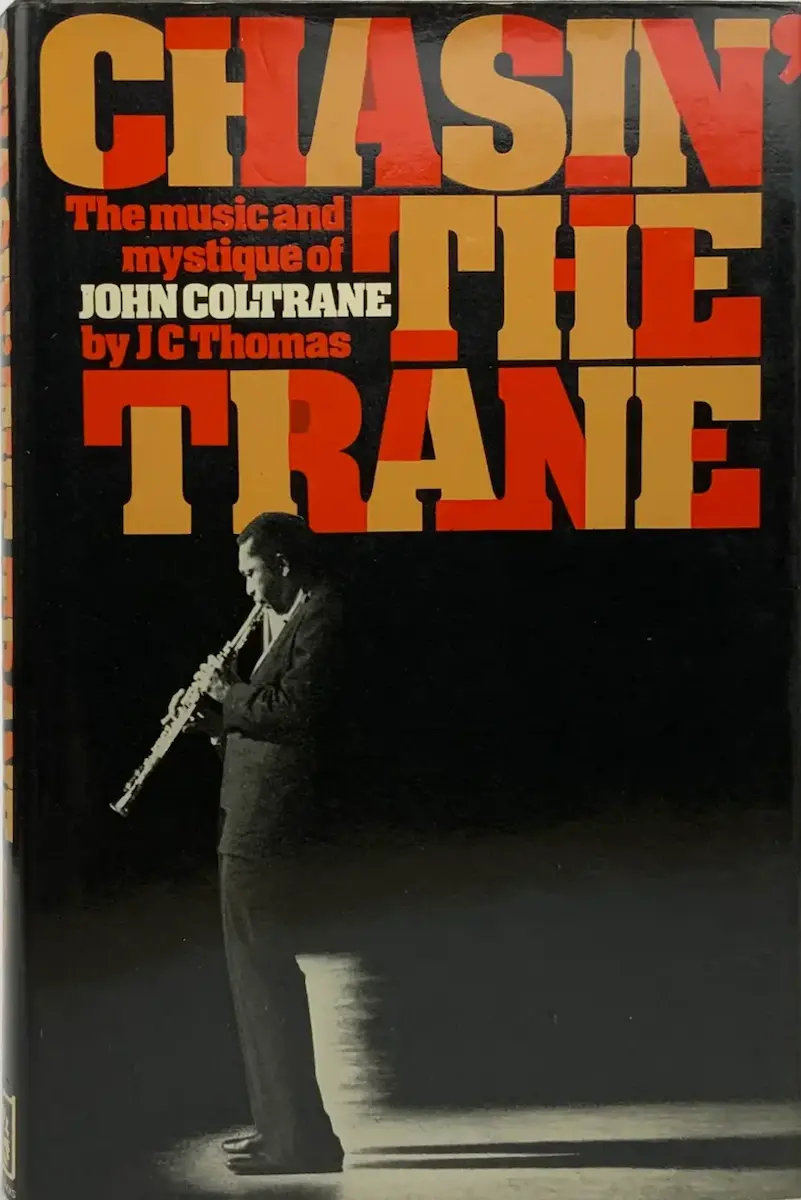
This was a very easy book to read and one which gave me much enjoyment. It does not attempt an in-depth analysis but does discuss Coltrane’s musical development in intelligent terms. It also considers the spiritual aspect of the man and looks briefly at the way in which his beliefs affected his playing.
There are very few points about which to argue, but the author’s put-down of Ornette Coleman is rather pointless and does nothing to further Coltrane’s cause. He is also wrong in claiming Coleman’s initial popularity, because it could be said that for every fan he had in the establishment, Coleman had ten enemies. This does, however, raise a slightly more relevant point. The book, in seeing Coltrane as a great figure, does tend to over-estimate the amount of purely pioneer work he did. Miles Davis’s tremendous influence and musical guidance is underplayed when it would have been a valuable subject to examine.
This does suggest that Mr. Thomas lacks an overall sense of perspective. This argument is supported by two fatuous statements: ‘It would take Coleman Hawkins until 1939, (my italics) with his monumental recording of Body And Soul, to make the saxophone a solo instrument in its own right’ and ‘Bechet was then (1939) just becoming known as the first exponent of the rarely heard soprano saxophone.’
These points apart, this is a good book and should be in any comprehensive jazz library. I certainly learnt facts about the man that I had previously not known, and the great regard that the author feels for Coltrane illuminates every page. For a book to succeed it must achieve what it sets out to do. This one does.
Chasin’ The Trane: Music And Mystique Of John Coltrane, by J. C. Thomas (Elm Tree Books, £4.50)