
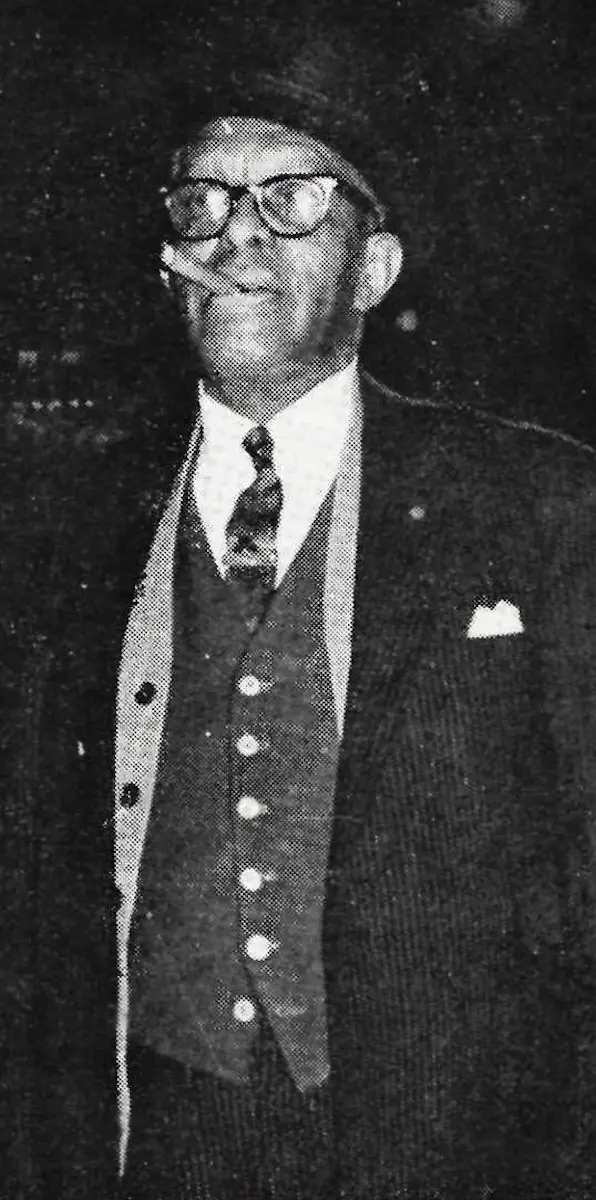
This is one of a series of taped interviews with musicians who are asked to give a snap opinion on a set of records played to them. Although no previous information is given as to what they are going to hear, they are, during the actual playing, handed the appropriate record sleeve. Thus in no way is their judgment influenced by being unaware of what they are hearing. As far as possible the records played to them are currently available items procurable from any record shop.
Willie ‘The Lion’ Smith is a pianist, composer, bandleader and one of the most delightful characters ever to emerge from jazz. As it will be known, the Lion is something of a talker and gifted raconteur, and so it was with great pleasure and anticipation that I had the honour of having him in my home. The ensuing informal chat was something that will never be quickly forgotten, and I only hope that not too much was missed. I am sure I got it nearly all down, but Willie is apt to be so quick with the riposte, that there were times possibly when the quickness of the tongue deceived the tape machine. It was wonderful having him in this country and I sincerely hope we shall see him back again soon. – Sinclair Traill
‘Recognition first came to jazz from Europe. The Hot Club of France was the first ones to get Louis to come over here – Panassié and Delaunay, they did it first!’
Tea For Two. Earl Hines – The Real Earl Hines. Atlantic ATL 5031
Earl Hines, he is one of those pianists who has a real difference in his conception of how to play show tunes. He’s certainly one of the great piano boys. All the best ones have an ability to show you, to demonstrate just how they feel – what I would call the perfect rendition of just how their soul and mind works. With reference to Tea For Two, which he played there, it was different in the old night clubs. You see we had to learn transposition. The mind and the soul tells us just how to play – sometimes you can be sitting at a piano stool in a studio, and if you start thinking too hard on what you are going to do; then it’s bad. But if you just sit there and relax, then the spirit will tell you what to play. And I think, that is the way Earl does it. He had a good band for a long time. You ask me about any band leader, and I can tell you, ’cause I was brought up with them. I remember Hines from the Apex Club in Chicago, where he was with Jimmy Noone. I used to play piano there, and we would play all night, for a salary of something like $75.00 a week. At the same time as I heard Earl, I also first heard Louis Armstrong who was working on 35th and State Street, and this was when they were just beginning to get recognised. Jazz was becoming recognised – and it didn’t happen on 52nd Street, and it didn’t happen in New York or Chicago. Recognition first came to jazz from Europe. The Hot Club of France was the first ones to get Louis to come over here – Panassié and Delaunay, they did it first! Joe Glaser was booking Louis even in those days, and he sent him over, though someone had to tell him what the word jazz really meant. But you can say what you like about Joe Glaser, he is the person who has made most of the big guys. He got them in places where they would never have got in by themselves and he got them good money. He is one of the most powerful men in show business in America, and rightly so, ’cause he is real businesslike and knows how to handle things. He opens his mouth and something happens! No one got on the Ed Sullivan Show or the Perry Como Show until Joe Glaser got in there pushing – and that even goes for Duke. Joe Glaser got real money for people like Louis and Duke, and that’s why I love him. Duke wanted someone to push for him. He has his own little publishing place and does most of his own numbers, and that gets him a rating from ASCAP of about fifty grand a year. So that gives him enough sugar to finance his band and to keep it going. All Duke needed was a guy to set up the route. His sister Ruth she takes care of the business, and all the young ones in the family join in and make it a strictly an Ellington thing. And Duke looks after all of them and supports everybody who is around him – it’s strictly family. Of course, in the middle come Doctor Arthur Logan, who is Duke’s personal friend and legal adviser. Then comes Strayhorn, a man who Duke confides in. There is also Harry Carney. It’s a happy set up. Well, we got a long way from Earl Hines – but that’s what talking does, brother.
Shootin’ The Pistol. Clarence Williams. Riverside RLP 8820
My old friend Clarence Williams. And that would be Ernest Elliott on saxophone, and there was a flute player – that’s not a clarinet. Was Wayman Carver around in those days? Yes, he was but I wouldn’t recognise his playing – not too many playing flute then. Of course, I know who Clarence hired mostly. He hired Buster Bailey and Alberto Socarras and Bennie Waters and a feller called Harris, I forget his first name now. That couldn’t be a soprano could it? Bailey played soprano a lot in those days; so too did Alberto. I am sure the other man is Ernest Elliott, he was a good player, and Clarence only hired the best he could get. I knew Clarence from the first time he came to New York. He was a help to everybody, was Clarence. Helped Jack Palmer, the white fellow who wrote the lyrics to Found A New Baby and he helped everybody who wrote any jazz tunes in those days. Clarence had a publishing house, and he was the only one that would give us writers a break to get in – no one on Broadway would. But Clarence started James P. Johnson, Fats Waller and Willie The Lion Smith. Every single writer you name, Clarence did something for them. There was also Herman Chittison who played piano sometimes for Clarence. Clarence wasn’t a great pianist, but he was a great organiser and had a pretty good disposition. I know his two sons – one is in the police and the other is head of a real-estate company. And, of course, his daughter Irene is a crackerjack singer. Somehow the recording companies went for Clarence, maybe because he was a good businessman. He was the person who first introduced me to Decca. And his wife Eva Taylor, a sweet singer, she was always with him – she was always there to keep him straight. He sold his catalogue to Decca Records, who sold it to Leeds Music Publishing Company. I think he got something like forty thousand dollars for that catalogue!
Fussin’. Ralph Sutton. Brunswick LA 8719
Ralph Simon, well, I was one of the persons who inspired him. Ralph is an exceptionally good reader, and you can add to that he is a real good two-handed pianist. He can read and play all those tough compositions at sight – the really tough ones, I mean. To be truthful I don’t know of anyone who can play Morning Air as well as that – except the composer of course. But no joking, he is a sweet man and a fine pianist. One of the greatest compliments an artist can get is when another artist writes to him, and I have received long, lovely letters from Sutton. He lives out on the Coast these days, and I hear he doesn’t get as much work as he deserves. That was a lovely record by the way.
Memories Of You. Eubie Blake. Stereoddities C 1900
Eubie Blake, he’s getting along now, must be over eighty! I met him way back in nineteen twenty something, when he wrote Shuffle Along. He won some piano contest or other, but I told him, boy you want to learn to use your left hand. Good conductor, but he was never anything of a pianist. But he certainly wrote some fine tunes. I’m Just Wild About Harry, Memories Of You and many more. The first time I saw Blake was in Kelly’s, right after the war (World War I), that was on North Carolina and Baltic. He was a very arrogant type of fellow in those days. He would just walk in where you were playing and would say ‘Well, I don’t think that is in the right key.’ He always wanted someone to know he knew music. He was just full of his own notions. He used to come up to Kelly’s and would play with a man named Madison Reed who looked like a mouse. But he was a good comedian. One of his best songs was called, I’m Going Upstairs And I Won’t Be Down ’Til Later. But Blake, if he didn’t like what you were doing, then he’d insult you. All the entertainers in those days had at least one hundred songs apiece, and so if there were four singers working, the pianist, the drummer and the bass player might have to play four hundred songs in one night. One night! You would start at 9 o’clock and finish when they decided to close, sometimes next morning. You weren’t even allowed to go to the gents room unless it was a real necessity and then only if there was another pianist there to pick you up while you went. And the entertainers just daren’t stop singing unless they were sick – you went on that floor and you stayed there until you finished your number. I’ve seen Ethel Waters cry, they worked her so hard – wouldn’t let her come off. We worked once for an ex-prize fighter named Edmond Johnson, who looked like an ape. He used to sit at the top of the stairs and no cops ever bothered him! There were a lot of gangs in New York at this time, such as the Goofer Gang, who wore blue shirts. They’d order crates of beer and gin, not by the glass but by the quart, and set it around the table. Brandy, whisky, anything in the manner of drinking, and always by the quarts. And Edmond, he didn’t allow a cop to go downstairs, unless he wanted them to. The Goofer Gang were Irish and all the cops in New York in those days they were strictly Irish. No bother. But those gangs they worked the entertainers into the floor. But if they liked them they paid off well. No one went wanting. Not the singer, or the pianist, nor any of the waiters, nor anybody.
To return to Blake, although he was a fine songwriter, he wouldn’t have got where he did without Nobel Sissle, one of the finest lyricists in the country – and one of the nicest guys. Now Billy Rose, he had the Diamond Horseshoe in New York, one of the swellist cafés you could ever walk into. And whose band played there always? Why Sissle of course! He had Sidney Bechet and at one time or another he had all the stars playing for him. It was a kind of society band, but they could play revue, jazz, anything – they could all read anything put before them.
Like those studio men today, the cream of the profession, read anything at sight. Now a jazz band can get to an important point, but no further. Guys like Jimmie Lunceford or Don Redman got their bands to that point, but only because they hired men who could read, and who knew just how to interpret those scores correctly. Lunceford was a sharp-looking guy who played the violin, and he insisted that anyone who played in his band, they had to have a college education. He was a real leader, he dominated that band, and they played exactly the way he wanted them to. He and his manager were partners. They put their money together and invested in their own band, and it paid off. Other great leaders, and I mean leaders, are Duke and Basie. But no doubt the greatest leader of them all is Mrs Gladys Hampton! She put Lionel where he is today, and she’ll keep him there! If you want to get the best out of any individual, get them with somebody nice – each and every artist carries a certain amount of inner strength that helps him when he is working, but he can always do with help. When Duke is working, I know how his mind works, but the minute he steps off that bandstand, he becomes a different personality. Yet, and one of the reasons he’s so great, is because he never fluffs anyone off. However tired, he is always courteous, and that is the badge of the truly great artist.
Euphonic Sounds. Scott Joplin. Riverside RLP 8815
Scott Joplin’s best composition, in my opinion, was Euphonic Sounds, although he was so advanced in musical theory that he also wrote operas. Joplin must have had vision, for he was not only a good composer of ragtime, he was a composer, period. Some of his things, such as this piece, are very difficult to play. You have to be a good reader, and a good pianist to play Euphonic Sounds. His wife, Lottie Joplin, had a house on 138th Street, right down the street from Eubie Blake. She lived at 212, and every performer worth a dime has stopped at Lottie Joplin’s and owed her room rent. That’s where Tatum, Sweatman and all of them would come after hours, but you couldn’t get in unless you were known. There were about 20 rooms in that house, and nobody ever knew who was staying there. The only people who knew who was there were the pianists who had a big room to themselves complete with a baby grand. And that is where we had our whisky, our beer or anything we wanted. That is where Fats met Tatum for the first time, and it was where I introduced him to Joplin. In fact, I was the person who introduced ‘Filthy’ (that’s what I called Fats) to that place. And Earl Hines was another. And we all used to eat and drink off Lottie Joplin. If we were hungry we all chipped in and bought food and she used to let us have the stove to cook it on. All the vaudeville acts came there, like the Crackerjacks, The Tumblers; every well known act stopped at Lottie’s. Scott Joplin died at an early age, in 1917, but Lottie never forgot anything about him and the wonderful times they had together.
Rhapsody In Blue. Duke Ellington – Will The Big Bands Ever Come Back? Reprise R 6168
Well, that is just what Gershwin lived for, but it unhappily never happened in his lifetime – to hear that tune played like that! And Duke is the only boy who could possibly play it that way. That was a real gem! No more to be said.