The Bavarian town of Burghausen is known not only for boasting the longest castle in the world, but also for its enduring commitment to jazz. This year marked the 55th anniversary of Jazzwoche Burghausen (B’Jazz), held from 17 to 22 March. Like Juan-les-Pins, home of the famed Jazz à Juan Festival, Burghausen proudly features its own walk of fame – though here it is signatures rather than footprints that line one street, commemorating the many jazz greats who have graced the festival stage.
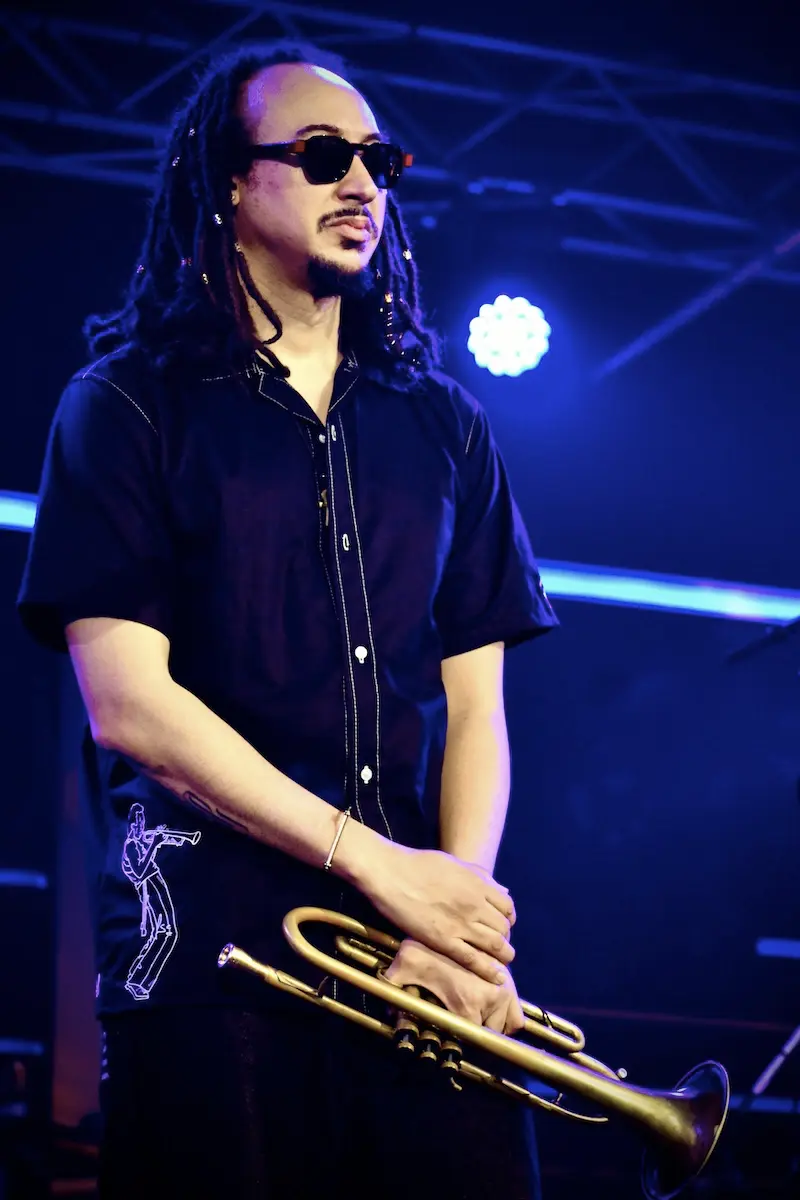
Among them is Wayne Shorter, who appeared at B’Jazz in 1988. Miles Davis, however, never performed in Burghausen – a notable absence recalled on Thursday evening at the Wackerhalle, the festival’s main venue. The remark served as a fitting prelude to Theo Croker’s tribute to Davis. Drawing inspiration from Miles’ first great quintet rather than the later formation featuring Shorter, the young American trumpeter set out to rekindle the trumpeter’s golden era. Opening with Concierto De Aranjuez, Croker immediately captivated a packed audience, setting the tone for a set rich in well-known material, including several pieces from Kind Of Blue. Opting for a broader sonic palette, Croker expanded beyond the traditional quintet format, adding an alto saxophone alongside the tenor – a subtle but telling departure from Davis’s classic line-up. “So what”, Miles would have uttered through his trumpet as he turned his back to the crowd.
Following this homage, the festival turned to veneration of another kind. German drummer Wolfgang Haffner marked a triple milestone: his 60th birthday, 50 years on stage, and his B’Jazz debut four decades ago alongside Albert Mangelsdorff. Unsurprisingly, the evening evolved into something of an ACT Music family gathering, as Haffner invited a host of label collaborators to join him. Saxophonist Jakob Manz, who debuted on ACT at just 19, was among the first to appear. Now 25, Manz would later re-emerge at the Jazzkeller for a late-night session – an energy that seemed inexhaustible.
The set initially focused on Haffner’s own compositions before shifting gears with the arrival of Swedish vocalist Viktoria Tolstoy, who delivered a piece by Ida Sand. Reflecting on her previous appearance at the Wackerhalle some 20 years ago, Tolstoy revisited familiar ground, including Calling You, which she recorded in 2017. She later returned alongside Nils Landgren, whose signature red trombone added further colour to the evening.
For those unwilling to call it a night, the Jazzkeller – tucked into the heart of the old town – remained the festival’s nocturnal hub. Upholding the tradition of late-night jam sessions, pianist Shuteen Erdenebaatar led nightly gatherings with her trio. Blending her own compositions with those of bassist Nils Kugelmann, her collaborator on a recent duo album for Motéma Music, she set the stage for spontaneous encounters. On this particular night, Jakob Manz returned, joined – more unexpectedly – by American organist Cory Henry, who swapped keys for drums during the session. Henry would reappear the following day at the Wackerhalle with his Funk Apostles. Though being more a jazz than a funk apostle, I could hardly resist his infectious rendition of Staying Alive, which had even the most reserved listeners moving. The set culminated with Henry stepping into the audience, dissolving the boundary between stage and crowd.
Saturday afternoon brought the festival’s traditional blues programme. Harmonica player Paul Lamb and the King Snakes opened proceedings, followed by guitar virtuoso Ronnie Baker Brooks. Showcasing his award-winning album Blues In My DNA, Brooks commanded the stage with authority, relegating his band and horn section to the background. Not understanding that the guitarist wanted to occupy all the space, Paul Lamb came out of the curtains for an impromptu solo, a moment that seemed almost at odds with Brooks’ dominant presence. After such a commanding performance, attention soon turned back to the Wackerhalle for the evening’s finale.
Bassist and vocalist Amy Gadiaga, based in the UK, presented a new trio that appeared promising on paper. Yet the performance struggled to find cohesion. Drummer Jordan Hadfield’s overpowering presence – think of an elephant in a porcelain store – undermined the group’s dynamics, making it difficult to fully appreciate the project despite the evident potential of Gadiaga and her pianist, Luke Bacchus.
The festival had opened with guitar legend Mike Stern, a former Miles Davis sideman, and fittingly closed with another guitarist of similar pedigree. Robben Ford, also in his 70s and once part of Davis’s orbit, joined forces with the Zurich Jazz Orchestra under Ed Partyka. Performing largely his own material, Ford delivered a refined and engaging set, with a notable highlight in a sensitive arrangement of Jealous Guy.
Saturday night also saw eight venues across the “Swinging Miles” district come alive for club night. With something for every taste, the town pulsed with music well into the night. At the Jazzkeller, Shuteen Erdenebaatar’s final session finished around 2am when Korhan Futaci and his band came to jam after their own concert at the Stadtsaal. With overlapping schedules, difficult choices were inevitable – Futaci’s main performance remained for me one of the festival’s missed opportunities.
The festival closed on a lighter note Sunday morning, back at the Jazzkeller, where Austrian brass band Newohrlinz delivered a spirited performance. True to their name, the group brought a touch of New Orleans flair from their Linz roots, delighting an audience of early beer drinkers. After all, we are in Bavaria, are we not?
With sunshine accompanying the entire week and music filling every corner of the town, the 55th edition of B’Jazz reaffirmed Burghausen’s place on the international jazz map. The next edition is already scheduled for early March – and there seems little reason to miss it.
Jazzwoche Burghausen, 17-22 March 2026