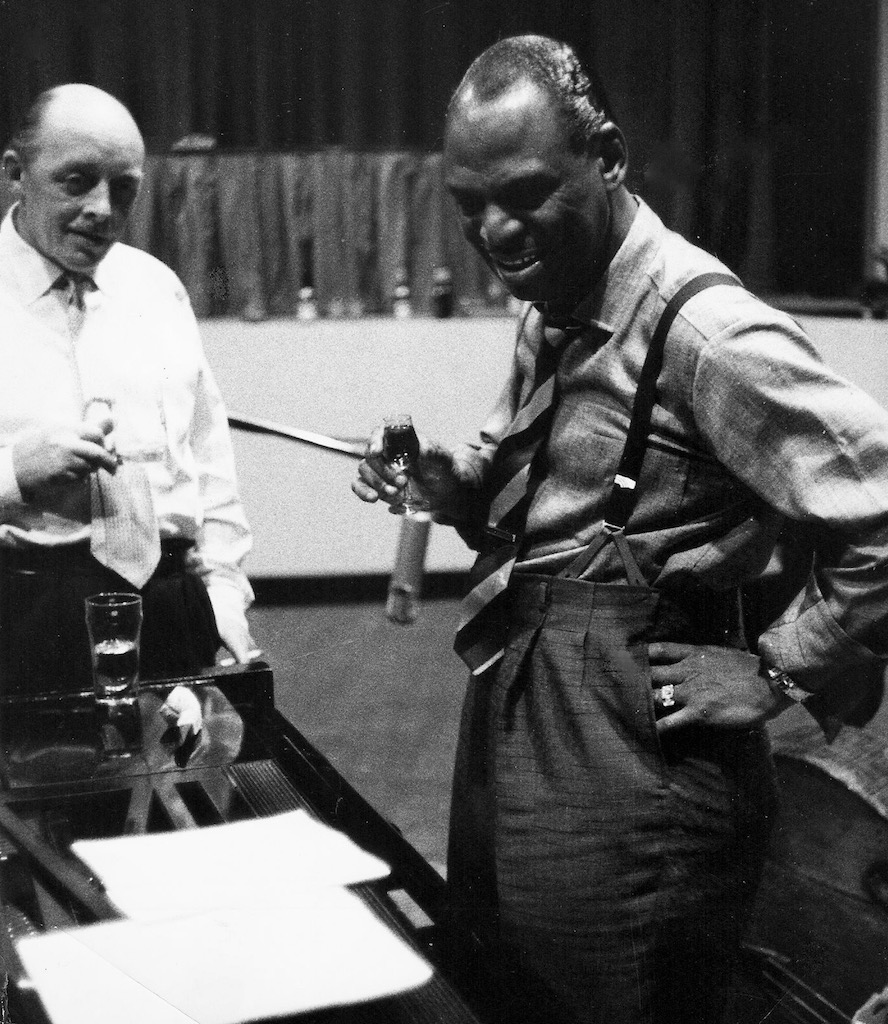
This is one of a series of taped interviews with musicians who are asked to give a snap opinion on a set of records played to them. Although no previous information is given as to what they are going to hear, they are, during the actual playing, handed the appropriate record sleeve. Thus in no way is their judgment influenced by being unaware of what they are hearing. As far as possible the records played to them are currently available items procurable from any record shop. Much has been written about Earl Hines in recent months. Ever since he came out of ‘retirement’ and was ‘re-discovered’, his prowess as a musician has been praised to the skies. Happily everything they said about him was true; all the more’s the pity that he was allowed to remain in such comparative obscurity for so long. His last European tour was a ‘smash-hit’, he was an outstanding success everywhere he played, and it looks as if the present one is going likewise. I am more than delighted that Earl has at last come to be universally recognised as one of the real giants of the jazz piano – it couldn’t have happened to a nicer ‘feller’. – Sinclair Traill
Dexter Blues. Jay McShann & Orchestra. Brunswick 87019
We have an expression back in the States about food. Down in New Orleans, or some of those Southern States, they have some wonderful places to eat – extraordinary places, like they have in Paris. And when one eats in one of those places we call it ‘soul food’. Well, that record was just like that to me. Charlie Parker playing that way, it was real soul music. Of course times changed and he went on to New York and got with the rest of the crew, and they got very technical and all that; but the way he was playing there, was right from his heart. Anyway that’s the way I look at it. The McShann band had a good, even beat and those kids played like they meant it. When I was through Kansas City in those days, that band used to play in those after-hours places, and the competition was such that they really had to play. But the sound was good and they were playing jazz. It was good .music.
Fat Babes. Earl Hines & His Orchestra – The Golden Swing Years. Vol. 1. German Brunswick 87528
I haven’t heard that in a long time. I remember I was surprised when I heard that for the first time, because something happened there that was new. The bass really came through for the first time, and the whole intonation was much better, because we got a kind of balance of the instruments for the first time. Also I really got an understanding on those arrangements, for it was not until then, with the bass brought out that way, that we got a true conception of what the band really sounded like. We were fortunate that we had a fine, technical engineer for these sessions – sympathetic to the music. And the band there sound almost exactly like they did in the club where we were working – this was the first Grand Terrace band in Chicago. Jimmy Mundy made this arrangement, and he got it into his head that he was going to have some fun with the other musicians. Now and again he would get a kick out of trying to trick them, or stump them, you know. Well, one of the boys in the trombone section was heard to say that there wasn’t anything written he couldn’t play. Mundy overheard the remark, and the next day he came up with Fat Babes. Boy, we stayed with that arrangement all night! The trombone section time and time again would almost get to the end, and then someone would fluff it, and off we’d go again. In those days if one made a mistake and something went wrong, then you had to wait until they heated up another wax. The trombone part on that side went wrong so often it looked as if the man was baking cakes – he got as mad as hell.
Looking at some of the tunes we recorded then such as That’s A Plenty, Wolverine Blues, I think they did a lot of harm to music when they tried to classify it. They said that Panama was a New Orleans number, well it may have been but we were playing it, and these other numbers, up North at the same time as they was being performed in New Orleans. I read somewhere that Rosetta, which I wrote in Chicago, was a Dixieland number. I also heard that Squeeze Me was a Dixieland number. But Fats Waller wrote that one, and neither of us knew anything about what they called Dixieland music. You know jazz didn’t all come from New Orleans! Ethel Waters, Duke Ellington were recording for Black Swan years before – I never even heard of New Orleans until I got to Chicago. So what was happening then? This classification is all a mistake, they classify bands and orchestras, and there is a difference between bands and orchestras. A Dixieland band had no piano, just guitar, but when you put a piano in, then to me that becomes an orchestra. Some people don’t realise that. The Dixieland music started as bands on the street playing for marches and all that, but when you bring that band inside and add a piano, then it becomes an orchestra. And that is why to me there are no Dixieland piano players. When I was playing in that small group of mine out on the Coast, people used to come to me and ask why I didn’t play Dixieland piano – and I used to tell them that there was no such thing.
You asked me about the trumpet on Maple Leaf. The muted solo was by Warren Jefferson. The open horn on Sweet Georgia Brown was played by George Dixon. Incidentally, this arrangement for Rosetta was by Henry Wood, and this was the first time the tune was recorded.
Hollywood Bed. Joe Turner. Realm RM 229
You can’t beat the originals, and that’s what those blues were, originals. Joe Turner was the first person I ever heard sing the blues, other than the ones I heard when I was a kid. Kansas City was a real home of the blues – they never sang any ballads, it was all the blues. Joe Turner was the first person I heard sing that ‘B-y-e, B-y-ee’, and I thought it was the most exciting thing I had ever heard. All those guys in Kansas, they just sang blues, never copied each other and never tried to set up a style, just sang the way they felt. I have heard them, getting up in the morning, coming down the hall, singing the blues – that’s the way they were. All the Kansas bands had that certain beat, which Basie carried on in that same way, even until today. All those bands from there, they got that groove, which would rock any place they played in. And Joe Turner, he would keep going with them, until he got hotter and they got hotter until that final chorus when everything was rockin’. And judging from this he is still singing that way today. I like it!
Teach Me Tonight. Erroll Garner – Concert By The Sea. CBS BPG 62310
Erroll is a real original – definitely an original. He did what a lot of pianists didn’t realise could be done and that was he started to use the rhythm section almost as a part of his piano playing. He used the bass to fortify his own left hand, so that he could play those guitar chords he plays. That way he is able to keep that beat going, like a guitar in a rhythm section. It is unique. So too is his manner of slowing things down, and not getting quicker as most pianists do. If you notice, his tempo sounds as if it is getting slower and slower – that is his tendency. Basie also does just that. When he gets a drummer, he always says to him ‘Hold it – hold it, slow ’em down’. That’s is to stop the thing running away, as so often happens. When you get a drummer, who gets a few licks going, he is apt to forget tempo, and so that is why Garner holds the tempo back that way. A bass player just can’t get away from Erroll, you know. He gets that tempo so set that you can’t get away, and that is very, very good.
There is one thing that Garner has in common with Armstrong – Louis will play something and remember it exactly when he comes to play it again. What he has played before, he can repeat exactly. Garner can do that too – so people come to recognise what he is playing, because he has played it before, exactly as he plays it then. It becomes a kind of trade mark with him. Myself, I never made it a business to remember, because I like to sit at the piano, and then play just as it comes out. Then I like to challenge myself. I get out there sometimes and have to get back, and that can be very difficult, without losing the beat or the melody. I always play just whatever comes in my mind. I am lucky in that I have a sort of photographic mind that records the chords before I get to them. I see them and most time I want to put something in there, just to make it prettier. Sometimes my brain works faster than my fingers and I get caught out there, and then I get to laughing as I try and find my way back in – and that’s why I don’t like using a bass player, ’cause when I’m way out there, I never know just where I am going. When I really get out there, it’s usually every man for himself. Sometime I really get to perspire, out there all by myself, for I know everybody knows the tune, so somehow I must get back. And I don’t know if you notice, but when I do get back I always return to the melody just to let them know that I was out there, that they can understand; which was a very smart idea.
But if you want that ‘way-out’ stuff then Dizzy can also play that better than most. And that is why I call him smart, because he can alter his style to suit his company. This record is as smooth a blues as one could wish to hear, and that goes for the whole group. You hear some of these modern musicians playing the blues, and they cease to be blues at all, because they are played without any feeling – and that’s the whole story. People are apt to forget that I also played with Charlie Parker and Dizzy and those modern boys, and I think my playing benefited by that. I still keep to the way I have always played, but I have also learned their chords, and so without destroying the way I play, I am able to use some of the more modern sounds as a kind of colouration now and again. Things are always improving you know – say what you will. Food is still cooked in the kitchen, but you can’t say the kitchen hasn’t improved with all this modern equipment. If you love the instrument you are playing, then you will automatically run into some changes and things like that, that you happen to hear. Not to copy them, but just to adapt them to your own use.
Gone With The Wind. Art Tatum-Ben Webster Quartette. Verve VLP 9090.
Well, there’s an example of a photographic mind. Tatum, he always saw the chord before he came to it. Many of the public were lost when Tatum played the piano, because they didn’t understand enough about music; and Art needed some following. Tatum was a real musician’s musician. He was like an artist with a lot of brushes in front of him, one red, one blue, one green and so on. He has a picture on his easel and he knows, almost without thinking, what colour brush he has to pick up to get the correct result. Tatum could see the chord he was going to play so far in advance, that he always had plenty of time to get ready for the one after that – it all fell into place without effort. He was always on top of it, and he played the whole piano, not a part of it. Technique is one thing, but when one gets it allied to beauty of execution, then it comes near to genius. I almost forgot to mention Ben Webster, who plays so beautifully, and Red Callender, who plays his bass as, worse luck, not many bass players do today. He is like a pendulum, solid and sound, giving Art and Ben the perfect chance to play their parts.
Summertime. Junior Mance – Big Chief. Riverside RLP 447
Well, that’s very different from Tatum’s playing. You can just hear the bass, but the left hand doesn’t come through at all. Tatum did it all himself, but so many modern piano players just leave it to the bass player – too many of these kids do that these days. But whatever you say, what he’s playing here he is really playing, and it’s good. Of its style it is very pleasing, and he is certainly a good pianist. His sound is good and so too is the beat. I liked that; pretty ideas.
Blue River. Jack Teagarden. Brunswick LAT 8229
He was another original with a style completely all his own. And I was grateful for that because I got so much pleasure out of what he played. He really played ‘soul’ music on that trombone. Jack never tried to do anything he couldn’t do on that horn, which is why he was always almost perfect every time he played. Perhaps his execution wasn’t as fast as, say, Miff Mole or a few others I have heard, but everything he did was true and full of feeling. Not enough has been made of Miff Mole’s playing, you know. I first heard him in Chicago and he was a great player. It was at that time that Tommy Dorsey was also around. Tommy played both trumpet and trombone, but he had Louis on one side of him and Miff Mole on the other, so he didn’t know which to choose. Louis told him to go on with the trumpet, and Miff said the other thing – so Tommy he went into the woodshed and came out playing a sweet trombone. He had devised a new style for trombone and with those mutes and things, he sounded just like a voice singing.