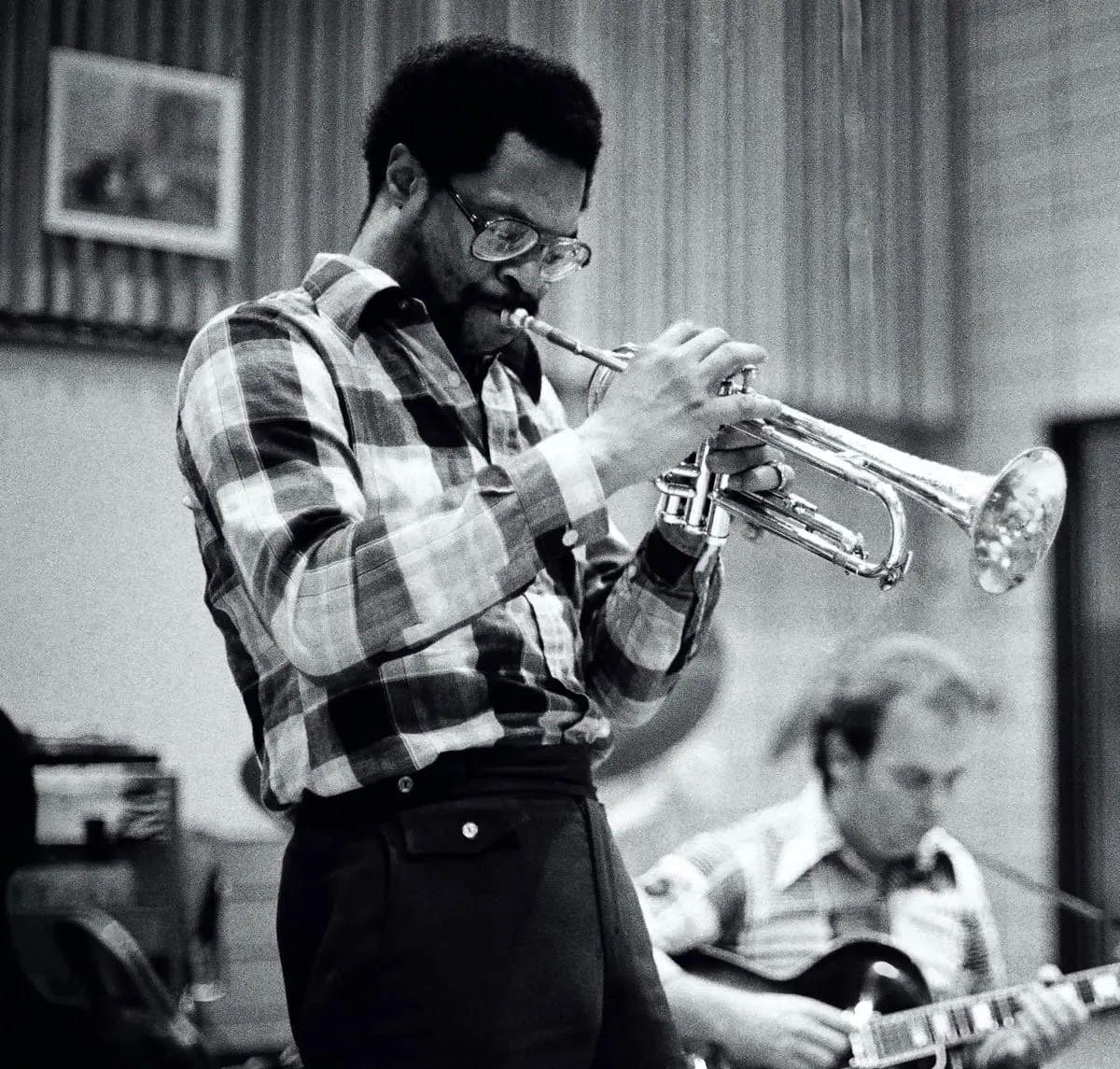
Woody Shaw: Love Dance
For me Woody Shaw will always embody the culmination of a trumpet lineage that starts with Dizzy Gillespie and Fats Navarro and continues through the likes of Clifford Brown, Lee Morgan and Freddie Hubbard. I only recently experienced the revelation of hearing Morgan’s The Last Session album for Blue Note, and that album is a good partner for this one: both albums take account of developments in post-bop, the Morgan album tipping the hat to fusion, Love Dance doing the same for modal jazz. It’s another Zev Feldman reissue from the Muse label.
The undervalued tenor saxophonist Billy Harper is another common denominator between the two albums. His solo on the title piece here might in a better world than this be far more widely heard and appreciated than it is, even by individuals not concerned with learning the art of playing this sophisticated music. A piece such as Obsequious makes the case for potent post-bop played with an overall level of commitment that seems to have gradually become a thing of the past. Solos from the leader and pianist Bonner act as notices served, while the work of Rene McLean, son of Jackie, indicates how in some cases the apple doesn’t fall far from the tree.
Soulfully I Love You provides nuanced contrast with the bulk of the material on the album. Shaw’s bright, burnished tone comes into its own in this reflective piece, his solo that of a musician who knows the value of stating his case concisely and without rhetoric, empty or otherwise.
Discography
Love Dance; Obsequious; Sunbath; Zoltan; Soulfully I Love You (Black Spiritual Of Love) (42.59)
Shaw (t); Steve Turre (tb, btb); Rene McLean (ss, as); Billy Harper (ts); Joe Bonner (p); Cecil McBee (b); Victor Lewis (d); Guilherme Franco (pc); Tony Waters (cga). Blue Rock Studio, New York City, November 1975.
Time Traveller Recordings / Muse TT-M004
The Descendants Of Mike And Phoebe: A Spirit Speaks
While they have a far lower profile than the Joneses of Detroit, namely Thad, Hank and Elvin, the titular family here [which appears to be the Lee family, given the discographical names below – the editor] is more remarkable given that a quartet of siblings turned out to be musically inclined. As far as I can tell this 1973 album is the only one they ever made. It was recorded at a time when black American consciousness was (to put it simplistically) more focused than it seems these days. The title, and the preoccupation with ancestry the group name implies, were and are key elements in that consciousness, but I found the music lacking in focus, as if in bringing together different strands the intensity of each strand got somehow diluted.
This is due in no small part to the singing of A. Grace Lee Mims, whose studied approach resounds in a manner antithetical to the making of music in the moment. Thomas A. Dorsey’s Take My Hand, Precious Lord has far more to do with the gospel tradition than any notion of jazz anyway. The sincerity is beyond doubt, but the fact that it’s followed up with a brief piano, bass and drums reading of the traditional Boll Weevil, complete with more fire, emphasises my point about the lack of focus.
Bass player Bill Lee’s Too Little, Too Late is somewhat ever-egged by the presence of Mims – and of the composer as second vocalist. Flugelhorn player Clif Lee also has a moment in the spotlight over the course of four minutes and 10 seconds, producing a rich yet somehow unsatisfying broth; a simpler, less crowded approach would have been better.
Discography
Two Songs For A Boy Named Mark: Little Bitty Baby, Soliloquy To A Man-Child; Coltrane; Chick Chick; Well Done, Weldon; A Spirit Speaks; Attica; Take My Hand, Precious Lord; Boll Weevil; Don’t Be A Stranger; Too Little, Too Late (33.41)
Clif Lee (flh); Consuela Lee Moorhead (p); Bill Lee (b); Billy Higgins (pc); Sonny Brown (pc); A. Grace Lee Mims (v). Minot Studios, White Plains, New York, 19, 20 and 21 December 1973.
Mack Avenue, CD-SES-19744252
QOW Trio: The Rule Of Three
This is the third album by this trio, suggesting that it’s a well-integrated, bedded-down group in which a challenge might be keeping alive the sparks of creativity and spontaneity. Suffice to say the life is there. Many precedents for the kind of considered, slightly intimate jazz on offer are evoked, but not to the point where they swamp proceedings. A most obvious reference point is the piano-less trios Sonny Rollins was leading over 60 years ago. The run-through of Albert Ayler’s Ghosts is a nod to more iconoclastic territory, the trio extracting a dancing quality from the piece in a way that the composer never did.
If there’s a better means of gauging exactly what a group’s all about than the interpretation of a standard then I don’t know what it is. In this case Billy Strayhorn’s Lush Life receives a quietly reverential treatment in which the trio’s subtle interplay is to the fore. The angle taken on Stone-Lonergan’s Sheriff Elvin is established from the off by bass player Myer, whose solo intro evokes the spirit of Jimmy Garrison before the group coalesces into a mood of animated reflection courtesy of Wells. His alertness and command of rhythmic colour ensure that proceedings engage the ear and lift the spirit. In response to this the composer digs in with some of his most eloquently responsive playing on the album, making for contemporary jazz that’s also steeped in the music’s history.
Discography
The Rule Of Three; Egglet; Kurt Angle; Lush Life; NowHere; Sheriff Elvin; Ghosts; Do Not Forsake Me Oh My Darling (44.35)
Riley Stone-Lonergan (ts); Eddie Myer (b); Spike Wells (d). Fish Factory Studios, Harlesden. No date, c. 2025.
Whirlwind Recordings WR4847